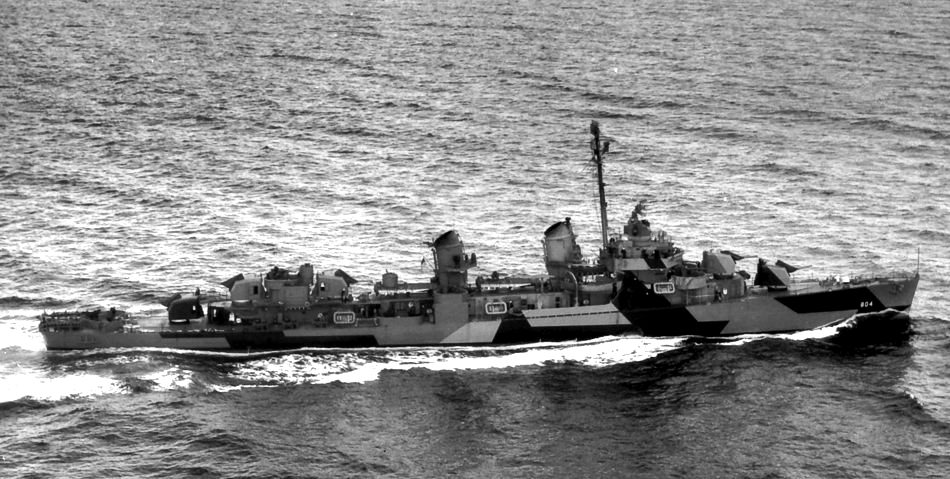
USS Rooks (DD-804) was a Fletcher-class destroyer. Launched on 6 June 1944, she was commissioned on 2 September 1944, and Robert F. Martin took command that same day.
Workups off San Diego were followed by a yard period at Puget Sound. She then headed for the Hawaiian Islands, where the ship rehearsed amphibious landings and practiced bombardment of shore targets. On 22 January 1945 she put to sea with a collection of tank landing ships, bound for Eniwetok in the Marshall Islands, her first halt on the way toward the fighting. Another landing rehearsal came at Saipan. On 19 February 1945, the morning the assault opened, she reached Iwo Jima, saw those landing ships in toward the beach, and settled into a radar picket station. During the afternoon she shifted to the southeast side of the island, covered Marines as they landed, and put several enemy batteries out of action. Her guns returned to the beaches on 21 and 22 February and again on 25 and 26 February. Mortar fragments killed one of her sailors on the 22nd. In the same period she passed radar warnings and guarded against submarines in the ring of ships around the island. On 28 February she left Iwo Jima, screening transports on the run to Saipan.
A second destroyer kept her company as far as Ulithi. She next took two escort carriers south to Leyte. Training there finished, she sailed on 25 March for the Okinawa group and arrived on Easter Sunday, 1 April 1945. What followed was eighty-seven days of continuous shore fire, in which she expended 18,624 five-inch rounds. Battle stations sounded for 131 genuine air alerts. On four of those attacks a kamikaze made her the chosen target. For the Okinawa battle she was credited with six enemy planes. She also held stations against submarines and aircraft, and on several nights she ran with the surface ships covering the island operation. Two or three times a week she stopped at Kerama Retto to refill magazines, fuel tanks, and storerooms.
The sixth of April was the hardest day she knew. At 0100 she shared in the destruction of six aircraft that were hitting the assembled Allied ships. Near 1600 at least 110 enemy planes struck the sector she was in, and from then until 1648 she downed one kamikaze herself and helped with five others. At 1712 she was ordered to help the destroyer Hyman, which had taken a grievous hit from a suicide aircraft, and to bring her in. Rooks arrived to find that ship under attack again. She brought down a Mitsubishi A6M Zeke and an Aichi D3A Val, led Hyman into the Hagushi anchorage, and sent her doctor and several pharmacist's mates across to look after the injured.
On 4 July she sailed with a mixed bag of minesweeping craft on a large clearing job whose aim was a safe route into the East China Sea. Alone among destroyers in that gathering, she had the fire-support assignment, and the rounds she fired were spent on mines that had come adrift. She kept a radar picket watch, acted as the guide that held the sweepers on their lane, and often supplied precise fixes for buoys laid down to show the boundary of swept water. July was taken up with that work. On 1 August she left Buckner Bay to take the cruisers Salt Lake City and Chester down to Saipan, continued to Ulithi, and from there guarded three transports on a passage to Leyte. Repairs completed, she left Leyte on 1 September with landing ships for Okinawa. On 11 September she set out for Nagasaki to help send prisoners of war home. Four days later she sailed for Okinawa carrying ninety-two former prisoners, most of them British officers seized at Singapore. She went back to Nagasaki and embarked Rear Admiral William H. P. Blandy, who led the Pacific Fleet's destroyers, for an inspection of Sasebo, long one of Japan's main naval bases.
Duty around Japan and Okinawa continued until 26 October, when she cleared Yokosuka, called at Pearl Harbor, and reached San Francisco on 10 November. On 15 November 1945 she joined the reserve fleet on the Pacific coast, reporting at Bremerton, Washington. The San Diego group of that fleet received her. Decommissioning came on 11 June 1946, and by 17 August 1946 she had been laid up completely. San Diego saw her commissioned again on 19 May 1951. A short spell with the Pacific Fleet ended in a transit of the Panama Canal. Crossing into the Atlantic, she made Newport, Rhode Island, her base on 13 October as a unit of Destroyer Squadron 20.
The next year went to hard training, above all in antisubmarine warfare, and to a heavy refit. Squadron 20 sailed from the eastern seaboard on 6 September 1952, bound for Korea. There Rooks backed the United Nations, screening and plane-guarding both the fast carriers of Task Force 77 and Task Force 95, the blockade and escort force. Shore bombardment was her most frequent combat work, and the North Korean harbors at Songjin, Wonsan, and Chongjin took the shells. In February 1953 she started home the long way, through the Indian Ocean, then the Mediterranean, then the North Atlantic. She tied up at Newport on 11 April, and Second Fleet duties resumed.
Mid-1954 brought another overhaul. From September of that year until February 1955 she served in the Mediterranean. On her return she became the seagoing school ship for students of the Atlantic destroyer gunnery school, then in summer turned to convoy and antisubmarine drills that occupied her through the remainder of the year. The Atlantic coast and the Caribbean were her grounds in 1956, with a December stint on barrier patrol out in the Atlantic. In 1957 she settled back into routine work off the American east coast. Two separate spells in the Mediterranean followed, one of them reaching the Red Sea, and both were done by September 1958. A further refit and more exercises along that coast and among the Caribbean islands led to one more Mediterranean deployment, which ran until August 1959. During 1960 she made a two-month cruise with midshipmen and, passing through the Mediterranean, went out to the Arabian Sea for a combined exercise under CENTO. In 1961 she trained again in the Caribbean and the Atlantic, waited on station while Freedom 7, the first American crewed spaceflight, went up, carried midshipmen to Halifax, and took part in antisubmarine operations in the northeast Atlantic. She had survived the war. Chile took her over on 26 July 1962.