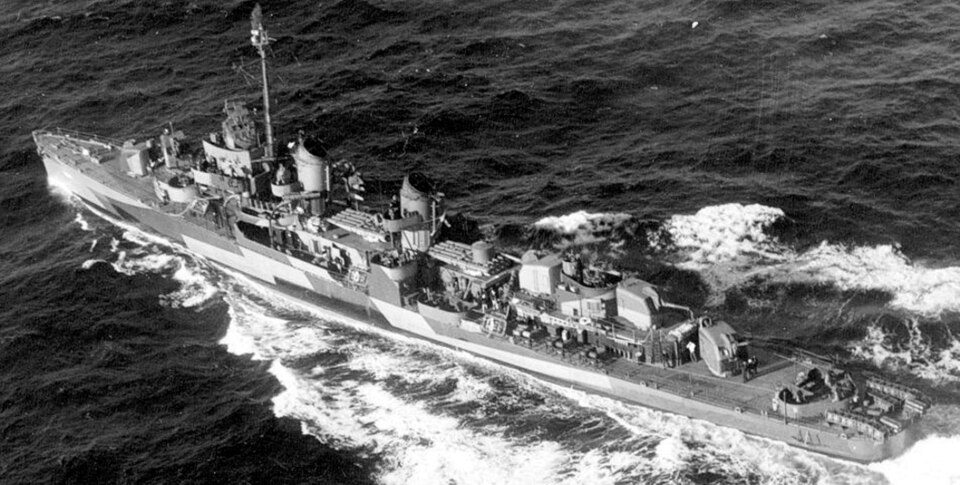
USS Rowe (DD-564) was a Fletcher-class destroyer. She was launched on 30 September 1943 and commissioned on 13 March 1944, the day Andrew Lee Young took command. After working up off San Diego, she left for Pearl Harbor on 24 May 1944. Two further weeks of training at sea around Hawaii followed. From 16 June to 2 July she made an escort run out to Eniwetok and back. On 3 August 1944, wearing the pennant of Destroyer Squadron 57, she headed for Adak, Alaska, and there joined the Ninth Fleet.
Off Alaska she continued training underway and joined three attacks in the Kurils. The targets were Matsuwa To on 21 November 1944, Suribati Wan on 3 January 1945, and Kurabu Zaki on Paramushiro on 18 February 1945. Destroyer Division 113 left the North Pacific Force on 18 April and shaped a course for Pearl Harbor. With repairs and more drills behind her, Rowe sailed on 11 May in company with the carrier Ticonderoga and the rest of her division, bound for Ulithi. She arrived on 22 May, reported to the Fifth Fleet, and about a week later left Ulithi in a convoy for Okinawa.
The Ryukyus were reached on 2 June, and Rowe took up radar-picket station. Fifteen days later Destroyer Division 113 saw the battleship Mississippi out of the Hagushi anchorage and continued to the Philippines, entering San Pedro Bay in Leyte Gulf on 20 June. On 1 July she cleared the gulf, met Task Force 38, and screened the carriers while standing by to recover aircraft during strikes on Honshu, Shikoku, and Hokkaido. On 10 July the first of those blows fell on airfields and nearby installations around Tokyo. Detached for a short spell on 23 July 1945, she helped shell Omura, a town on Chichi Jima, before going back to the carriers.
On 2 September 1945, the day the Japanese surrender was signed in Tokyo Bay, Rowe was still at sea with Task Group 38.4, patrolling east of Honshu, while aircraft from the group flew observation sorties over camps holding prisoners of war. Another voyage out to Eniwetok and back followed. She cleared Tokyo Bay on 18 November for Pearl Harbor and the United States, called at San Diego, crossed the Panama Canal on 17 December, and entered Philadelphia on 23 December. Charleston, South Carolina, received her on 20 March 1946. She left commission on 31 January 1947 and was laid up there with the Atlantic Reserve Fleet.
After almost five years idle, she was taken from reserve on 20 September 1951 and returned to commission on 5 October 1951. She shook down near Guantanamo Bay, then fired at shore targets off Culebra Island, Puerto Rico. Norfolk saw her again on 12 March 1952, and she worked locally in Destroyer Division 322. A trip to Halifax in July was followed, late in August, by a yard period at Charleston. Early 1953 brought further Caribbean training. Summer found her carrying midshipmen across the Atlantic to Europe, and that fall she joined Task Group 81.2 for hunter-killer antisubmarine exercises, again in the Caribbean.
On 20 April 1954, with the commander of Destroyer Squadron 32 embarked, she sailed for Far East duty, passed through Panama, and reached Yokosuka, Japan, on 28 May. Three days later Rowe and Fechteler left for Sasebo and went on to Pusan for patrol. They arrived the same day and took over the Korean patrol from Douglas H. Fox and Laffey. On 4 June Rowe helped crash boats and aircraft hunt for an Air Force plane down between Korea and Japan. Six of those aboard were saved. She also towed into port an Air Force seaplane that heavy seas kept from getting airborne. Seventh Fleet duty closed on 28 August 1954. The division then started the homeward half of a voyage around the world, by Suez and the Mediterranean, and entered Norfolk on 28 October 1954.
The next months went to time alongside a tender, routine upkeep, leave, and short trips near the coast. On 20 June 1955, in high-speed night operations with the carrier Bennington, Rowe pulled a downed pilot from the water. Between 18 July and 19 September she shared in CONVEX periods and other drills under Commander, Anti-Submarine Warfare Forces, Atlantic Fleet. On 5 November she headed back to the Mediterranean for a Sixth Fleet tour and was in Norfolk again on 26 February 1956. June and July 1956 brought another midshipman cruise, then more work out of Norfolk. She served with the Sixth Fleet from 21 October 1957 to 5 March 1958, and in June crossed once more to Europe for visits in Sweden and Germany. Norfolk had her again by early August. She cruised the Atlantic seaboard and the Gulf until she decommissioned in November 1959, and the Norfolk berth held her afterward. Her name left the Navy Directory on 1 December 1974. Three battle stars marked her Second World War service. She survived the war, and on 23 February 1978 she was sunk as a target.