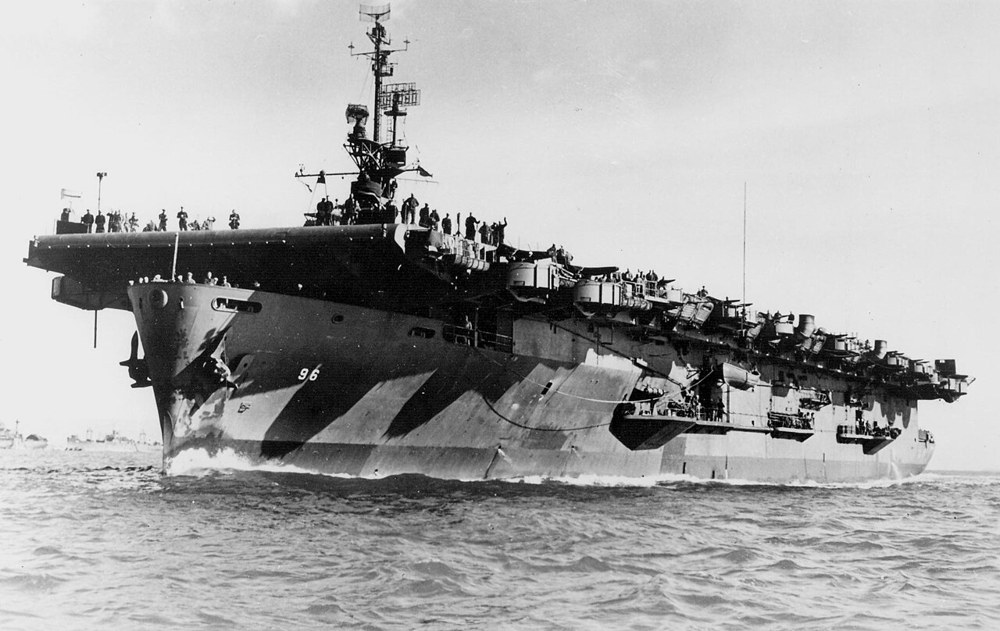
Anguilla Bay (ACV-96) was reclassified CVE-96 on 15 July 1943, renamed Salamaua on 6 November 1943; laid down under Maritime Commission contract (MC hull 1133) on 4 February 1944 by the Kaiser Shipbuilding Co., Vancouver, Wash.; launched on 22 April 1944; sponsored by Mrs. W.J. Mullins [wife ofCapt. J.W. Mullins, USN]; and commissioned on 26 May 1944 [at Astoria], Capt. Joseph I. Taylor, Jr., in command.
Following shakedown off the west coast, Salamaua transported planes and cargo from San Diego to Pearl Harbor, then returned to California, whence she conducted a similar run to Finschhafen, New Guinea. On 1 September, she returned to Alameda; underwent overhaul, conducted training exercises, and, on 16 October, again sailed west from San Diego. She arrived at Ulithi on 5 November, thence continued on to the Palaus and the Philippines. From the 14th to the 23d, she furnished air cover for convoys in the Leyte Gulf area; then proceeded to the Admiralties to stage for the invasion of Luzon.
She departed Seeadler Harbor on 27 December and moved north. On 6 January 1945, she arrived off the entrance to Lingayen Gulf. Her planes began blasting enemy positions ashore and providing air cover for the approaching Allied ships. On the 9th, they provided air cover for the troops landing on the assault beaches; then continued that support until the 13th.
Just before 0900 on that day, a kamikaze carrying two 250 kg. bombs crashed Salamaua's flight deck. Over eighty men were injured. Fifteen were killed. Damage was extensive. The flight deck, the hangar deck, and spaces below blazed with a multitude of fires. One of the bombs, failing to explode, punched through the starboard side at the waterline. Power, communications, and steering failed. One of her engine rooms flooded. The starboard engine quit. But, by 0910, her gunners had splashed two of the kamikaze's compatriots.
Temporary repairs enabled the CVE to return to San Francisco. Arriving on 26 February, repairs were quickly completed; and, on 21 April, she moved west again. On 20 May, she arrived at Guam, whence she continued on to the Ryukyus where she joined other escort carriers on the 26th to support land operations on Okinawa. On 4 June, she joined a logistic support group; but, on the 5th, she was damaged by a typhoon. Repairs were made at Guam and, toward the end of July, she assumed antisubmarine patrol duty in the Marianas-Okinawa convoy lanes. In August, she shifted to the Leyte-Okinawa lanes, where she remained until after the mid-month Japanese surrender.
On the 25th, Salamaua returned to Leyte, replenished, then escorted a troop convoy to Tokyo Bay. The convoy arrived on 2 September, and the CVE's planes photographed the landing of the occupation troops at Yokohama the same day. After guarding a second convoy into Tokyo Bay, she joined the "Magic Carpet" fleet; embarked veterans for transport to the United States; and disembarked them at Alameda on 3 October.
Before the end of the year, Salamaua completed two more "Magic Carpet" runs, then, with the new year, 1946, she prepared for inactivation. She was decommissioned on 9 May 1946, struck from the Navy list on the 21st; and subsequently sold to the Zidell Ship Dismantling Co., Portland, Oreg., for scrapping on 18 November 1946,
Her wartime commanding officers, from NavSource: Captain Joseph Irwin Taylor Jr., 26 May 1944 to 5 August 1945; Captain John Hook Griffin, 5 August 1945 to 10 February 1946.
Sources: Dictionary of American Naval Fighting Ships (DANFS), Wikipedia, NavSource Online (commanding officers) and Wikimedia Commons (photograph records).