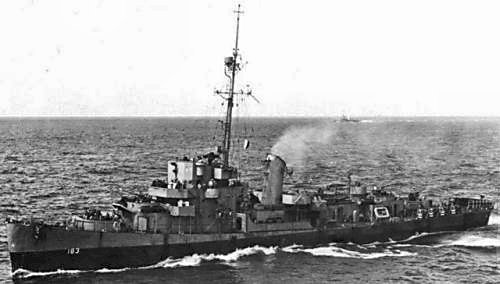
Samuel S. Miles was named for Samuel Stockton Miles, a Navy doctor. He was born in Philadelphia on 12 November 1913, took a degree at Princeton in 1936 and a medical degree at Johns Hopkins in 1940, and was appointed a lieutenant (junior grade) in the Medical Corps of the Naval Reserve on 16 May 1942. On 7 August 1942, in the landing on Tulagi, he was killed going forward to the wounded under fire. He was given the Silver Star. His widow sponsored the ship.
She was a Cannon-class destroyer escort, diesel-electric, about 21 knots, with 3-inch guns, torpedo tubes, a Hedgehog, and depth charges. Federal Shipbuilding laid her down at Newark on 5 July 1943. She was launched on 3 October and commissioned at the New York Navy Yard on 4 November. Lieutenant Commander George B. Coale had her.
After a shakedown off Bermuda she left New York on 30 December 1943, crossed the Panama Canal, and reached the Marshalls on 19 February 1944. Through the spring she escorted fleet oilers for the fast-carrier strikes on the Carolines and on Hollandia. She stayed with the oilers for the capture of Saipan and Tinian, and on 18 June her guns brought down two planes. Coale left her on 21 May. Lieutenant Commander Henry G. Brousseau, Jr., had her from that day.
By September she was with the escort carrier Hoggatt Bay in Task Group 30.7, on submarine patrol for the ships off Peleliu and Angaur. I-177 had already been damaged, on 1 October, by an acoustic torpedo from a Mariner. Before dawn on 3 October the carrier's radar found a boat on the surface, about 20,000 yards out, north-northeast of Angaur. Miles was sent in. Masaki Watanabe, her captain, took her down. The first Hedgehog salvo did not sink her. The second did. Three explosions. The place was 7°48′ N, 133°28′ E. No one came up. About 101 men were lost, among them the division commander, Kanji Matsumura, and Watanabe.
She screened for Leyte and Luzon, then for the invasion force at Iwo Jima in February 1945. For Okinawa she was in Task Force 54, screening the ships that shelled the island in the week before the landings on 1 April. On 27 March she shot down one plane. On 11 April a kamikaze missed close aboard. One of her men was killed, and some of her gear was damaged. She stayed afloat and in service. After that she screened escort carriers north of Okinawa. In July she went to the West Coast. Brousseau left her on 23 July.
Lieutenant Commander Arthur T. Wendells, of Seattle, had her from 23 July until 5 November. She was overhauled, crossed the Canal, and reached Norfolk on 21 October. Lieutenant Commander Edward A. Marelius took her on 5 November. She entered the St. Johns River on 8 November and decommissioned into reserve on 28 March 1946, at Green Cove Springs. On 12 August 1950 she was transferred to France and renamed Arabe, pennant F-717. The United States struck her on 26 September 1950. France struck her in 1968, and she was broken up. She had earned eight battle stars.