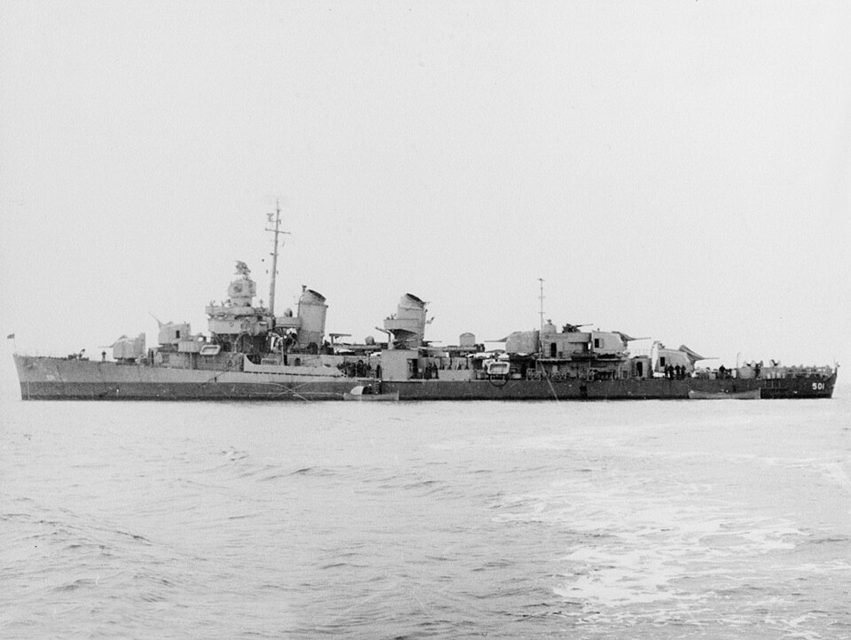
USS Schroeder (DD-501) was a Fletcher-class destroyer. Her hull was begun on 25 June 1942 at the Federal Shipbuilding and Drydock Company in Kearny, New Jersey. She entered the water on 11 November 1942 with Miss Grace Wainwright Schroeder as sponsor, and her commission date was 1 January 1943. John Treadwell Bowers commanded her from that year until 7 June 1944.
In 1943 she guarded two carriers on separate Caribbean shakedown voyages and took merchant ships as far as Casablanca, then turned toward the Pacific. Yard work at Mare Island came next. On 28 July she reached Pearl Harbor and joined Destroyer Squadron 25. When carriers struck Marcus Island on 1 September, she helped form the screen. Early the following month, during a bombardment of Wake Island, enemy gunfire reached her for the first time; the ship and her crew came through intact. Training with amphibious forces in the New Hebrides followed.
Early in November she sailed with the ships gathered for the Gilbert Islands landings. The morning of 20 November found her shelling Tarawa Atoll along its eastern side. Before the next day was far along she was inside the lagoon, covering the Marine assault and caring for wounded men brought out to the ship. Pearl Harbor was the next stop after she left on 24 November, the screws having been damaged on a reef in that lagoon.
On 1 February 1944 she was with the division again, screening transports and laying down fire for the assault on Kwajalein. Several weeks in the Marshalls included shelling of Maloelap and Wotje from 20 February through the 24th. Further drills in the New Hebrides led to 20 March, when she and the division poured close to 900 rounds into coastal defenses the Japanese held at Kavieng, on New Ireland, then shaped course for Efate that evening. After ammunition was loaded at Espiritu Santo, she shepherded Pocomoke and SS Red Rover into Guadalcanal on 1 April, picked up merchant ships, and saw them through to Milne Bay in New Guinea. Later that month she bombarded enemy positions at Hollandia, screened transports and landing ships inside Humboldt Bay, and directed fighters through 30 April. A convoy then took her toward Cape Sudest and on to Buna.
Duty around Purvis Bay and Guadalcanal lasted until 4 June, when she headed for Kwajalein inside Task Group 53.1. Robert Wallace McElrath became captain on 7 June 1944. The group was at Eniwetok on 28 June for upkeep and stores. On 11 July the division left for the Mariana Islands and spent 16 through 20 July bombarding the Tumon shore of Guam. Picket duty held her until 4 August, when she brought a convoy into Eniwetok. Once upkeep at Espiritu Santo was finished, 22 August found her bound for Humboldt Bay. She sailed on 13 September with Task Group 77.5 for the landing at Morotai in the Netherlands East Indies, covered landing ships on the way into Pitoe Bay, stood picket, and on 21 September turned back toward Humboldt Bay. On 13 October she went out with Task Force 78 for Panoan Island in the Philippines. Midnight on 19 October saw her enter Leyte Gulf among transports; the morning after, she took up antisubmarine patrol and fighter direction. She cleared that area on 25 October for San Francisco and arrived on 23 November to begin overhaul.
A move down the coast put her at San Diego on 11 January 1945. She sailed on 20 January and was at Ulithi on 7 February, assigned to Task Force 58, the fast carriers. That force put to sea on 10 February. Strikes on 16 and 17 February hit airfields, plane works, and harbor shipping near Tokyo, and the day after that the carriers struck the Volcano Islands ahead of the assault planned there. Early March brought her back to Ulithi; by 23 March she was again off Japan's home islands. Released from the task group on 31 March, she steamed to Ulithi with Murray. On 10 April, inside Task Group 50.8, she headed for Okinawa in support of the landings. Covering Ie Shima on 16 April, she sounded general quarters on nine separate occasions as aircraft came in. Five days afterward, with Destroyer Division 49, she fired along the western shore of Minami Daito Shima. Many fires took hold ashore, and the positions there stayed silent. Ulithi kept her from 27 April through 9 May for upkeep, replenishment, and a spell of recreation. Three days after leaving she was with the fast carriers again for bombing and photo runs over Kyushu, and a further four days found those ships aiding troops on Okinawa's southern shore. The force lay in San Pedro Bay from 13 June for upkeep, sailed on 1 July, and on 10 July opened a long run of carrier attacks on Tokyo. Strikes on 17 and 18 July fell across the Tokyo and Yokohama districts. Schroeder herself bombarded Shimizu, on Honshu, on 31 July.
On 6 September, the fighting already finished, the force steamed into Tokyo Bay and then split apart. Orders sent Schroeder to Task Force 11 at Okinawa and onward to Pearl Harbor. She cleared Pearl Harbor on 1 October, bound for the east coast. Charleston Navy Yard, in South Carolina, took her in on 2 November 1945 so she could be readied for deactivation. Her active career ended with decommissioning on 29 April 1946, after which she lay in the Atlantic Reserve Fleet. Reserve status lasted until 1 October 1972, the day her name left the Navy List. Southern Materials Co., Ltd., of New Orleans, bought the hull for scrap on 1 January 1974. Ten battle stars marked her World War II service.