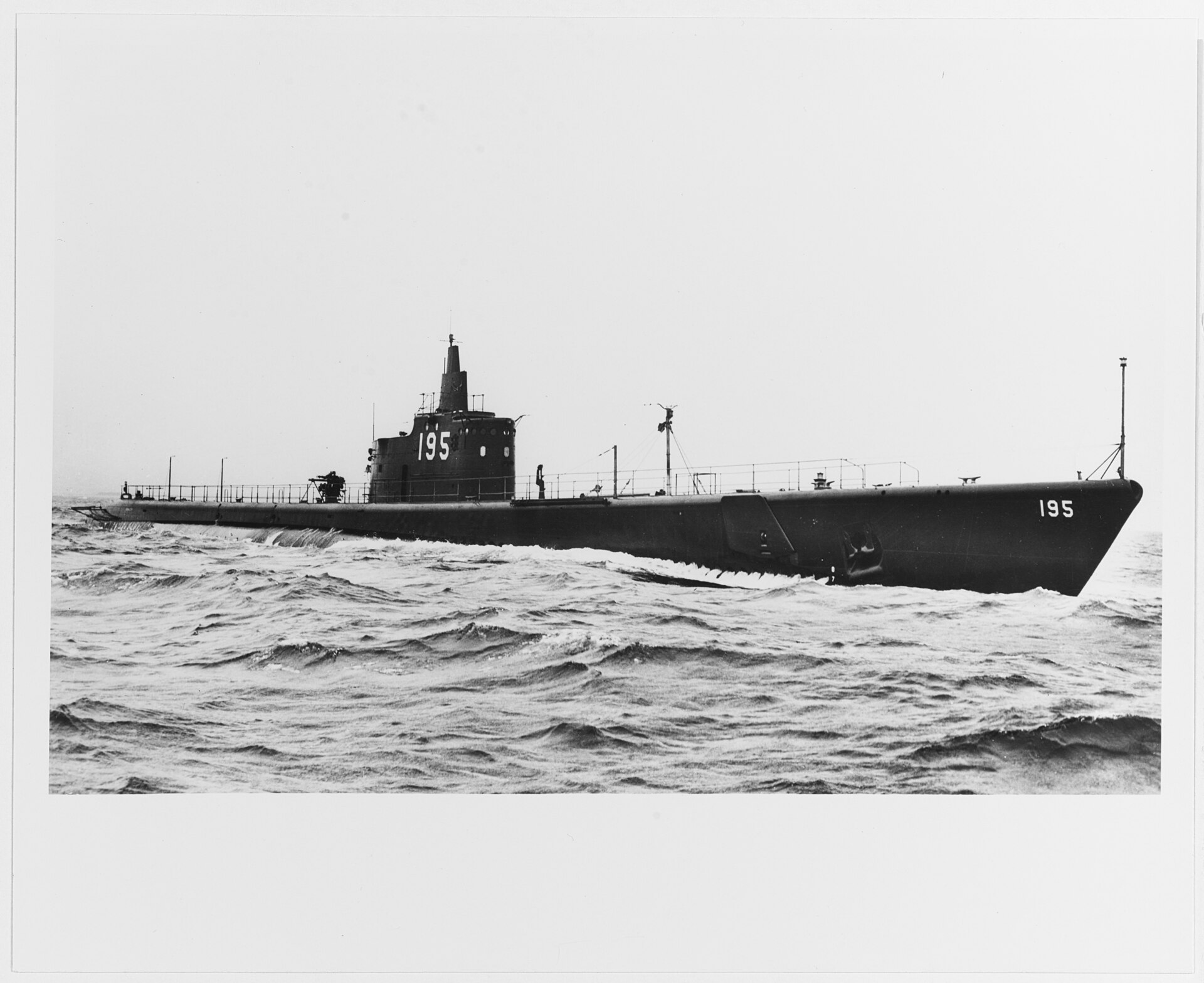
Sealion (SS-195) was the first submarine lost to enemy action in the war. Lieutenant Commander Richard G. Voge had her. The east-longitude opening of the war, 8 December 1941, found her with Seadragon in the last stages of overhaul at the Cavite Navy Yard. Both boats were scheduled to finish on 12 December. The Electric Boat Company at Groton, Connecticut, laid her down on 20 June 1938 and launched her on 25 May 1939, sponsored by Mrs. Claude C. Bloch, and she was commissioned on 27 November 1939 under Lieutenant J. K. Morrison, Jr. She sailed for the Philippines with Submarine Division 17 in the spring of 1940 and reached Cavite that fall. A later submarine, SS-315, carried the name. She was a different boat.
Air-raid alarms had sounded over Manila on the first two days. No enemy planes came to the yard until the afternoon of the third day, 10 December. The alarm went about half an hour after noon. Fifty-four planes, in two groups of twenty-seven, were then in sight. Sealion lay nested at Machina Wharf, with Seadragon inboard and the minesweeper Bittern outboard. Except for Voge, the executive officer, Lieutenant Albert L. Raborn, and three men, the crew was below.
The first stick of bombs landed a hundred to two hundred yards astern. Voge saw that the planes were bombing from an altitude the machine guns could not reach, and he ordered all hands below. A few minutes later two bombs hit Sealion almost together. One struck the after end of the conning-tower fairwater. It demolished the machine-gun mount the men had just left, the main induction, the battery ventilation, and the after conning-tower bulkhead. It exploded outside the hull, a few feet above the control room. Had it entered the hull before it exploded, most of the crew would have been in that room. A fragment pierced Seadragon's conning tower and killed Ensign Sam Hunter at once. Other fragments wounded three men in Sealion's control room.
The second bomb passed through a main ballast tank and the pressure hull and exploded in the maneuvering space at the after end of the after engine room. It killed four men at work there: Electrician's Mates Foster, O'Connell, and Paul, and Machinist's Mate Ogilvie. The after engine room flooded immediately. She settled by the stern in the mud. About forty percent of the main deck was under water, and she took a list of fifteen degrees to starboard.
There was no way to dock her for a rebuild. The nearest navy yard that could do the work was at Pearl Harbor, about five thousand miles away. The gyro, the radio, and the sound gear were removed. On Christmas Day 1941, three of her own depth charges were exploded inside the hull.
A note on sources. The loss is the Navy's United States Submarine Losses, World War II, the chapter on Sealion (SS 195), read from the HyperWar transcription. That chapter names Voge, Raborn, Hunter, Foster, O'Connell, Paul, and Ogilvie, and it places the nest at Machina Wharf. The Office of Naval Intelligence Java Sea narrative says she was destroyed in dock by two direct hits and does not name the wharf. The Dictionary history of Seadragon says Sealion took a direct hit, in the singular, and counts one killed and five wounded in Seadragon. The loss book does not say five wounded. The Dictionary history of Pigeon prints Seation, and later Scotian, for this boat. The Dictionary history of Bittern says bombs did not hit the minesweeper and that the debris came from Sealion moored alongside. No page read gives the builder or the commissioning of SS-195. Ranks and given names beyond the forms printed in the loss book were not supplied from anywhere else.