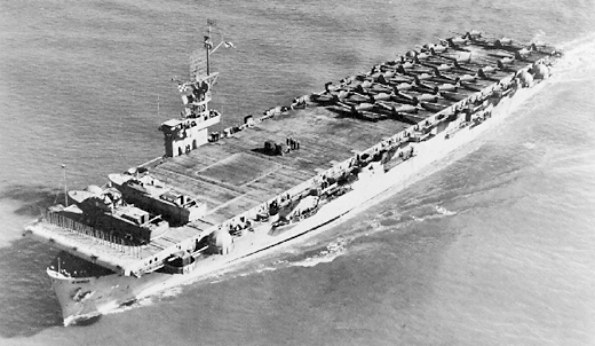
Sitkoh Bay (CVE-86), an escort aircraft carrier, was converted from a Maritime Commission hull (MC hull 1123) by the Kaiser Shipbuilding Co., of Vancouver, Washington. Her keel was laid down on 23 November 1943, and she was launched on 19 February 1944; sponsored by Mrs. Kathryn Mullinnix; and commissioned at Astoria, Oreg., on 28 March 1944, Capt. Robert G. Lockhart, USN, in command.
She spent the month after commissioning completing her fitting out and making short shakedown and trial cruises along the northwestern coast of the United States. On 28 April, the escort carrier entered port at Alameda, Calif., loaded cargo and embarked passengers. She stood out of Alameda on 30 April, bound for Pearl Harbor, and began the first of many routine voyages shuttling planes, pilots, and air crewmen back and forth between the front line and rear areas. The majority of her missions carried her from Pearl Harbor, or via Pearl Harbor from the California coast, to various islands in the southern or central Pacific which served as staging areas for the war being waged farther north or west. In the latter part of 1944, her ports of call were Majuro in the Marshall Islands, and Manus in the Admiralty Islands. From these two points, planes were staged on to the 3d and 7th Fleets, respectively.
In January 1945, the South Pacific was dropped from Sitkoh Bay's itinerary, and she concentrated on replenishing the 3d Fleet in the Central Pacific. Her ports of call included Apra Harbor, Guam, in the Marianas; Roi Harbor, Roi Island, and Eniwetok Atoll in the Marshalls; and Ulithi Atoll in the Western Carolines. Her missions in early 1945 were in support of the campaigns in the Philippines, the assault on Iwo Jima, and the preparations for the invasion of Okinawa.
Sitkoh Bay's only action came on 7 April 1945 while she was delivering Marine Air Group 31 to Okinawa. At 1528, a twin-engined Japanese "Francis" dove at the carrier. Sitkoh Bay's antiaircraft gunners combined with a Marine Corsair from Breton's (CVE-23) combat air patrol to splash the interloper about 100 yards off Sitkoh Bay's port beam. The next day, she cleared the area for Guam en route to Pearl Harbor and a return to her replenishment routine.
After the cessation of hostilities with Japan on 15 August 1945, Sitkoh Bay joined Task Group 30.8, the replenishment group for the 3d Fleet, and cruised with it off the southeastern coast of Honshu from 25 August until 5 September. On 10 September, she entered Eniwetok and departed the next day for Guam. For the next month, she made voyages between Guam, Samar Island in the Philippines, and Okinawa, returning to Pearl Harbor on 18 October and San Diego on the 26th for an availability period. After further voyages to the Central Pacific, Sitkoh Bay returned to the United States and was placed out of commission, in reserve, on 30 November 1946 at Bremerton, Wash.
Her wartime commanding officers, from NavSource: Captain Robert Green Lockhart, 28 March 1944 to 1 February 1945; Captain James Paul Walker, 1 February 1945 to 30 November 1946.
Sources: Dictionary of American Naval Fighting Ships (DANFS), Wikipedia, NavSource Online (commanding officers) and Wikimedia Commons (photograph records).