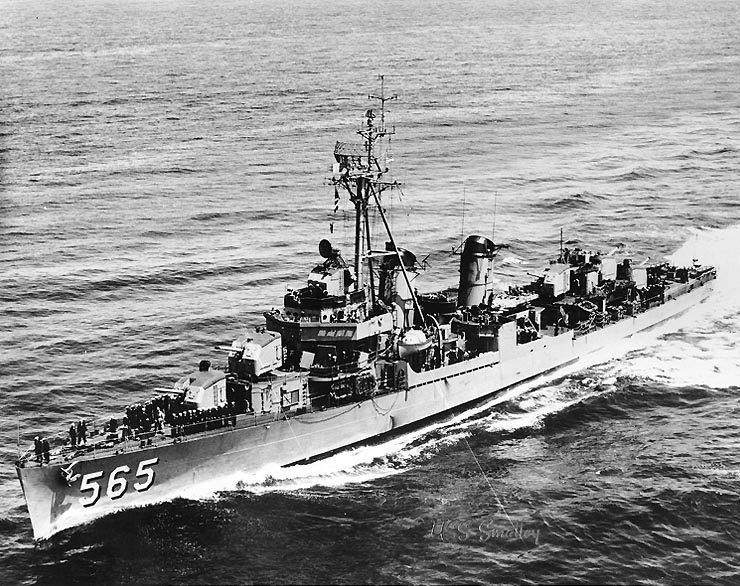
USS Smalley (DD-565) was a Fletcher-class destroyer. The Seattle-Tacoma Shipbuilding Corporation in Seattle, Washington, laid her down on 14 February 1943. Miss Lina A. Mayo sponsored the launch on 27 October 1943, and the ship was commissioned on 31 March 1944. P. H. Horn took command that day.
After shakedown, Smalley and a second destroyer put to sea on 7 June 1944 guarding three transports bound for Hawaii. The convoy reached Pearl Harbor on 11 July. On 28 July the crew lined the rail as President Franklin D. Roosevelt entered the harbor aboard the cruiser Baltimore. She sailed for the Aleutians on 8 August. On 21 November 1944 she fired at Matsuwa in the Kurils, covering buildings, tents, machine-gun posts, and the airstrip, and used 466 rounds in that shoot. Three further bombardments of the same kind followed before the northern duty ended. Orders of 18 April 1945 sent her back toward Hawaii.
On 11 May she met Rowe and Stoddard and helped screen the carrier Ticonderoga on the passage to Ulithi. A week afterward, aircraft from Ticonderoga struck Taroa, and Smalley picked up a crewman from a torpedo plane that had come down. She arrived off Okinawa on 4 June 1945 and took close-in radar picket work, patrolling against submarines and guarding the transport area from the air. Afterward she joined the last push against the Japanese home islands, running surface sweeps, directing combat air patrol, scouting, and shelling shore targets. Her last bombardment was Chichi-jima on 23 July 1945. She returned to the United States in October 1945. In January 1947 she was decommissioned and berthed with the Atlantic Reserve Fleet at Charleston Naval Shipyard.
The Korean War brought her back to commission on 3 July 1951. Refresher exercises at Guantanamo Bay followed, and she reached Newport, Rhode Island, her new home port, on 10 December 1951. All of 1952 went to further drills, upkeep, and calibration of equipment. A Boston yard period in the spring of 1953 came before she sailed for Korea on 19 May. On 2 July she entered the Korean combat zone as plane guard for the carrier Princeton and stayed with Task Force 77 while its carriers flew the Cherokee strikes, through the armistice of 27 July 1953.
She remained in those waters until early November. Her work included carrying 110 Marines from Sasebo in Japan to Pusan and taking aboard 29 men from a South Korean fishing boat in distress. She left the Far East in November 1953 and was back at Newport on 15 January 1954, having stopped at Hong Kong and Singapore, then Ceylon, and later Saudi Arabia, Aden, Port Said, Piraeus, Cannes, and Gibraltar. Newport remained home port until July 1955, when she cruised northern Europe and the Mediterranean. She called in England and Denmark, went on to Finland and Scotland, and also visited Spain, France, and Turkey, exercising with Danish ships and with the British fleet. She started home on 15 November and entered Newport on the 28th. In 1956 she cruised the Caribbean and then spent time in a yard.
In 1957 she left Newport on her last operational cruise, with the Middle East Force, showing the flag along the east coast of Africa and the Persian Gulf. Outbound she visited Sierra Leone, Cape Town, and Mombasa in Kenya, and she arrived at Karachi, Pakistan, on 10 February. Two more calls at Bahrain followed. She quit the region in April and, stopping again at Mombasa, Cape Town, Freetown, and Sierra Leone, came home. Dry dock at Charleston Naval Shipyard took her on 12 June. On 23 August 1957 she departed her home port for the Philadelphia Naval Shipyard, where she was decommissioned and returned to the Atlantic Reserve Fleet. She stayed in reserve until the Navy struck her name on 1 April 1965. Norfolk Shipbuilding and Drydock Corporation bought her, and on 4 January 1966 she was sold for scrap. She had survived the war. Three battle stars marked her World War II operations, and one star marked her Korean service.