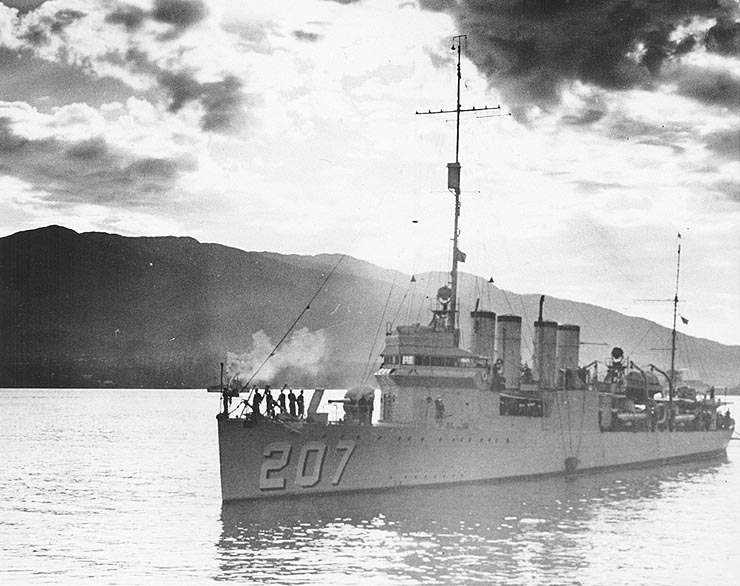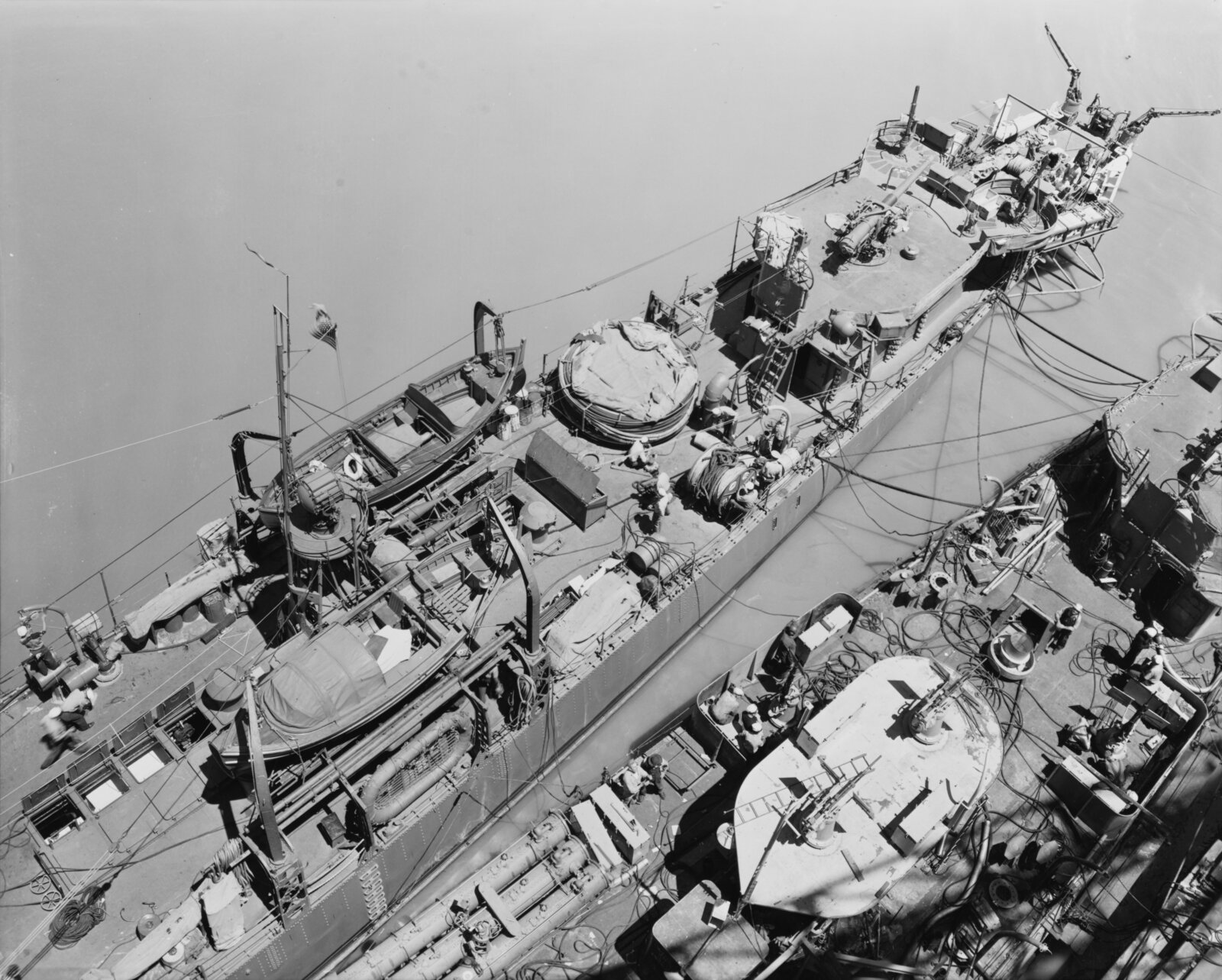
Southard, DMS-10, was named for Samuel Lewis Southard. He was born at Basking Ridge, New Jersey, on 9 June 1787, graduated from Princeton in 1804, and after the law in New Jersey became an associate justice of the state supreme court in 1815. He sat in the United States Senate from 1821 to March 1823 and was Secretary of the Navy from September 1823 until 1829. In those years he also served briefly as Secretary of the Treasury and Secretary of War. He was attorney-general of New Jersey in 1829, governor in 1832, back in the Senate in 1833, and President pro tempore of the Senate on 4 March 1841. He died at Fredericksburg, Virginia, on 26 June 1842. The destroyer was laid down on 18 August 1918 at Philadelphia by William Cramp and Sons, launched on 31 March 1919, and sponsored by Miss Francesca Lewis Steward. She was commissioned on 24 September 1919. Commander Russell Willson, later a vice admiral, was her first commanding officer and had her until 10 May 1920. She was a Clemson-class destroyer: displacement 1,215, length 314 feet 4 inches, beam 30 feet 11 inches, draft 9 feet 4 inches, 35 knots, complement 122, four 4-inch guns, one 3-inch gun, and twelve 21-inch torpedo tubes.
She fitted out in the fall of 1919, shook down on the Florida coast, and at New York joined six other destroyers escorting HMS Renown to sea with Edward, Prince of Wales, after his visit. On 19 November 1919 she left Newport for the eastern Mediterranean and spent about a year in the Adriatic. She then left the Dalmatian coast, passed the Suez Canal, called in Egypt, Arabia, India, and China, and reached Cavite on 16 February 1921. Repairs there lasted until 21 March. On 27 August 1922 she sailed for the United States and arrived at San Francisco on 2 October. From there she moved to San Diego and was decommissioned. She flew a commissioning pennant again on 6 January 1930, after the years in reserve.
Through 1930 she operated off the west coast, and in the first months of 1931 near the Panama Canal. For the next nine years she stayed with the Battle Force in the Pacific, except for short Atlantic cruises in 1934 and 1939. In 1940 she was converted to a high-speed destroyer minesweeper and, on 19 October, reclassified DMS-10.
She was stationed at Pearl Harbor when the war began, and she was at sea during the attack on 7 December. Two days earlier she had left that base for exercises near Johnston Island. She returned to Oahu two days after the attack and patrolled the approaches until 23 January 1942. Lieutenant Commander Joe Brice Cochran had commanded her since 18 July 1940, and he kept her until 26 September 1942. After a convoy to San Francisco and back, she resumed Hawaiian patrols on 15 February. On 20 May she screened an eastbound convoy, reached San Francisco on the 31st, and spent ten days in restricted availability at the Mare Island Navy Yard. She reentered Pearl Harbor on 1 July and, nine days later, stood out for the South Pacific.
She called at British and American Samoa and reached Tongatabu on 22 July. She left three days later, stopped at Efate in the New Hebrides, and made Guadalcanal by 7 August. Commander William H. Hartt, Jr., had the Minesweeper Group, Task Group 62.5, of Rear Admiral Richmond K. Turner's amphibious force. Southard was one of the five ships. Morison's task organization and chapter 5 of the combat narrative name Lieutenant Commander Joe B. Cochran. She took part in the opening bombardment of Florida Island, then joined the minesweeping force in a sweep south of Gavutu and through Lengo Channel. On the 8th, about twenty high-altitude bombers attacked the transport area, and she splashed at least one of them.
Once the beachhead was established she screened convoys from New Caledonia and the New Hebrides to the Solomons. For almost eight months she steamed among Espiritu Santo, Efate, Noumea, Tulagi, Purvis Bay, and Guadalcanal. Air attacks were frequent, and submarines worked the sea lanes. Lieutenant Commander John Gardner Tennent III relieved Cochran on 26 September 1942 and had her until 14 May 1943. Early on 10 November 1942, while passing between San Cristobal and Guadalcanal en route to Aola Bay, she met an enemy submarine on the surface. She slowed to 10 knots and opened fire. The submarine submerged. She made a depth-charge attack, lost contact, and regained it at 0607, almost three and a half hours later. Over the next three hours she made five more runs. After the last, oil was sighted. The crew found no further evidence of damage in the slick. About 2,000 yards on the other side, the submarine surfaced almost vertically, exposing the whole conning tower, the hull forward of the tower, and part of the keel. The bow dropped about ten degrees, and she sank rapidly by the stern. Absolute confirmation of a kill never came. The evidence of the oil and of that last surfacing was what the ship had.
After liberty at Brisbane and six days in dry dock at Sydney she was back on patrol and convoy duty in early January 1943. On 20 March she left Noumea with Hovey, Stringham, and Sonoma towing Aulick. The unit stopped at Suva on the 25th and went on to Pago Pago, Pearl Harbor, and San Francisco. She entered the Mare Island Navy Yard on 19 April and stayed until 8 June. By the 15th she was at Pearl Harbor again, and nine days later she headed back. She reached Dumbea Bay, New Caledonia, on 6 July 1943. Lieutenant Commander Frederick Richard Matthews had her from 14 May 1943 to 1 June 1944.
On 30 October she joined a convoy off Tetere Point, Guadalcanal, for Bougainville. The convoy arrived off Cape Torokina the next day. She joined the bombardment, swept in Empress Augusta Bay, and entered Purvis Bay on 3 November. Four days later she went back to look at the shoals on the approaches to the bay, then resumed patrols off Guadalcanal. Patrols and convoys lasted until 21 November, when she passed Lengo Channel for Noumea. From 25 November to 16 December she drilled and screened ships at New Caledonia. On 17 December she entered Suva with a convoy and, two days later, got underway for Guadalcanal. On 22 January 1944, escorting Cache from Florida Island to Espiritu Santo, a Japanese submarine torpedoed the oiler. Her hunt was cut short by covering Cache's retirement. In late February she visited Auckland. In March she patrolled Guadalcanal and exercised in the Russell Islands. In April and May the work widened to the Bismarck Archipelago and convoys to Borgen Bay, New Britain. By 10 May she was at Espiritu Santo. A week later she sailed for the United States, fueled at Funafuti on 19 May, provisioned at Pearl Harbor on the 24th and 25th, and entered San Francisco Bay on 31 May. Overhaul at Mare Island began the next day, which was also the day Matthews was relieved.
Two months later she made Pearl Harbor on 5 August and on the 12th sortied with six escort carriers and five other destroyer-type ships for the Solomons. Twelve days later the group entered Purvis Bay. She exercised in the Russells the next day. Lieutenant Commander John Edward Brennan had her from 1 June 1944 to 1 September 1945. On 4 September she rendezvoused off Guadalcanal, reached the Palaus on the 12th, and swept off Peleliu and Angaur. On the 24th she fueled at Manus, then returned to the Palaus. She reentered Seeadler Harbor on 4 October for Leyte. She sortied from Manus with the Dinagat Attack Force on 10 October, swept Leyte Gulf on the 18th and 19th, and made an exploratory sweep of Surigao Strait on the 20th. On the 24th she joined the screen of Carrier Group 77.4 until the 26th. Back at Seeadler Harbor by 30 October, she spent November and most of December in drills and availability at Manus.
Two days before Christmas 1944 she rendezvoused with Task Group 77.6 for Leyte Gulf, then Luzon and Lingayen. She began minesweeping at Lingayen on 6 January 1945. Late that afternoon, while she was fighting off a kamikaze attack, one plane crashed abaft her stacks. The engine embedded itself in the ship. The fuselage ricocheted off the starboard side and tore a trough six feet wide in her deck. She cut loose her sweep gear and retired for emergency repairs. Within fourteen hours she was sweeping again, and she continued for five more days. She returned to San Pedro Bay on 14 January, and on 4 February headed east. She stopped at Ulithi on the 6th and Guam two days later, left the Marianas on the 13th, and reached Pearl Harbor on 22 February, Washington's Birthday. Repairs held her in Hawaiian waters until 4 May. She stopped at Eniwetok on the 12th and, with Clinton and Buckingham, continued to the Marianas. On 21 May she sailed from Guam to Saipan and, two days later, for Okinawa.
On the day she arrived at Nakagusuku Wan an attacking kamikaze splashed a scant 15 yards ahead of her. For the next three months she swept, screened transports, and delivered mail to the fire-support ships around Okinawa. Hostilities ended on 15 August 1945. She remained in the Ryukyus for the rest of August for inspection and survey. By 15 September the survey team wanted her moved to the rear for further inspection and repair. Two days later, maneuvering at anchor during a typhoon, her screws were fouled by a drifting antisubmarine net and she grounded on a pinnacle reef off Tsuken Shima. She was floated clear, and divers cleared the propellers on the 18th. Lieutenant John Ryan relieved Brennan on 1 September 1945. The September grounding and the October wreck came in his tour, and he was in command on 2 September. He had her until 13 November. While she was still waiting to move, on 9 October she was wrecked on another reef about 1,000 yards southwest of Tsuken Shima. The next day the officers and crew were removed except the commanding officer and a skeleton crew. She was declared a total loss. Ensign Robert Samuel Coney had her from 13 November 1945 until she was decommissioned on 5 December 1945. She was struck on 8 January 1946, and the hulk was destroyed six days later. She received ten battle stars.
A note on sources. The career is the Dictionary of American Naval Fighting Ships entry for Southard. Commanding officers are NavSource's page for DD-207. The 7 August assignment, and Cochran's name in it, are the combat narrative, chapter 5, and Morison, volume IV, pages 270 to 274. The Dictionary commissions her under Commander Richard Willson. NavSource names Commander Russell Willson, from 24 September 1919 to 10 May 1920, later a vice admiral. The Dictionary sails her from Cavite on 27 August 1922, brings her to San Francisco on 2 October, and then says she was decommissioned at San Diego on 7 February 1922. NavSource also dates the decommissioning 7 February 1922, and the recommissioning 6 January 1930. That day is earlier than the arrival in the same passage, so it is not used here as the end of the 1922 cruise. The 10 November submarine contact does not have the year repeated in that sentence. It sits after the landing and before the January 1943 return from Australia, and it is given here as 1942. The Dictionary says confirmation of a kill was never received. It does not name the officer who stayed aboard with the skeleton crew after 9 October 1945. NavSource has Lieutenant John Ryan, with no middle name and no class given, from 1 September to 13 November 1945, and Ensign Robert Samuel Coney from 13 November to 5 December 1945.