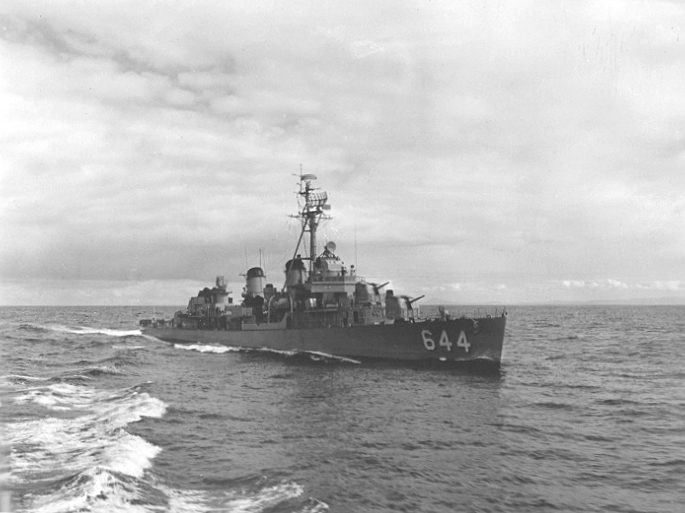
USS Stembel (DD-644) was a Fletcher-class destroyer of the United States Navy. She was launched on 8 May 1943 and commissioned on 16 July 1943, with T. H. Tonseth taking command that same day.
Trials occupied her first weeks around Casco Bay. Between 11 August and 25 August she shook down in Bermuda waters, then returned for the refit that follows a new ship's trials. On 2 October she headed for San Juan, Puerto Rico, with a call at Norfolk. There she joined a squadron bound for Morocco. That group sailed on the 8th and reached Casablanca on 15 October. Three days later Stembel began the long run out to Hawaii, with calls at Trinidad, the Canal Zone, and San Diego. She entered Pearl Harbor on 11 November and spent December 1943 in overhaul.
On 16 January 1944 she put to sea with the fast carrier force, known as Task Force 58 while it served the Fifth Fleet and as Task Force 38 when those same ships operated under the Third Fleet. The carriers opened their attacks on the Marshall Islands on 29 January. On 17 and 18 February they struck Truk, Japan's main base in the Carolines, and the force then turned back toward Pearl Harbor. Stembel set out for the South Pacific on 10 March. In the Solomon Islands she picked up a convoy of tank landing ships and took it to Aitape, New Guinea. She shelled the approaches before troops went ashore on 22 April and stayed with them through the 25th. Empty landing ships were escorted to Cape Sudest, and she brought a follow-on supply convoy back to Aitape.
In May she came under the Fifth Fleet as flagship of LST Flotilla 16 for the Guam operation. The flotilla cleared Eniwetok on 15 July and by morning on 21 July was lying off Asan. Stembel fired on the beach until the first waves started in, then became the radio and traffic center for the landing ships. She held that duty until 1 August, shaped a course for Hawaii, and reached Pearl Harbor on 11 August for time alongside a tender and for landing practice. Sailing in Task Group 33.7, Tractor Group Able, she made for Manus by way of Eniwetok and reached Seeadler Harbor on 4 October to finish preparations for the Philippine landings. The group left on 11 October and came into Leyte Gulf on the 19th. At dawn the next day Stembel lay 4,000 yards off Dulag, guarding landing ships and small craft from aircraft and submarines. On 25 October she screened unloaded transports toward New Guinea and was back at Leyte with supplies on 18 November. From Manus she joined the escort carriers of Task Force 77 and moved to the Palau Islands. On 10 December she sailed in Task Group 77.12 toward the western Philippines, crossed into the Sulu Sea on 13 December, and gave gunfire and antiaircraft cover through the Mindoro assault, leaving that work for Leyte Gulf on 26 December 1944.
On 4 January 1945 she left San Pedro Bay with the force bound for Lingayen and the next day was shifted to the escort-carrier group. Japanese suicide planes struck that group on 8 January, and Kitkun Bay (CVE-71) was torn open along the waterline. Stembel came alongside the crippled carrier and took off more than 360 of her people. Those men returned to Kitkun Bay the following day once the carrier was moving on her own power, and Stembel took up a patrol across the mouth of Lingayen Gulf. On 11 January she and four other destroyers were sent to clear Japanese shipping from San Fernando Harbor. They sank a fifty-foot tug and an inter-island tanker and left a freighter damaged, then drew off to shell the town of Rosario on the 12th. On 21 January she pointed for San Pedro and went on to Ulithi. From there, on 10 February, she sailed in the screen of the amphibious support force aimed at the Volcano Islands. After a pause off Saipan she was in the waters off Iwo Jima on 16 February, covering minesweepers, firing harassing rounds through the night, shelling the beaches as the landing went in, and answering calls for fire until 7 March.
Voyage repairs at Ulithi came next. On 14 March she sortied with the fast carriers for waters east of Kyushu. Planes from the force hit that island on 18 March, and on the 19th the blows fell on Kyushu airfields and on shipping in the harbors of Kure and Kobe. On 18 March Stembel picked up two airmen from a Wasp (CV-18) aircraft that had gone down, and the next day she shot down one Japanese plane. On 26 March she took aboard a pilot from Hancock (CV-19), and another man from that carrier three days afterward. The group was then working sixty to one hundred miles east of Okinawa, sending aircraft ahead of the landing along that island chain. Damage sent her back to Ulithi on 11 April. On 21 April she was with the carriers again, southeast of Okinawa. Bunker Hill (CV-17) took heavy damage early on 11 May, and Stembel closed in to help put the fires out. On 27 May she left for a tender refit at San Pedro in the Philippines, stopping at Guam on the way. She sailed on 1 July with Task Force 38 and stayed with the fast carriers in home waters off Japan through 1 September. In company with other surface ships she shelled Kamaishi, on Honshu, on 14 July and once more on 9 August. Late that month, on the 29th and the 30th, those ships fired into Hamamatsu. Detached on 1 September, she headed for the United States and reached Port Angeles, Washington, on 13 September.
In November she received a pre-layup overhaul at Puget Sound Naval Shipyard, then went south along the coast and into San Diego. Stembel left commission on 31 May 1946 and was placed with the Pacific Reserve Fleet. She came back into active service on 9 November 1951. With refit, trials, and another shakedown behind her, she left San Diego on 21 June 1952, bound for the waters off Korea. From 26 July to 2 November she worked with the carriers of Task Force 77 on behalf of United Nations troops, stood plane guard for Boxer (CVA-21), helped the battleship Iowa (BB-61) shell Kojo and Wonsan, and kept watch in the strait off Taiwan. She was back in San Diego on 5 January 1953. The months that followed were spent on the Pacific coast, and on 16 May she deployed again to Korean waters, remaining until 8 December. She was in the western Pacific between 17 June and 24 October 1954. Stembel had come through the Second World War, and on 7 August 1961 she was loaned to Argentina.