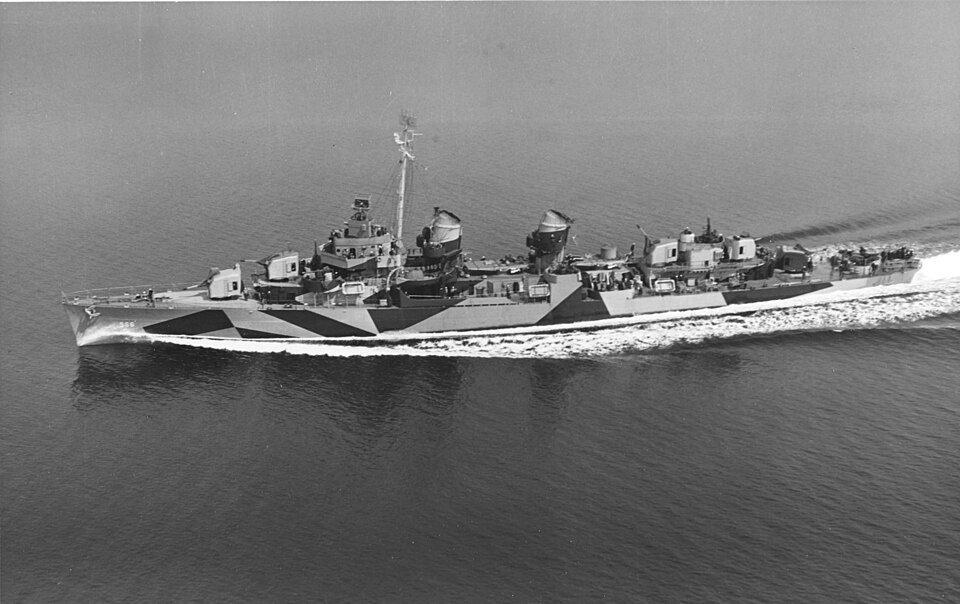
USS Stoddard (DD-566) was a Fletcher-class destroyer. She was launched on 19 November 1943 and commissioned on 15 April 1944. After working up from San Diego and a short repair spell at Seattle, she escorted a convoy toward Pearl Harbor, leaving the Pacific coast on 16 July and dropping anchor in Hawaii on 29 July. A brief docking there ended with orders north. On 8 August she reached Adak, in the Aleutians, and was assigned to Task Force 94. With her were the light cruisers Trenton, Concord, and Richmond, plus Destroyer Division 57.
The force was there to harry Japanese garrisons in the Kurils, west of the Aleutians and northeast of Japan. Stoddard's first sweep got underway on 14 August 1944 and was abandoned when the weather closed in. By the time a second attempt started on 26 August, the formation wore a new number, Task Force 92. Storms spoiled that effort too, and the ships anchored at Attu. Repeated gales kept any finished raid out of reach until late in November. On the night of 21 November the cruisers and destroyers shelled Matsuwa, wrecking airstrips and other Japanese works ashore. Wind and heavy swell held the withdrawal down to nine knots, and the same dirty weather kept enemy aircraft from chasing. The warships were in Attu again on 25 November.
From Adak, Destroyer Division 113, Stoddard among its ships, was sent to Dutch Harbor, where the submarines based. The opening two weeks of December were spent in port. On 13 December the destroyers sailed and joined Task Force 92 once more. George Paul Unmacht took command on 17 December 1944. Early in January 1945, on the 3rd, another sweep of the Kuril defenses began. Two days later, snow squalls overhead and the water calm, the ships shelled Suribachi Wan on Paramushiro, doing heavy harm to canneries and airfields. They ran fast for Attu, then on 13 January entered Dutch Harbor for ten days of rest.
Stoddard sailed with Rowe on 16 January, bound south for training around Hawaii, and the two reached Pearl Harbor on the 22nd. They got underway again on 7 February, steering back toward Attu, and stood into Massacre Bay on the thirteenth of February, ready for a bombardment of Kurabu Zaki. At sea on 16 February, they opened fire off Paramushiro in the dark of the 18th, kept shooting until midnight, and regained Attu on the 20th. A move to Adak three days afterward brought supplies and repairs. The ships were at Attu again by 8 March, and on 15 March they hit Matsuwa a second time. Exercises near Adak filled the first seventeen days of April. On 18 April Destroyer Division 13, with Stoddard, left the Aleutian chain.
On 24 April 1945 she was back in Pearl Harbor, her third call there. Nearly a month went to liberty in the islands and to drills aimed at Okinawa service with the Fast Carrier Task Force. She sailed on 11 May in Ticonderoga's screen, the carrier headed for Ulithi. On 17 May that ship's air group expended live ammunition on Japanese troops cut off at Taroa and on nearby islets of Maleolap Atoll. Ulithi's lagoon took the group in on 22 May. A week later Stoddard left for Okinawa, and on 2 June she began radar picket duty. The fight ashore was in its last days. Planes flying from Japan and from Formosa still harried the ships. Suicide sorties were past their early peak and remained numerous. During a typhoon evasion on 4 June she covered cargo vessels as they withdrew, then went back to her station. Near sunset on 7 June two suicide aircraft attacked, and both were shot into the water short of the formation. Her picket claim for the tour was two Japanese planes downed by the ship, a pair of shared credits, and one probable.
She cleared Okinawa on 17 June in Mississippi's screen. Three days on, she threaded Surigao Strait and came into Leyte Gulf. The balance of the month was repairs and provisioning at San Pedro Bay. On the first of July she sailed again, this time screening Task Force 38. Across the following forty-five days the carriers' planes struck the Japanese home islands repeatedly, with Stoddard in the guard. On 23 July she shifted to Destroyer Division 113 for a shelling of Chi Chi Jima, one of the Bonin Islands. Hostilities ended on 15 August. She kept on near Japan with Task Force 38 while occupation troops went in. From 21 September through 7 October she was at Eniwetok for upkeep, after which she returned for training that lasted into November. Homeward bound, she left Japan on 18 November, crossed the Panama Canal roughly a month later, and reached the Philadelphia navy yard with Christmas two days off.
The Philadelphia overhaul lasted into late March 1946. In April she ferried people to Charleston, South Carolina. Inactivation at the Charleston navy yard began on 8 July, and January 1947 found her decommissioned. Berthed in the Atlantic Reserve Fleet at Charleston, she stayed idle until November 1950, when reactivation started. She returned to commission on 9 March 1951. Gear and stores were completed at Charleston and at Newport, Rhode Island, and she then ran trials out of Newport and out of Guantanamo Bay, Cuba. Through December 1954 she swapped Mediterranean deployments with the Sixth Fleet for Philadelphia overhauls and Atlantic coastal work. That December she passed the Panama Canal and became a Pacific Fleet ship. In January 1955 she opened her first western Pacific tour since the Second World War. She survived the war. An exercise sank her on 22 July 1997.