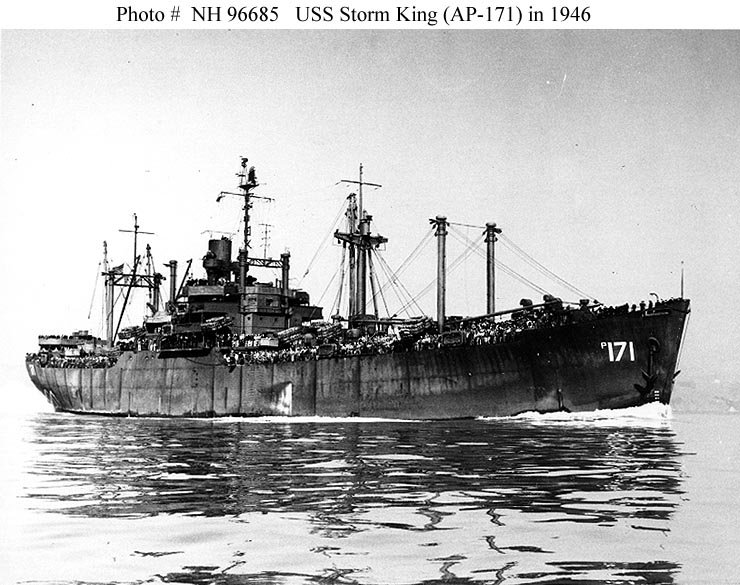
A Catskill peak looking down on the Hudson north of West Point gave Storm King (AP-171) her name. North Carolina Shipbuilding at Wilmington laid the keel on 20 July 1943 under a Maritime Commission contract. Mrs. P. F. Halcey sponsored the launch on 17 September 1943. The Navy took delivery on 3 December 1943 and commissioned her the next day, Captain Harold D. Krick in command. On 10 February 1944 she shifted to Staten Island to be fitted as a troop transport. She left New York on 3 March for a shakedown out of Hampton Roads. On 6 April the Naval Transportation Service received her. Troops and cargo went aboard, and the next week she sailed for Hawaii, arriving at Pearl Harbor on 1 May. The troops went off, and on 2 May she joined Transport Division 26 of the 5th Amphibious Force.
The rest of May went to rehearsals for the Marianas attack. The force sailed on 29 May, fueled at Eniwetok, and was off Saipan early on 15 June, D-day. She landed the 23d Marines with their vehicles and supplies. Wounded men started coming aboard on the 16th. On the 24th she was ordered to carry those casualties out, and she headed for Eniwetok and Pearl Harbor, which she reached on 11 July. The 3d Amphibious Force then took her for the Palau campaign. Rehearsals ran until 12 August. She sailed to Guadalcanal, waited with the force until 8 September, and sortied for the Palaus. On 15 September the 1st Marine Division went onto Peleliu. Her own troops waited through the next two days. Angaur was her beach, and the boats started in on 17 September. The final unit landed on 22 September. Manus was the sailing on the 23rd.
The 7th Amphibious Force had her next. Seeadler Harbor was cleared on 6 October, New Guinea the aim. Lae took her on the 7th. On the 9th troops and cargo came aboard, and that same afternoon she shifted to Finschhafen, finishing the load on the 10th. Hollandia was the 13 October arrival. Task Group 78.6, called Reinforcement Group One, sailed the next morning toward Leyte. San Pedro Bay on 22 October was a reinforcement unloading, not the opening assault. She cleared the same day for Kossol Passage and stayed there from 25 to 28 October. The Marianas followed. Apra Harbor at Guam was entered on 31 October, where vehicles, freight, and part of the 77th Army Division were taken aboard. A 3 November sailing pointed at New Caledonia until the orders were rewritten on the way. Seeadler had her again on 15 November. Leyte was resumed two days afterward, and she entered the gulf on 23 November. Anchored off Tarranguna, she started putting men and supplies ashore, then the next afternoon shaped for Hollandia and reached Humboldt Bay on 29 November.
She was then ordered into the flotilla preparing the Lingayen attack. Sansapor, on 14 December, was where freight and the Army's 6th Infantry Division came aboard. Task Group 78.5 sailed on 30 December 1944. About dawn on 9 January 1945 she anchored off Luzon and started the assault boats in. Those boats returned at 1130. Vehicles and freight followed until the beach had everything by 1614. That evening she left for Leyte Gulf and remained from 12 to 18 January. The 3d Lingayen Reinforcement Group then took her to Biak. Cargo was loaded on 23 January. Men of the 41st Army Division boarded on 27 January. The Leyte sailing was 2 February. Mindoro replaced Lingayen as the objective. Troops and supplies went onto Mindoro on 9 February, and she continued to San Pedro Bay. With Lamar (APA-47) and Starlight (AP-175) she delivered boats at Samar on 15 February, boats taken from transports heading back to Pearl Harbor, and returned to San Pedro.
Orders toward Pearl Harbor by way of Ulithi sent her out on 18 February. At Ulithi she was sent to Iwo Jima instead. Between 10 and 17 March she lay offshore. She then anchored along the west side and took aboard men and gear of the 5th Marine Division, an embarkation rather than a trip to the beach. By way of Eniwetok she reached Pearl Harbor on 12 April, sailed the next day for Hilo, finished offloading on 15 April, and headed for the United States. San Francisco on 22 April opened a scheduled upkeep. She then loaded at Oakland and sailed for Hawaii on 20 May, arriving the following week. Some passengers left and others, bound for Okinawa, came aboard. After Eniwetok and Ulithi she entered Buckner Bay on 14 July. On 25 July she stood out for the Marianas beside Latimer (APA-152). Comet (AP-166) sailed in that group as well. Guam was the next day. Passengers, patients among them, came aboard, and on 27 July she headed for California. San Pedro received her on 10 August.
Yard work came first. Fourteen hundred troops then boarded, with ammunition and freight. She sailed on 28 August. Manila, reached on 18 September, was left after eight days. The next run carried 1,389 passengers toward Pearl Harbor. On the night of 26 September a native banca appeared off the starboard bow at 2325. She turned to avoid it, but the little boat cut across her bow. At 2329 Baby Rose was struck and capsized. Nineteen people had been in the banca. All but one were taken aboard and later passed to the schooner Visayan. She then went on toward Pearl Harbor. For the next nine months people and freight moved on her from Pacific bases back to American ports. A Manila trip ended in July 1946, and Hampton Roads was ordered for decommissioning. The Navy struck her on 15 August 1946. One day afterward the Maritime Administration had her again. Four battle stars were credited for the war.