Tappahannock was a fleet oiler, AO-43, built on Maritime Commission hull 157 at the Sun Shipbuilding and Dry Dock Company in Chester, Pennsylvania. She had been laid down on 24 December 1941. On 31 March 1942 she was named Tappahannock and numbered AO-43. She was launched on 18 April 1942, sponsored by Mrs. George Jessup, and acquired from the War Shipping Administration on 29 May. The Philadelphia Navy Yard converted her, and she was commissioned on 22 June 1942. Commander Alf Ole Ruh Bergensen, Naval Academy class of 1919, was her first commanding officer. She was the former Jorkay, a T2-A tanker, geared turbine, single screw, of 21,750 tons, 520 feet, a beam of 68 feet, a draft of 30 feet 6 inches, 17 knots, and tanks for 135,000 barrels.
She reported to the Atlantic service force on 13 August, transited the Panama Canal with 300 tons of stores for a motor-torpedo-boat squadron and with two of the boats themselves, and reached Noumea on 18 September. She worked as a station tanker, called at Auckland, Pago Pago, and Nandi, and in December 1942 went back to the west coast. In January 1943 she touched Dutch Harbor briefly and then returned to the South Pacific. By early spring she was in the Guadalcanal area.
On 1 April a Grumman J2F Duck attached to Enterprise crashed into her mainmast at Espiritu Santo and damaged the radar tower and the antenna. She shifted to Tulagi. On 6 April she went to Lunga Point, transferred fuel and diesel to Kanawha and to the yard oiler YO-147, and pumped aviation gasoline into tanks ashore. At 1930 that night a nuisance raid dropped bombs astern. She was not hit. On 7 April she was still off Lunga on the aviation-gasoline hose. The warning came at 1130 for an attack expected at 1245. Fifteen minutes later every ship was told to get underway. She dropped the hose and stood out with Woodworth and Farenholt, smokeless, at 17 knots, through Lunga Channel. At 1510 the condition went red. Four minutes later bursts walked up astern and seven planes were on her. For five minutes she was the target. The first dive bomber came from the port quarter as she swung to starboard. The bomb fell abaft the bridge. A near miss carried away fenders and a life ring, showered the bridge, and knocked the way off her when the overload switches opened. Her gunners splashed that plane. Woodworth was firing. The engineers got her moving. A second plane crossed and escaped. Three 20 mm guns jammed. A third dropped clear astern and soaked the forecastle gunners. A fourth, hit repeatedly, blew up off the starboard quarter, finished by the 20 mm mount on the bridge. A fifth crossed the well deck aft and its bomb went off just alongside. The plates were dished. That was the damage. Woodworth and Farenholt were not hurt, and Woodworth claimed one of the bombers. Behind them, in Tulagi, Kanawha and Aaron Ward went down.
She reached Espiritu Santo. Repair crews from Vestal patched the topsides and the plating below the waterline. Vestal was not in the sound during the raid. At 0023 on 24 May another air attack put one bomb near her and missed. She stayed on the South Pacific station until late August, then went to the west coast, made two runs between San Pedro and Pearl Harbor, and from the Gilberts in November 1943 fueled the fleet forward through the rest of the Pacific war, including Okinawa. Bergensen left her on 23 September 1943. Charles Arthur Swafford, also class of 1919, had her until 3 January 1945. Harry Corman, class of 1919, on the retired list, took her that day.
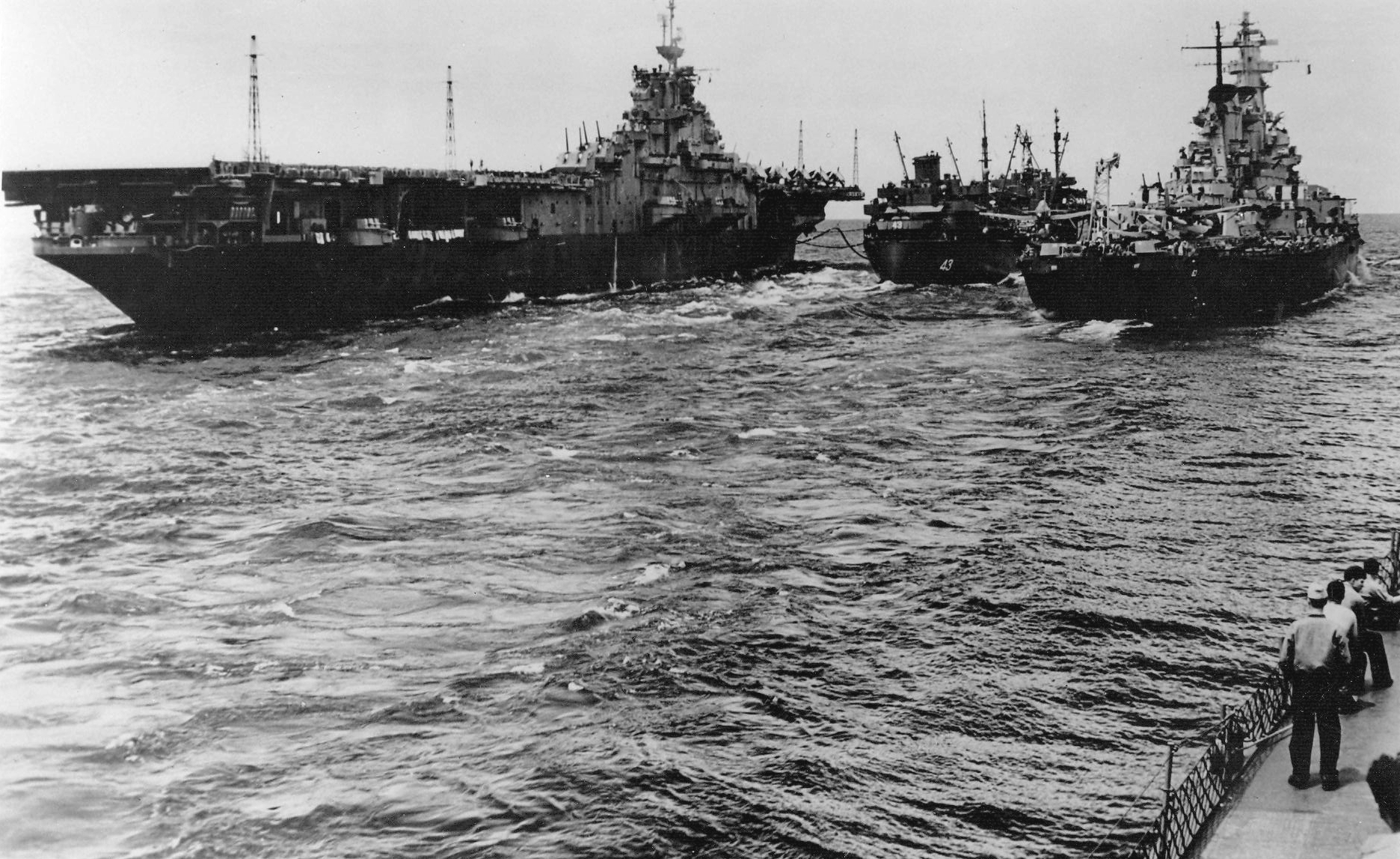
She was decommissioned at San Diego on 3 February 1950 and recommissioned in December 1950. Joseph Aloysius McGoldrick had her into September 1951, Lawrence John Hasse until August 1952, and Henry Warren Dusinberre until the decommissioning in January 1953. She returned on 12 December 1956 under Orville Owen Liebschner and was decommissioned at Orange, Texas, on 18 November 1957. On 31 May 1966 Erman Oran Proctor recommissioned her. John Saabye Christiansen, George Leon Dickey, Jr., and George Franklin Lockeman, Jr., followed. She was decommissioned at San Diego on 6 March 1970, struck on 15 July 1976, and sold for scrap on 16 September 1987. In July 1945, two years after Lunga, she fueled Bon Homme Richard and Missouri.
A note on sources. The 1 April crash, the 6 and 7 April movements, the five planes, the dished plates, and the Vestal repairs are the Dictionary of American Naval Fighting Ships. That entry spells the first captain A. O. R. Bergensen and spells Kanawha as Kanawah. NavSource spells him Alf Ole Ruh Bergensen and gives Charles Arthur Swafford, Harry Corman, and the rank of commander. uboat.net spells Bergesen, spells the next captain Chester, and gives Swafford and Corman lower ranks. Woodworth and Farenholt are named in the Dictionary as the ships in company, and as unhurt. The postwar commanding officers and the decommissioning dates are NavSource. The July 1945 photograph is a Navy photograph in the National Naval Aviation Museum collection, public domain. It shows her fueling Bon Homme Richard and Missouri. HyperWar gives the class as Mattaponi, and gives 21,750 tons, 520 feet, a beam of 68 feet, a draft of 30 feet 6 inches, 17 knots, and tanks for 135,000 barrels. Some summaries give a Kennebec type. The hull, the builder, and the commissioning day agree.