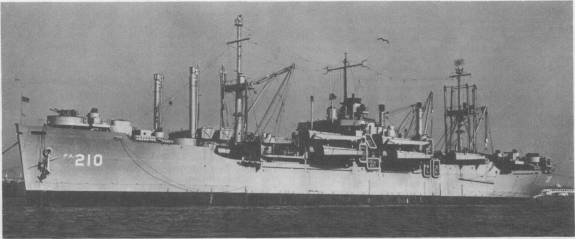
The name is a county in southern central Georgia, itself called after Edward Telfair, second governor of the state. Mrs. J. L. Cauthorn sponsored her. Permanente Metals Corp. at Richmond, California, laid the keel on 30 May 1944 under Maritime Commission contract MCV hull 558, and launched the Haskell attack transport on 30 August 1944. Commander Lyle O. Armel, USNR, placed her in commission on 31 October 1944 while she lay at San Francisco.
Fitting out was at Oakland. Shakedown and amphibious drills off San Pedro followed, and she came back through San Diego to load troops and cargo at San Francisco. On 2 January 1945 she sailed west. Pearl Harbor came on 8 January, and after nine days the passage resumed with elements of the 111th Infantry, bound for garrison duty in the Palaus. Peleliu took that garrison from 30 January through 6 February. She then went on to the Philippines. Leyte, on 9 February, was where she made ready for the invasion of the Ryukyus.
Mid-March brought elements of the Army 77th Division aboard, and she sortied from San Pedro Bay in Task Group 51.1. Called the Western Islands Attack Group, that force was to take the anchorage at Kerama Retto, islets clustered just south and west of Okinawa, as the prelude to the larger landing. In the invasion itself it was the first element to fight in those waters. Between 25 March and 2 April she shared in the assault and the occupation of the islets. Troops reembarked on 30 March. A waiting area farther south was the next station, and she left the roadstead on the afternoon of 2 April. Just after 1830 that evening, ten or more kamikazes jumped the group. Three aircraft pressed her and the sister ship Goodhue (APA-107) one after another. Gunners of the two ships together blew one plane apart in the air. A second slammed from the starboard kingpost across to the port kingpost, struck her bulwark, and pitched over the side. Fire knocked the third off its glide; it hit the cargo boom of Goodhue, wrecked the after tubs of 20-millimeter guns, and went into the sea.
She kept supporting the Okinawa invasion until 26 April, then made for Ulithi in the western Carolines and entered the lagoon on the 30th. Replenishment and repair of the battle damage lasted until 22 May, when she turned east. Seattle on 13 June took her passengers off, and more repair work followed. Puget Sound was astern on 26 June. Army hospital units reached Saipan safely on 13 July. Four days later she left the Marianas, and San Francisco saw her on the last day of July. Another sailing, on 12 August, pointed at Ulithi. The Pacific was already at peace when that atoll came up on the 28th.
Two months of steaming between Luzon and Leyte followed. She was in Manila across the opening thirteen days of October, and on 16 October left Lingayen Gulf with occupation troops. Hiro Wan and Kure, on Honshu, were made on the 20th, and the troops landed. Magic Carpet began at the end of October. The first veterans boarded at Samar on 2 November. She left on the 4th and, after nearly three weeks at sea, entered Portland, Oregon. The west coast held her until Christmas Eve, when she weighed for the western Pacific again. Saipan was a call near the close of January 1946's first week, and she moored at Manila on the 12th. Two months in the Philippines included Subic Bay and Samar. A departure from Samar on 5 March, a call at Pearl Harbor, and San Francisco on the 25th closed the cruise. Stockton on 8 April began the inactivation overhaul, and on 20 July she lay inactive with the Stockton Group of the Pacific Reserve Fleet.
Orders to activate her came on 7 August, after North Korea attacked the Republic of Korea that June. She rejoined the Pacific Fleet on 12 September 1950, Captain John Andrews, Jr., in command. Three western Pacific deployments fell during the Korean fighting. Yokosuka, Kobe, and Sasebo were the Japanese calls on the tour that opened in October 1950 and ran into July 1951, and from those ports she shuttled troops onward to Inchon and Chinnampo. Six months of west-coast work separated that tour from the next. She cleared San Francisco on 26 January 1952. San Diego on 24 May was the homecoming, and Korean waters had not been on the cruise. The steaming was among Okinawa, Kobe, Yokosuka, and Sasebo, training United Nations troops in landings. Four months on the west coast preceded the last of those deployments, begun on 30 October 1952. Familiar Japanese ports returned, along with Manila, Subic Bay, and Hong Kong. Korean stops included Pusan and Inchon, Koje Do, and waters near Sokcho Ri. San Diego on 20 April 1953 closed it. From August 1953 to February 1958 three further Far East deployments mostly lifted United Nations troops from a Korea then at peace, moved men and supplies among bases the United States held in the Philippines, Okinawa, Japan, and Korea, and joined 7th Fleet landing exercises. August 1954 broke the pattern for Operation Passage to Freedom: Vietnamese refugees moved from Haiphong, in the communist half of a newly divided Indochina, to Saigon in the pro-western half. Between cruises she worked the west coast and took leave and upkeep in California. Decommissioning on 29 February 1958 put her in the National Defense Reserve Fleet. On 1 July 1960 the Maritime Administration received her and the Navy struck the name. The Navy took her back on 24 August 1961, restored the name on 1 September, and commissioned her a third time on 22 November 1961 with Captain E. M. Higgins in command. Training off San Diego led to the Atlantic Fleet amphibious force. On 1 February 1962 the Panama Canal was behind her. Norfolk, the new home port, came on the 6th. Until the last decommissioning in 1968 she alternated Mediterranean cruises in the 6th Fleet with western Atlantic duty in the 2d Fleet. Mediterranean time included exercises with other navies. In April 1967 she waited in Greek waters with the backup force watching American lives and property while a military junta took Athens. On 2d Fleet duty she worked from Norfolk along the Atlantic seaboard, through the Caribbean, and into the Gulf of Mexico, usually landing marines from Camp Lejeune, and she also carried Naval Academy midshipmen on summer training cruises. The final decommissioning was on 31 October 1968 at the Naval Amphibious Base, Little Creek, Virginia, and the name was struck the next day. On 26 June 1969 she passed once more to the Maritime Administration and, in the same transfer, to the buyer, Boston Metals Co. of Baltimore, which scrapped her. One battle star was earned in the Second World War and three during the Korean fighting.