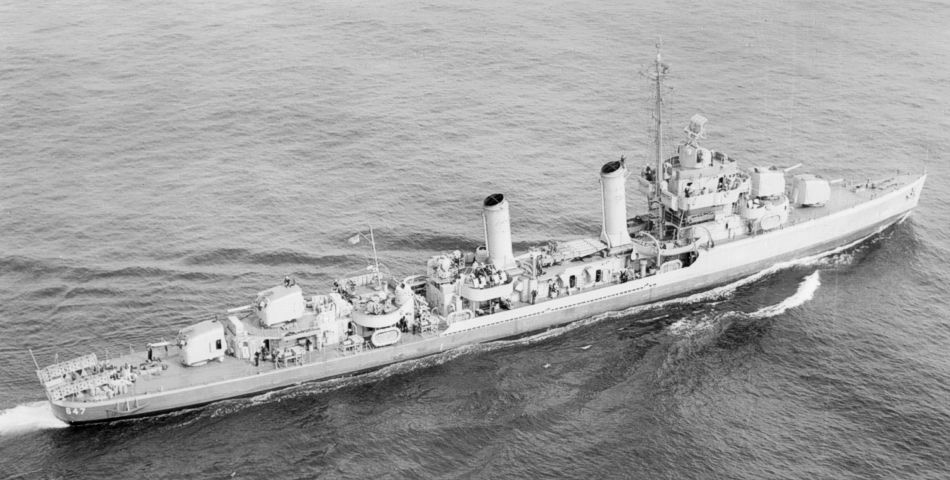
Thorn was a Gleaves-class destroyer, named for Lieutenant Jonathan Thorn. He went into Tripoli harbor with Stephen Decatur in 1804, and he was the first commandant of the New York Navy Yard. The name had been assigned to an experimental destroyer, DD-505, and that contract was cancelled. Federal Shipbuilding and Drydock laid DD-647 down at Kearny on 15 November 1942. She was launched on 28 February 1943, sponsored by Mrs. Beatrice Fox Palmer, and commissioned on 1 April 1943, Lieutenant Commander Edward Brumby in command.
After shakedown out of Casco Bay she joined Destroyer Squadron 19. Between 28 May 1943 and 2 January 1944 she made four convoy runs on the New York–Norfolk–Casablanca route, the first with Task Force 69 and the other three with Task Force 64. On the last run she and Stockton took two oilers into Punta Delgada, in the Azores, the first ships in under the new agreement with Portugal.
On 3 January 1944, the day after she came back to New York, Turner blew up and sank in Ambrose Channel, about 5,000 yards astern. Thorn put a whaleboat in the water. Lieutenant James P. Drake and Boatswain's Mate First Class E. Wells received the Navy and Marine Corps Medal for bringing three of Turner's men off. Three other men of the boat received commendation bars.
Late in January she sailed for the Pacific and went through the Panama Canal on the 29th. She was sent to relieve ships in New Guinea, and she was detoured to Guadalcanal and Rendova to escort an oiler group. She reached Milne Bay on 29 February. On 4 March, at Cape Sudest, she embarked troops and supplies of the Army's 7th Cavalry and went to Los Negros for the Admiralties landing. She made three more trips between Cape Sudest and Seeadler Harbor, bombarded Pityilu twice, patrolled north of the Admiralties, and served as a fighter-director ship.
On 10 April, during a practice torpedo run before the Hollandia landings, she struck an uncharted reef. The screws and the shafts were damaged. She escorted Massachusetts to Bremerton and Thetis Bay from Puget Sound to San Francisco, and she arrived there on 22 May. Hunter's Point overhauled her. Commander Frederick Henry Schneider, Jr. relieved Brumby on 31 May 1944.
She escorted Mississippi to Pearl Harbor, arriving on 11 August, and then took Maryland to Purvis Bay. With an escort-carrier unit she screened the Palau landings of 15 September and picked up the crews of three Avengers that had ditched. At the end of September she joined the Seventh Fleet at Manus. She entered Leyte Gulf on the night of 18 October and screened the battleships and cruisers during the early bombardments. On the 20th she fired on Abuyog, south of the beaches, and patrolled the southern end of the gulf. At dawn on the 21st her guns splashed a Val near the transport area. On the 22nd she and Portland splashed another plane.
On the night of the action in Surigao Strait she screened the battleships. She and the destroyers with her were ordered to make a torpedo attack on the Japanese line and were then recalled. They formed on the left-flank cruisers and came up on a Japanese destroyer. Thorn fired seventeen salvoes and her spotters called twelve hits. The sinking is not credited to her.
She went to Ulithi and screened fast carriers for the November strikes on the Philippines. In December she was with the logistics group and stood by Cape Esperance in the typhoon of 18 December. That storm sank three destroyers. Thorn searched the area for survivors. In January 1945 she escorted oilers for the Lingayen strikes and the carrier raids in the South China Sea. On the way back to Ulithi she took off the crew of a ditched Avenger and the pilot of a crashed fighter.
She screened oilers and fire-support ships off Iwo Jima. On 21 February she and Ute were sent to Bismarck Sea, which two kamikazes had hit. When they reached the place the escort carrier had already gone down. On 13 March she joined the replenishment group built around Detroit for the Ryukyus. On 25 March she and Aylwin attacked a sonar contact and saw an oil slick. They could not say the contact had been a submarine. She made four runs escorting oilers into Kerama Retto. On one of them a kamikaze crashed Taluga, two miles astern.
On 5 June she steamed through the eye of a second typhoon at 0530 and then helped four damaged escort carriers retire to Guam. From 4 July she was back with the replenishment group through the surrender. In that time she sank seven drifting mines. She lay off Tokyo Bay until 9 September, entered Sagami Wan the next day, and stayed at Yokosuka through the end of the month. On 8 October she left Tokyo Bay with Destroyer Squadron 19, joined Tennessee and California off Wakayama, and on 15 October started home by Singapore, Colombo, and Cape Town. She reached New York on 7 December 1945, by way of St. Helena and Ascension. After a month's overhaul she went to Charleston and was decommissioned there on 6 May 1946. She lay in reserve until she was struck on 1 July 1971, and she was later sunk as a target. She received seven battle stars.