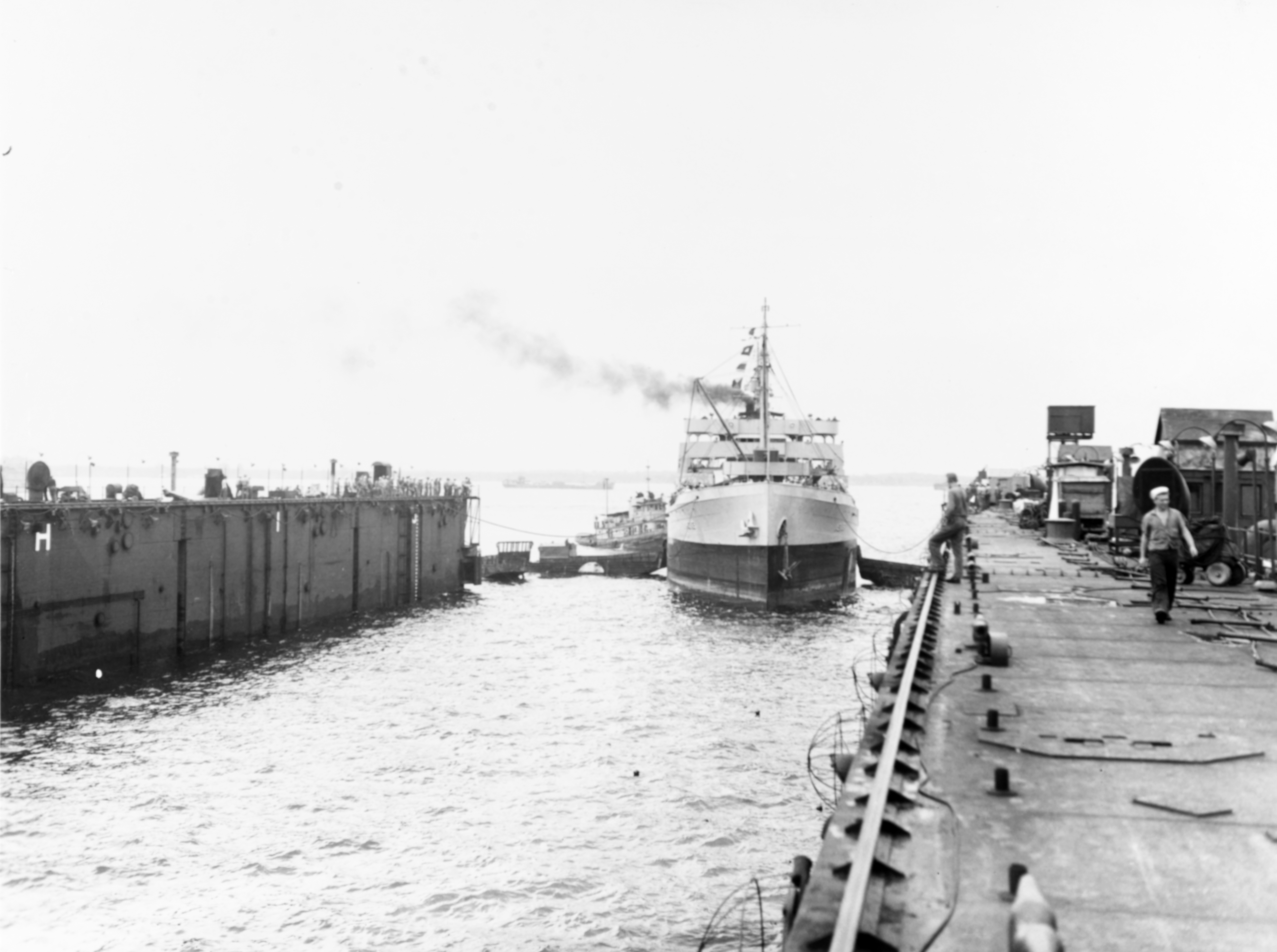
Trinity (AO-13) was a Patoka-class fleet oiler. Newport News Shipbuilding and Dry Dock laid her down on 10 November 1919. She was launched on 3 July 1920 and commissioned on 4 September 1920, with Commander Harry M. Bostwick of the Naval Reserve Force in command.
She was given as 16,800 tons, 477 feet 10 inches long, with a beam of 60 feet and a mean draft of 26 feet 2 inches, a complement of 107, and two 5-inch guns. She was decommissioned on 22 December 1923 and laid up at the Philadelphia Navy Yard. She was commissioned again at Philadelphia on 21 June 1938. Late in 1940 she was assigned to the Asiatic Fleet.
Through 1941 she made eight round trips from Manila to Borneo and the Netherlands East Indies. She arrived at Manila on 3 December. On 8 December she lay alongside the fuel docks at Sangley Point, discharging oil ashore, when Admiral Hart's message arrived. Later that day she left Manila Bay with the oiler Pecos, the seaplane tender Langley, and the destroyers Pope and John D. Ford. The convoy reached Balikpapan on 14 December. Commander William Hibbs had her.
On 17 January 1942 she stood out of Kebola Bay for Australia, with the destroyers Alden and Edsall. Shortly after 0630 a Japanese submarine fired three torpedoes at her and missed. At Darwin she fueled the tenders Holland and Otus, then went on to Tjilatjap. She left Tjilatjap on 17 February with Edsall. The escort was ordered back, and she went on alone. She reached Abadan, in Iran, on 9 March, and headed for Fremantle on 17 March.
She arrived at Milne Bay, New Guinea, on 13 August 1943, and at Leyte in May 1945. She left Samar on 12 January 1946 and reached Mare Island on 22 February. She was decommissioned on 28 May 1946 and struck on 3 July 1946. She was delivered to the War Shipping Administration on 5 September 1946, sold into merchant service, and renamed Seabeaver. On 29 July 1952 she was sold to Pelivalle Compania Naviera. She earned one battle star. She was not sunk.
A note on sources. The career, the 16,800-ton figures, the two 5-inch guns, Hibbs's sailing on 8 December, and the three missed torpedoes are the Navy's ship history of 2017. An older transcription of the same history gives two 6-inch guns. A second account gives 5,400 tons light and 17,820 tons limiting, a length of 447 feet 10 inches, a limiting draft of 27 feet 8 inches, 10.5 knots on trial, 14 officers and 176 men, and a later battery of two 5-inch 38-caliber guns. It decommissions her on 2 December 1923 rather than 22 December, sells her to the Hillcone Steamship Company on 9 August 1947 rather than delivering her at 10:00 a.m. on 9 December 1947, and describes the namesake as the Trinity River in Texas. The ship history calls the namesake a river in California. Both accounts agree on the later sale, on 6 February 1951, to the Colonial Steamship Corporation, and on the 29 July 1952 sale. The second account's captains skip from the first to the third, with no second name. A campaign line in that account keeps her in a Manila operation through 17 February 1942. The ship history has her leave Manila on 8 December and reach Balikpapan on the 14th. No other United States Navy ship of this name is in these accounts.