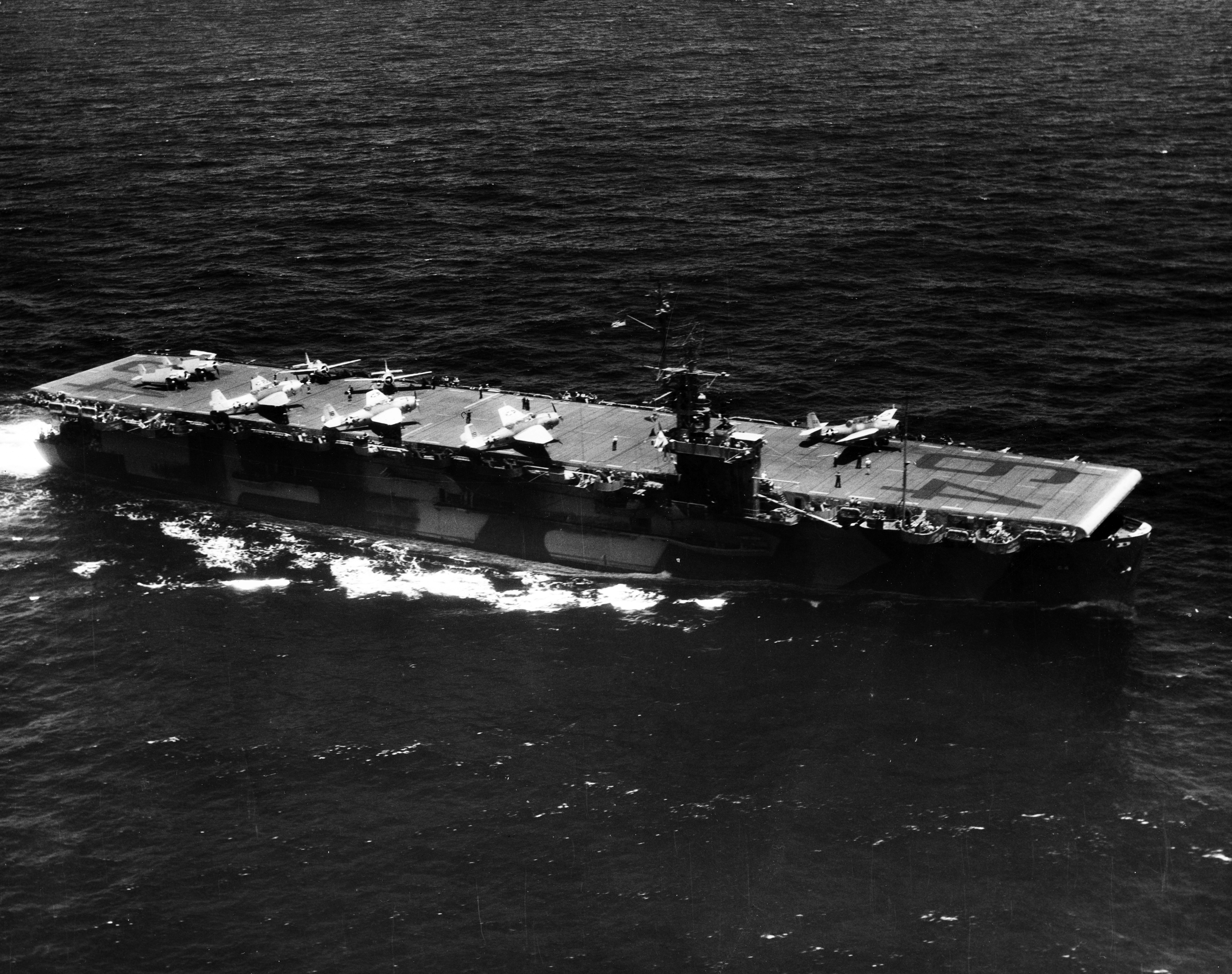
Tripoli was the first ship of the name to serve as an escort carrier. Kaiser at Vancouver laid her down on 1 February 1943 as Didrickson Bay, Maritime Commission hull 1101. She was renamed Tripoli on 3 April, launched on 13 July, and sponsored by Mrs. Leland D. Webb. Captain Wendell G. Switzer commissioned her at Astoria on 31 October 1943.
She shook down off California and entered the repair base at San Diego. On 4 January 1944 gasoline was dumped into the water along her starboard bow. Sparks from an acetylene torch set it off. The fire ran from the bow to frame 82 and took the forward galley walkway and the island. Yard craft and the ship's company put it out. One man died.
She left San Diego on 31 January for the Panama Canal and the Atlantic Fleet, and reached Norfolk, her new home port, on 16 February. With Composite Squadron 13 she sailed on 15 March as the center of a hunter-killer group west of the Cape Verde Islands. A later cruise with Composite Squadron 6 took her to Recife. On 1 August a destroyer escort attacked a sonar contact while her planes marked an oil slick. The group believed it had sunk a submarine. The postwar German record did not confirm that sinking. In September the group hunted U-1062, a tanker submarine bound from Penang, in company with another escort-carrier group. The boat was found. Tripoli's own share of that hunt is the search.
She reached Pearl Harbor on 10 January 1945, sent Composite Squadron 8 ashore to operate from Hilo, and ferried fighters and bombers to Roi, arriving on 20 February. She then trained pilots at Pearl Harbor through the end of the war. On Magic Carpet duty she reached San Diego on 29 August with 500 Navy veterans, returned to Pearl Harbor on 8 September, and made a further run with Army passengers to San Pedro and another to San Diego. She left the west coast on 15 January 1946 and was decommissioned at Norfolk on 22 May 1946.
She was recommissioned at New York on 5 January 1952 as an aircraft transport. Over six years she made forty-four transport voyages, most of them to Europe and the Mediterranean, with one call in Hawaii and two in the Far East, including a load of F-84 Thunderjets delivered at Yokosuka on 5 September 1952. She was redesignated CVU-64 on 12 June 1955 and T-CVU-64 on 1 July 1958, and she decommissioned at New Orleans on 25 November 1958. She was struck on 1 February 1959. A Japanese firm scrapped the hulk in January 1960.