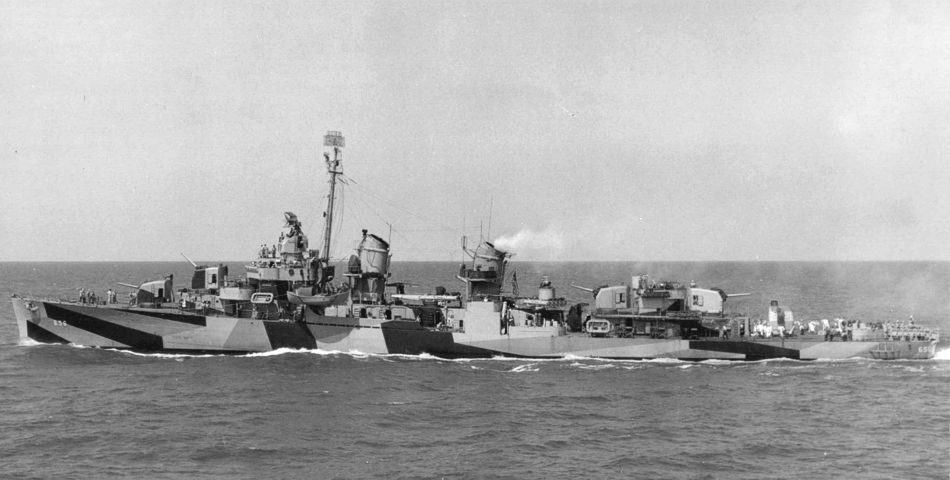
USS Van Valkenburgh (DD-656) was a Fletcher-class destroyer of the United States Navy. She was launched on 19 December 1943 and commissioned on 2 August 1944, with Alexander B. Coxe in command. Trials and structural gunfire tests followed the first stretch of fitting out. On 7 August, bound back from those gunnery tests, she answered a call from the Army tug LT-18. Changing course, she found the tug disabled and still towing three barges loaded with explosives. She patrolled around LT-18, ready to give help if it was needed, until other aid arrived early on 8 August. Back at Mobile, fitting out went on.
On 20 August she left for Bermuda and carried out shakedown training from Great Sound into the latter part of September. On 26 September she set out for Charleston, South Carolina, and the yard period that follows a shakedown. She then moved to Hampton Roads for further training. On 22 October she met the new light cruiser Wilkes-Barre, escorted that ship to the Panama Canal Zone, and passed the canal on 27 October. At Balboa, Mannert L. Abele joined the pair, and the three ships continued toward San Diego. From 10 through 16 November they took troop transports out to Hawaii, exercised off Lanai and Maui, and entered Pearl Harbor on 17 November.
From Pearl Harbor she worked through a hard round of drills: torpedo approaches, antiaircraft practice, and bombardment of shore targets. The pace was so steady that a sailor aboard wrote that real combat could scarcely have taxed them more. She trained in Hawaiian waters through December 1944. After an availability alongside the tender Yosemite, she left Pearl Harbor on 27 January 1945 for the western Pacific and her first combat cruise. She called at Eniwetok, then reached Saipan in the Marianas, where the ships rehearsed the landings planned at Iwo Jima in the Volcano Islands. Two days of those exercises ended and the fleet sailed. The morning of 19 February came on gray and wet. Van Valkenburgh patrolled in a screen three ships deep around the unloading transports and took her turn firing in support of the marines ashore. Through that week at Iwo she moved among screening, escort, and bombardment. Sent to shepherd empty ships toward the Marianas, she saw one group into Saipan and was back off Iwo at midday on 3 March. Five days afterward she made another run to Saipan, and on 18 March she returned to screen an amphibious group.
With that force she rehearsed landings off nearby Tinian and learned the destination was Okinawa, in the Ryukyus, about 350 miles (560 kilometers) from the Japanese homeland. On 27 March, in Task Group 51.2, she sailed on her second combat operation. Her group was ordered to pretend a landing on the southwest coast and pull defenders that way, while the main body closed from the west. On the morning of 1 April the demonstration ships lay off the southern beaches as Sixth Army troops and marine units went ashore on the western side. The ship's historian later wrote that resistance on land gathered slowly, while attacks from the air began at once. During a close sweep inshore a kamikaze struck LST-884, loaded with ammunition and carrying a marine detachment. The aircraft brought no bomb of its own, yet it tore the hull open forward near the waterline and fire broke out low in the double bottom. Van Valkenburgh remained with the landing ship for eight hours. She sent firefighting gear and a rescue party led by Lieutenant Commander W. Brown, of the staff of Captain W. D. Chandler, the screen commander embarked in the destroyer. Brown's party had a large part in quenching the fires. LST-884, though she had taken a starboard list that looked dangerous at the start, reached Kerama Retto under tow. Three officers and fifteen enlisted men of Van Valkenburgh received decorations, the highest of them Silver Stars for Brown and for Lieutenant J. D. McCormich, USNR.
On 4 April she drew off with the feint group nearly 100 miles (160 kilometers) east of Okinawa. Those movements had done what was asked. The ships stayed as a reserve afloat, at times sending transports in to land soldiers and marines, and then returned to the Marianas, reaching Saipan on 15 April. Four days later the destroyer was off Okinawa again. She opened that tour in the inner screen, watching the transport area close by the beach. Her commanding officer remembered eighteen raids on the first night, every one of them hostile. When she later anchored at Kerama Retto, a cluster of small rocky islands 15 miles (24 kilometers) off the southwestern coast, her men saw what the Special Attack Corps had already done to other ships. She then went out to take over radar picket station 14 from J. William Ditter, going as support ship for Wickes. The station lay 72 miles (116 kilometers) northwest of Okinawa, and her captain described it as lying more toward Japan than toward anywhere else. Enemy airfields were close. Within six hours of her arrival, the combat air patrol directed from Wickes had shot down twenty-one planes. Van Valkenburgh herself downed one more and helped destroy a second. She also went to LCS-15, which a burning suicide plane had hit and which sank immediately.
Van Valkenburgh survived the war. Command passed on 8 March 1951 to C. A. Marinke. On 28 February 1967 she was transferred to Turkey.