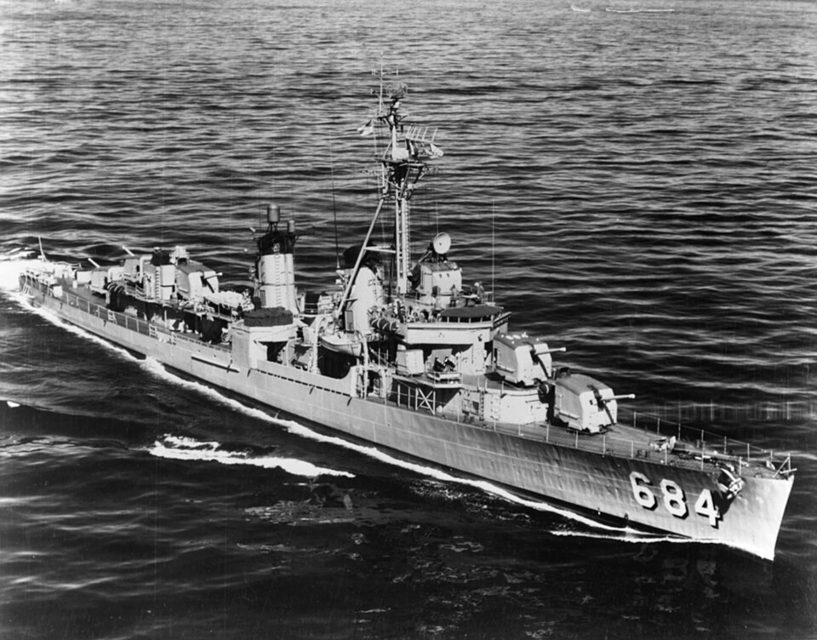
USS Wedderburn (DD-684) was a Fletcher-class destroyer. She was launched on 1 August 1943 and commissioned on 9 March 1944. John Lester Wilfong served as her captain from commissioning until 10 August 1944. Charles Hansford Kendall held command from that date until 5 May 1945, and Robert William Clark became captain on 5 May 1945.
In World War II, during the closing months of the Pacific fighting, she screened groups of Task Force 38. The carriers were still taking part in the Okinawa operation, and later that summer they carried their strikes to the Japanese home islands. Japan’s capitulation came on 15 August while Wedderburn was screening Task Group 38.4. Another carrier strike was in preparation, and it was cancelled before the aircraft flew.
With the fighting over, she joined occupation units in the waters around Tokyo Bay. She escorted Japanese merchantmen, supervised mine clearance, and ran hydrographic surveys. She started home on 31 October, stopped at Pearl Harbor from 9 November through 13 November, and on 19 November entered the naval shipyard at Puget Sound. When the repairs were done she was decommissioned in March 1946 and laid up at San Diego. From August 1946 she trained naval reservists in a reduced state of activity, remaining there until she was recommissioned on 21 November 1950.
In January 1951 she joined the destroyer force of the Pacific Fleet. Work to reactivate the ship was completed at Hunters Point Naval Shipyard, and in May she finished her at-sea training. The first Korean War tour opened on 18 June, when she sailed from the west coast. She served in the Blockading and Escort Force, Task Force 95, stood plane guard at times for fast carriers of Task Force 77, and took a share of the Taiwan Strait patrol under Task Force 72. Most of her days went to blockading the Korean coast and to gunfire support of United Nations troops ashore. The Far East tour ended on that strait patrol, and by February 1952 she was back in the United States.
A shipyard overhaul at San Francisco and several weeks of training followed, and in August 1952 she headed for Korea once more. She again split the cruise among blockade duty, gunfire along the Korean coast, escort of the fast carriers, and short periods with the Taiwan Strait patrol. March 1953 brought her into San Diego at the end of that second Korean deployment. Over the seven months that followed, she carried on routine west-coast duty from San Diego with the 1st Fleet. On 27 July 1953 the armistice halted the Korean War, near the midpoint of those months. Her October return to the Far East was the first deployment of her career lived largely in peacetime.
Through the decade from 1954 to 1964 she traded time in the western Pacific for tours along southern California. Seven deployments to the Far East in those years were given over mostly to harbor visits and sea exercises. In 1958 she added a call at Sydney, Australia, to the northern ports already on her list, and she sailed in Operation Ocean Link, a SEATO exercise with several navies. During that same deployment she patrolled the Taiwan Strait while the United States displayed force after Chinese communist batteries shelled Quemoy and Matsu. Later cruises settled into plane-guard work with Task Force 77, port calls, training, and spells on the strait patrol. On the California coast between deployments she drilled, maintained the ship, and went into overhaul from time to time.
On 5 August 1964 she left San Diego to open her eleventh Far East deployment. Four days earlier the Gulf of Tonkin incident had pointed to a larger American role in the strife in South Vietnam, and that conflict governed her Seventh Fleet employment for as long as she stayed active. On 21 August 1964, in an exercise, her five-inch guns fired at a drone aircraft. Through the autumn she remained off Vietnam, screening carriers of Task Force 77 in the same kind of duty she had known in the world war and off Korea. In November she left the combat zone just then marked out, joined a SEATO weapons demonstration, and took upkeep in the Philippines at Subic Bay. Christmas leave was spent in Yokosuka. January 1965 saw her working the South China Sea again, and late that month she turned for California, reaching San Diego on 6 February.
The rest of 1965 kept her in the eastern Pacific. About a month of rest after deployment gave way to four weeks of nearby work from San Diego, and then a month of repair availability at Long Beach Naval Shipyard. In June and July, NROTC midshipmen boarded for their summer cruise, which called at San Francisco and in Hawaii at Kauai and at Oahu. She was in San Diego again on 4 August, spent three weeks completing repairs, and trained until November, when she began preparing for another westward passage. She put to sea from San Diego on 7 January 1966 with Worden (DLG-18), Bausell (DD-845), and Richard B. Anderson (DD-786). Calls at Oahu, then Midway, then Guam brought her into Subic Bay on 28 January. On 1 February she sailed for the South China Sea, joined Task Group 77.5, and through 28 February escorted the carriers and guarded their flight operations. A brief stop at Subic Bay followed, and early in March she visited Sasebo in Japan and the island of Okinawa. On 12 March she was again off Vietnam, this time in Task Group 77.7, escorting carriers whose planes were striking North Vietnam. She remained with that group until 2 April, then shifted to Task Unit 70.8.9 for gunfire missions off Quang Tri and Danang. On 6 April she rejoined Task Group 77.7. On 24 April she changed to Task Unit 77.0.3 and kept watch on trawlers in the Gulf of Tonkin. Gunfire support resumed on 2 May off Chu Lai and ran to 8 May. That day she became a search-and-rescue ship for Task Force 77 on the southern rescue station. The assignment ended on 15 May and was the last combat duty of her 1966 deployment. The ship was sold for scrap on 25 January 1972.