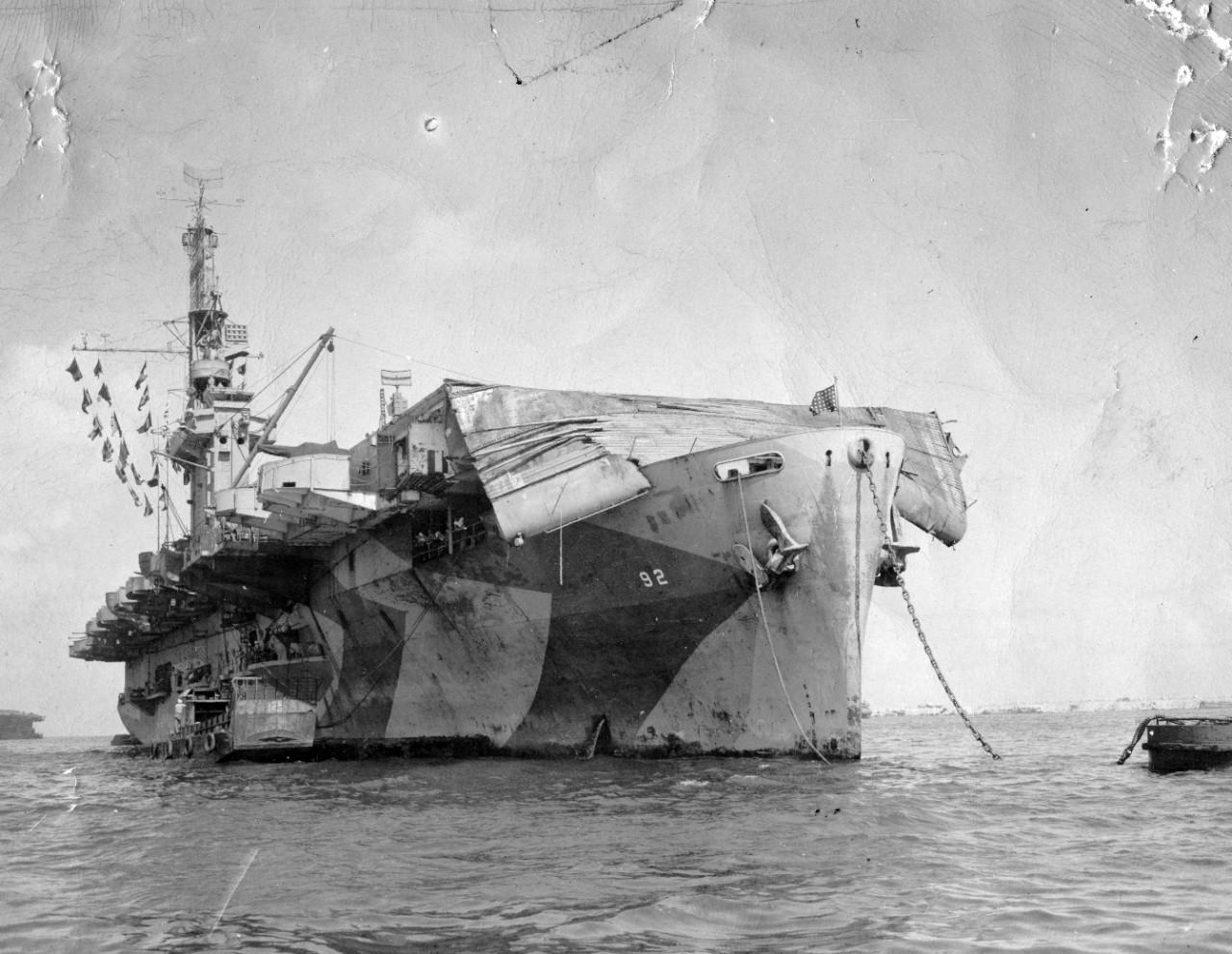
Windham Bay (CVE-92) was laid down under a Maritime Commission contract (MC hull 1129) on 5 January 1944 at Vancouver, Wash., by the Kaiser Shipbuilding Co., launched on 29 March 1944; sponsored by Mrs. Henry M. Cooper, and commissioned on 3 May 1944, Capt. Charles W. Oexle in command.
Following commissioning, Windham Bay conducted shakedown training in Puget Sound and then headed for San Diego on 6 June. There, she conducted air qualifications and catapult trials before taking on a load of Hawaii-bound aircraft and passengers. She departed San Diego on 12 June and arrived in Pearl Harbor on the 19th. Trading her cargo of aircraft and passengers for a similar one bound for the Marshall Islands, Windham Bay stood out of the harbor on 25 June and arrived at Majuro on 2 July. After unloading her aircraft, she moved on to Kwajalein where she loaded planes and men of Marine Night Fighter Squadron 532 and headed for the Marianas. The marines flew off near Saipan, and Windham Bay put into Garapan anchorage to unload the squadron's gear.
Afterward, the escort carrier took on a load of captured Japanese aircraft and other material for transportation back to Hawaii. She arrived in Pearl Harbor on 10 July and remained there for 15 days, getting underway for the west coast on 25 July. The warship arrived in San Diego on 31 July and soon began overhaul at San Pedro.
Repairs took the entire month of August, but she was back at sea on 1 September with a load of aircraft bound for Emirau and Manus. She arrived at Emirau at mid month and at Manus on the 18th. From there, she voyaged to Espiritu Santo on a passenger run, returning to Manus on 5 October with a load of planes. After a brief visit to Guadalcanal during the second week in October, she got underway for the United States. Windham Bay steamed via Espiritu Santo and arrived in San Diego on 20 October. In November, she made another voyage from the west coast to the South Pacific, carrying aircraft to Manus and picking up about 350 casualties from the Palau campaign at Guadalcanal on 24 November for the return voyage to San Diego.
The escort carrier remained at San Diego from 10 December until the 27th when she resumed aircraft ferrying operations. She arrived in Pearl Harbor on 2 January 1945, unloaded one cargo of aircraft there and took on another made up of F4U Corsairs. She departed Pearl Harbor on 5 January and arrived at Midway Island on the 9th to unload the Corsairs. Departing Midway the next day, Windham Bay returned to Oahu on the 13th. On 1 February, the ship stood out of Pearl Harbor on her way to the Central Pacific. Carrying replacement aircraft for the fleet carriers of Task Force 58, she made a stop at Eniwetok on her way to the staging base at Ulithi Atoll in the Western Carolines.
From there, she operated with the 5th Fleet Logistics Group, Task Group 50.8, in support of the fast carrier strikes conducted during the Iwo Jima and Okinawa operations. During the next four months, she visited Guam and the Ryukyu Islands. On 4 to 5 June, while steaming with the logistics group in support of TF 58 and the strikes on Okinawa, the carrier steamed right through the famous typhoon of 1945, suffering lost and damaged planes as well as damage to her flight and hangar decks. On 16 June, she cleared the Marianas en route to Oahu. The warship arrived in Pearl Harbor on the 25th but departed again two days later. She entered port at San Diego on 11 July and immediately began repairs to correct the typhoon damage she had suffered earlier in the month. Those repairs lasted through late August so that she missed the final weeks of the war.
On 26 August, she departed San Diego on her way back to the Central Pacific carrying Marine Fighter Squadron (VMF) 312 to Guam. She stopped briefly at Pearl Harbor and arrived in Apra Harbor on 15 September. After unloading passengers and cargo at Guam, Windham Bay headed for Samar in the Philippines, where she arrived on 19 September. There, she loaded passengers, planes, and equipment for transportation back to Hawaii. She got underway from Leyte on 24 September, made a stop at Guam on the 27th, and arrived back at Oahu on 7 October. On the 8th, she continued eastward toward the west coast and arrived at San Diego on the 14th.
Five days later, the ship headed back to Pearl Harbor on her way to participate in Operation "Magic Carpet," the return of American servicemen to the United States. After a round-trip voyage to San Pedro, Calif., and back to Pearl Harbor, she set out for the western Pacific once more on 13 November. Arriving at Samar in the Philippines on the 26th, she loaded passengers and then headed east again on the 28th. She stopped at Oahu along the way and arrived in Port Hueneme, Calif., on 17 December. She moved to San Pedro on the 18th and remained there through the New Year.
On 8 January 1946, Windham Bay departed San Pedro, headed for Hawaii, and arrived in Pearl Harbor on 14 January. She departed Oahu again on the 15th and arrived in San Pedro on the 21st. Within days, however, she moved north to Tacoma, Wash., where she reported for duty with the Pacific Reserve Fleet on 25 January 1946. She remained there--in commission, in reserve--until 23 August 1946 when she was placed out of commission.
Her wartime commanding officers, from NavSource: Captain Charles William Oexle, 3 May 1944 to 19 December 1944; Captain George Theodore Mundorff Jr., 19 December 1944 to 22 December 1945.
Sources: Dictionary of American Naval Fighting Ships (DANFS), Wikipedia, NavSource Online (commanding officers) and Wikimedia Commons (photograph records).