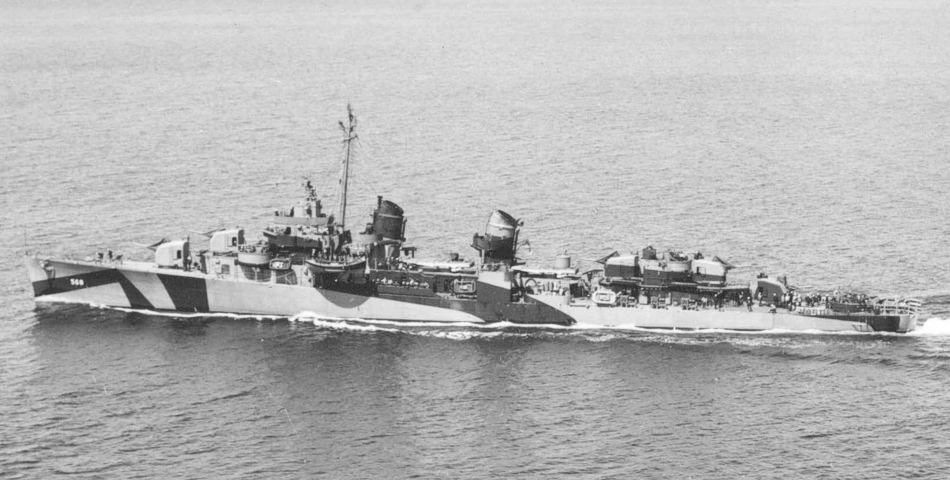
USS Wren (DD-568) was a Fletcher-class destroyer. She was launched on 29 January 1944 and commissioned on 20 May 1944, with Captain Edwin Anderson McDonald in command. He held that post until 31 August 1945.
After commissioning she trained out of San Diego on shakedown. In August 1944 she joined the Northern Pacific Force in the Aleutians, where patrol and escort duty along the island chain took most of her time. With Task Force 92 she also carried out four shore bombardments in the Kurils between November 1944 and April 1945. Matsuwa was shelled on 21 November 1944. Paramushiro was struck on 5 January 1945 and again on 18 February. The last shoot, on 15 March 1945, returned to Matsuwa.
On 19 April she left Kulsk Bay for Hawaii, reached Pearl Harbor on the 25th, and continued on to the western Carolines. She stayed at Ulithi until 17 May, then sailed for the Ryukyus, where the fighting around Okinawa was already about six weeks along. From 21 May to 18 June she patrolled for submarines and stood radar picket against aircraft. Planes attacked her more than once. She came through without major damage and brought down at least four of them. She cleared Okinawa on 18 June, reached Leyte three days afterward, and remained in the Philippines until 1 July, when she joined Task Force 38 for the last carrier air strikes on Japan. Through the closing weeks she stayed at sea with that force, covering the carriers while their aircraft hit the home islands.
On 26 August she entered Tokyo Bay with other ships of the Third Fleet as the occupation of Japan began, and she was present for the formal surrender on 2 September. Captain Clayton Ross had assumed command on 31 August. Wren sailed from Japan that day, called at Iwo Jima and Eniwetok during the following month, and was back in Tokyo on 13 October for a stay of a little more than a month. She left Japan on 18 November, reached Oahu on the 28th, headed east on 1 December, and came into San Diego on the 7th. After two days she continued by way of Panama to the Philadelphia Naval Shipyard, arriving on 23 December. An overhaul to ready her for layup was followed by a shift to Charleston, South Carolina, late in March 1946. On 13 July 1946 she was decommissioned there. Wartime service brought her three battle stars.
On 7 September 1951, a little more than five years later, she was commissioned again at Charleston. For about two years she worked the Atlantic coast and the West Indies. Late in 1951 she ran standardization and vibration trials for the Bureau of Ships at the David Taylor Model Basin in Carderock, Maryland, then returned to Charleston in December. Through 1952 and the opening eight months of 1953 she trained and operated in the western Atlantic. In August 1953 she was assigned to Destroyer Division 61 for Far East duty. She sailed from Norfolk, Virginia, on 28 August, crossed Panama on 2 September, called at San Diego, Pearl Harbor, and Midway, and arrived at Yokosuka on 3 October.
About a week later she put to sea and joined Task Force 77, then flying from the Sea of Japan. Those fast carriers also operated in the Yellow Sea. From 10 October through 26 November Wren screened them and served as plane guard. She next did similar duty with the Australian carrier HMAS Sydney, and by mid-December she was at Sasebo for the Christmas holidays. On 3 January 1954 she was back with Task Force 77 until the 17th, then shifted to Task Force 95. Along the Korean coast she carried out cease-fire surveillance until 1 February, returned to Sasebo to prepare for the passage home, and left Japan on 11 February. A westward track through the Indian Ocean and the Atlantic brought her around the globe to Norfolk on 9 April.
Norfolk was her base for the rest of her active years, with overseas deployments from time to time. Second Fleet work included summer cruises for midshipmen, some to harbors in northern Europe and others to ports in the West Indies and on American coasts. She also served several times with the Sixth Fleet in the Mediterranean. Each spring the Springboard exercises sent her to Puerto Rico, Cuba, and Panama. During the 1957 Mediterranean deployment she operated with the Mid East Force in the Indian Ocean and joined units of the Pakistani Navy in Operation Crescent. On a call at Naval Station Key West, Florida, she appeared in the 1959 film Operation Petticoat.
She was later transferred to the Naval Reserve Force. A reserve unit in Houston used her, and in the early 1960s she was based at Galveston, Texas, supporting reserve activity with weekend antisubmarine trips in the Gulf of Mexico. In December 1963, after nearly a decade with the Atlantic Fleet, she was decommissioned and placed in reserve. Eleven years followed in the Reserve Fleet at the inactive-ship berths of Naval Station Philadelphia. Her name left the Navy list in December 1974. On 22 October 1975 the North American Smelting Company of Wilmington, Delaware, bought her for scrap. She had survived the war. In 1962 the film No Man Is an Island cast her as the destroyer that first reaches George Ray Tweed, and the 1983 Magnum, P.I. episode Operation Silent Night reused earlier footage of her after the hull had already been broken up.