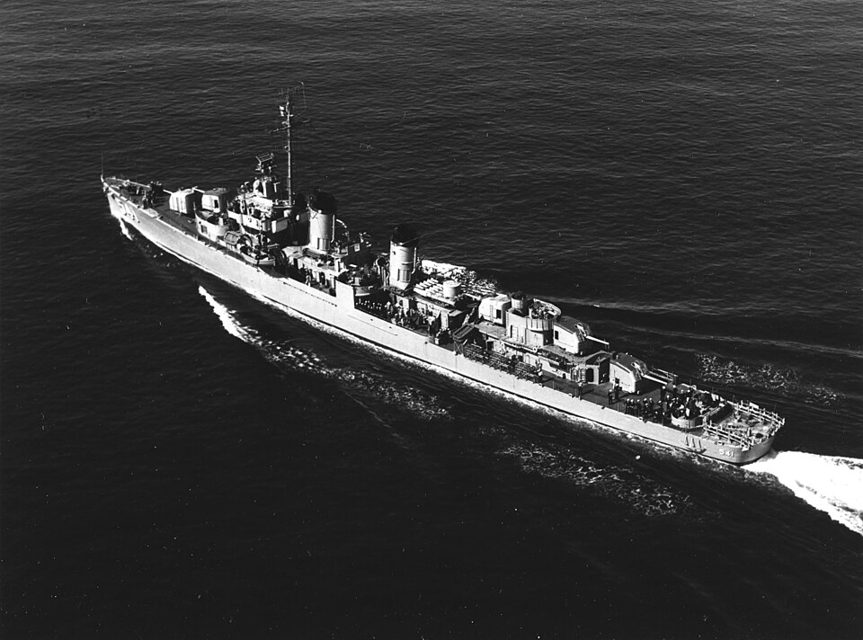
USS Yarnall (DD-541) was a Fletcher-class destroyer, the second United States Navy ship named for Lieutenant John Yarnall, who lived from 1786 to 1815. Bethlehem Steel at San Francisco laid her keel on 5 December 1942. She went down the ways on 25 July 1943, with Mrs. Earl Groves as sponsor, and entered commission on 30 December 1943. Benjamin Francis Tompkins held command from that day until 8 August 1944. January and February 1944 went into working up off San Diego. Early in March she left the West Coast, reached Oahu on the 19th, and spent the next ten weeks on tactical drill in Hawaiian waters.
On 31 May she cleared Pearl Harbor in Task Group 52.17, paused at Kwajalein in the Marshalls, and continued toward the Saipan landings in the Marianas. Her station for that assault was Rear Admiral Jesse B. Oldendorf's Fire Support Group 1. When the preparatory shelling opened on 14 June, Yarnall covered the light cruisers Cleveland and Montpelier and placed 148 five-inch rounds on the island. On the 15th, with the landing under way, she remained alongside Cleveland. The day after that she answered her first call for fire, a shoot that helped throw back a counterattack and demolished a pillbox. On 17 June, submarine reports of the Japanese fleet moving toward the Marianas took Yarnall and twenty other destroyers off the beach and sent them to guard the fast carriers. She joined Task Group 58.7, the battle line Rear Admiral Willis A. Lee had assembled on short notice, for the Battle of the Philippine Sea.
Aircraft first came at her at 5:15 on 19 June. A Mitsubishi A6M Zeke, having tried to bomb the destroyer Stockham, banked in and strafed Yarnall. Three guns of the main battery answered. The fighter blew up and fell into the water as it drew onto her port quarter, and that splash was her first victory. About five hours later she learned of the opening strike in a series of four heavy raids the Japanese Mobile Fleet had sent to hit the ships off Saipan. Near 10:45, five Aichi D3A Val dive bombers swung out against Yarnall and Stockham, the two ships on picket. Her guns brought one down, and the other four pressed on toward the larger vessels. Warning of a second raid arrived at 11:10. Thirty-five minutes after that, some twenty hostile planes got through the Hellcats sent to intercept. Yarnall engaged seven of them and destroyed one, closing her combat for the day. Two further raids still reached Task Force 58, on courses well clear of the destroyer.
On 20 June the Japanese fleet turned back toward home. Search aircraft found it late in the day, and the carriers launched a strike at the far edge of their range. After full dark, Yarnall switched on searchlights so the pilots could find their decks. She was off Saipan again the next morning, firing for the troops inland, and she stayed on Marianas duty until 8 July. She then sailed in the escort of a convoy for the Marshalls and entered Eniwetok on the 12th. Ammunition, food, and fuel came aboard, and on the 15th she put to sea for patrol and antisubmarine screening. On the 25th she stood in close and shelled in support of the soldiers occupying Tinian. She shifted between screening and bombardment until 16 August, then shaped a course for the Marshalls once more. Eniwetok held her from 20 August through the 29th. James Henry Hogg relieved Tompkins on 8 August. On 29 August she sortied with Task Group 38.2 for carrier attacks over the Philippines ahead of the Leyte invasion. From 1 October through the 6th the force lay at Ulithi.
On 6 October Yarnall went to sea with the full fast carrier force for three days of strikes on airfields Japan held on Formosa. She stood by to recover aircrews and watched for submarines and aircraft. On the opening day she engaged fifteen enemy planes and destroyed two. The following evening a bomb detonated a short distance astern, and she cleared the burst by a slim margin. On the 14th a further bombing left the hull intact. Her formation then moved south to Luzon, where she covered the carriers while their squadrons kept Japanese aviation on shore from breaking up the Leyte landings. The Battle of Leyte Gulf ran in three phases and stopped Japan's bid to wreck that landing. Yarnall held her station in the screen as the carriers steamed north against Admiral Ozawa's decoy, a group of carriers that had come out with bare flight decks. Task Force 38 fueled on 30 and 31 October, went back to striking targets on Luzon, and returned to Ulithi when November's first week ended.
On 14 November she was underway again, screening Task Force 38 through further air attacks on Japanese positions in the Philippines. On 23 November she headed for Ulithi with Task Group 38.1 to replenish. December found her in the islands once more with that group, backing the Mindoro landings and keeping the pressure on Japanese aircraft stationed on Luzon. On 17 December 1944 she rode out the typhoon that sank the destroyers Hull, Monaghan, and Spence. Hogg's tour ended that day, and James Beattie Denny took command. Yarnall reached Ulithi on 24 December and was still there as January opened. She survived the war. On 10 June 1968 the United States loaned her to Taiwan.