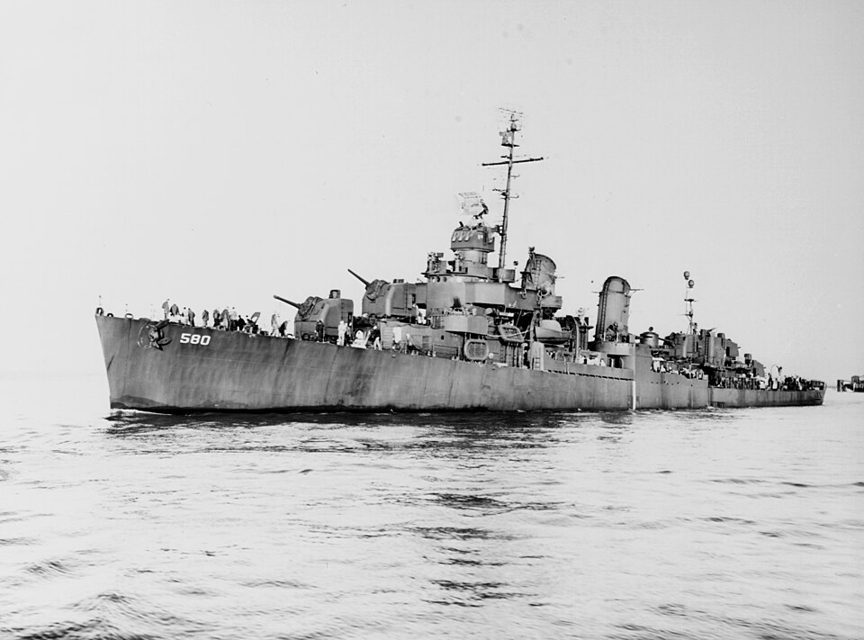
USS Young (DD-580) was a Fletcher-class destroyer. She was launched on 15 October 1942 and commissioned on 31 July 1943, with Captain George Bernard Madden in command.
Shakedown took her through Caribbean waters and the Gulf of Mexico. She then worked for a short spell out of Guantanamo Bay, Cuba, and while there joined the escort of the battleship Iowa. Iowa was carrying President Franklin D. Roosevelt on the Atlantic portion of his trip to the Teheran Conference in November 1943. Partway across, Young received orders for the Pacific. She went through the Panama Canal on 24 November and reported to the Pacific Fleet. Pearl Harbor saw her in the opening days of December. She was assigned to the small Ninth Fleet, operating in the northernmost Pacific, waited several weeks more at Pearl Harbor, and then sailed for the Aleutians, arriving in mid-January 1944.
The fighting in the Aleutians had ended about three months before she got there. Over the next eight months her work was escort duty, patrol, and occasional bombardment of Japanese positions in the Kuril Islands. On 2 February 1944 she took part in Rear Admiral Wilder D. Baker's strike, the first time naval guns hit Japanese home territory in the Kurils. June brought two further shoots, Matsuwa on the 13th and then Paramushiro on the 26th. Aleutian weather remained a hard enemy in that season. On 26 August 1944 Captain Donald Granville Dockum relieved Madden. In September the destroyer returned stateside for overhaul. Repairs complete, she sailed from San Francisco Bay on 6 October toward the western Pacific and reached Manus, in the Admiralty Islands, late in the month. The explosion of Mount Hood (AE-11) in November 1944 damaged her.
She was then ordered to escort a supply convoy bound for the newly taken Philippines and reached Leyte on 18 November during an air attack on the invasion shipping. The screen, Young included, brought down three of the raiders. On 19 December she left Leyte in company with ten other destroyers as the screen for Mindoro's first resupply echelon. Aircraft attacked early on 21 December. Heavier attacks came only near dusk. At roughly 17:18, five kamikaze planes broke past the combat air patrol, and three of them succeeded, striking LST-460, LST-479, and Juan de Fuca, a Liberty ship. Both landing ships were abandoned. Juan de Fuca stayed in the convoy and arrived at Mindoro on 22 December. On the voyage back, enemy aircraft harassed the ships and inflicted no hits. Between the run toward Mindoro and the trip home, Young claimed five aircraft downed without help and two more shared with others.
Her first amphibious operation came with the Luzon landings in January 1945. On 9 January, the main landing, she screened landing craft belonging to Attack Group Baker and covered a share of the Lingayen Gulf assault. Opposition on the beach was slight. The Japanese waited and fought inland, once the troops had moved beyond destroyer gun range, and the ships off Lingayen had little firing to do. Later in the month the same thing happened at Zambales. Young was looking over the landing area when a small boat brought out a lieutenant of the Filipino guerrillas. He said his men had already taken the ground. The troops went ashore and no gun was fired.
During work around Subic Bay and Manila Bay, she and Nicholas on 14 February destroyed two Japanese suicide boats, each 17 feet (5.2 meters) long, that had been sent from Corregidor against the force taking Mariveles. Two days later Young joined the capture of Corregidor itself. She shelled the island ahead of the assault. Batteries on Caballo Island then fired at the landing craft, and she helped silence them. That same morning she passed through waters sown with mines and gave gunfire support to the troops seizing the fortress. In the weeks after, she patrolled from Subic Bay. April found her supporting an Army landing on Mindanao, where strong Moro guerrilla pressure had left the operation an easy one. She patrolled in the Philippines until near the end of the third week of May, then was ordered home to the United States for repairs.
The voyage home ran by Eniwetok Atoll and Pearl Harbor. On 12 June she entered San Francisco Bay and spent forty-seven days refitting at Mare Island Navy Yard. Trials after the yard work ended late in July, and early in August she pointed toward Pearl Harbor again. The fighting had stopped before she arrived. She stayed in Hawaiian waters, escorting the carrier Saratoga and acting as plane guard. On 25 September she departed Hawaii alongside units of the Third Fleet, bound for the East Coast and the Navy Day celebration of 1945. She arrived at New York on 27 October, where President Harry Truman reviewed the fleet. Young stayed in New York through 1 November, then headed to Charleston, South Carolina. Captain Carl Elliott Olson assumed command on 15 November 1945. She went into reserve on 31 January 1946 and left commission sometime in January 1947. Reserve lasted until 1 May 1968, the day her name was taken off the Navy list. On 6 March 1970 she was expended off the mid-Atlantic coast as a target. Five battle stars marked her World War II service.