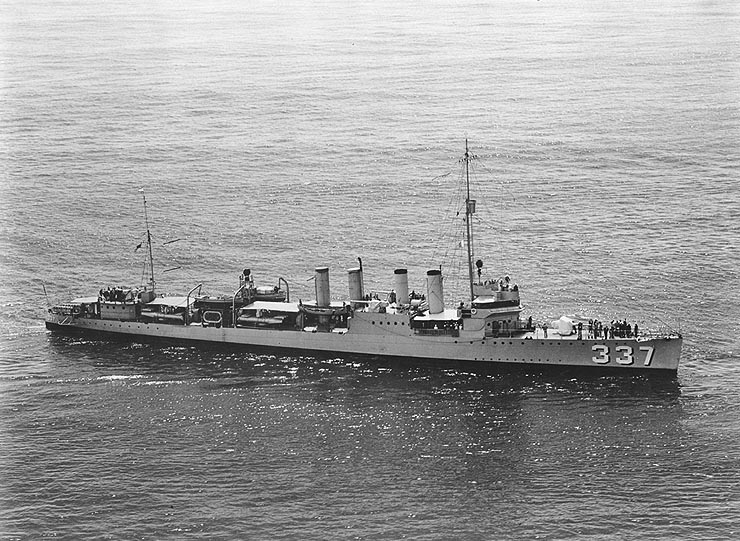
Zane, DMS-14, was named for Randolph Talcott Zane. He was born in Philadelphia on 12 August 1887, commissioned a second lieutenant in the Marine Corps on 6 January 1909, and died on 24 October 1918 of wounds received at Belleau Wood on 26 June. The destroyer was laid down on 15 January 1919 at the Mare Island Navy Yard, launched on 12 August 1919, and sponsored by Miss Marjorie Zane, his daughter. She was reclassified DD-337 on 17 July 1920 and commissioned at Mare Island on 15 February 1921. Lieutenant Commander Philip Seymour, Naval Academy class of 1908, was her first commanding officer and had her until 10 August 1921. She was a Clemson-class destroyer: displacement 1,215 tons normal, length 314 feet 4 inches, beam 30 feet 11 inches, mean draft 9 feet 4 inches, 35 knots, complement 122, four 4-inch guns, one 3-inch gun, and twelve 21-inch torpedo tubes.
She fitted out, fueled at Port Costa, stored at Puget Sound, and on 22 June 1921 joined Destroyer Division 14 at San Francisco. She reached Cavite on 24 August and worked in the Philippines into the spring of 1922. On 6 June, bound up the Whangpoo for Shanghai, she was rammed aft by the Chinese steamer Tse Kiang. The damage was minor. She docked at Yangtsepoo on 15 June. She visited Chefoo and Chinwangtao, sailed for home on 25 August, touched Nagasaki, Midway, and Pearl Harbor, and reached San Francisco on 2 October. She was decommissioned at San Diego on 1 February 1923. She was recommissioned on 25 February 1930, Lieutenant Commander Charles Jefferson Parrish in command. She served in the Battle Force for a decade, with one stretch in Rotating Reserve Squadron 20 in late 1934, and took part in fleet problems between the West Coast, the Caribbean, and the Canal Zone. Converted at the Pearl Harbor Navy Yard, she was reclassified a high-speed minesweeper, DMS-14, on 19 November 1940 and operated in Hawaiian waters.
On the morning of 7 December 1941 she was moored off Pearl City with Trever, Wasmuth, and Perry. The crew was finishing breakfast when, at 0757, a signalman saw a plane drop a bomb on the south end of Ford Island after a long glide from the north. With 10 percent of her enlisted men and 25 percent of her officers ashore, she went to general quarters and within three minutes manned the .50-caliber battery. Her commanding officer, Lieutenant Commander Louis Marcel LeHardy, Naval Academy class of 1926, was senior officer afloat in the division. He had had her since 21 July 1940. His report timed the moment the attack was certain: "0800 Observed Japanese plane gliding low over Ford Island, enemy character now positive. This was not a drill." She fired at planes that came near the nest. At 0830 she saw a strange submarine 200 yards astern of Medusa. Perry, moored outboard, fouled the aim of the after 4-inch. At 0840 Monaghan rammed that midget submarine and depth-charged it. Zane took no enemy damage. Friendly antiaircraft fire cut rigging and antennae. At 1410 she and Wasmuth rigged a twin sweep with 400 fathoms of wire, entered the entrance channel at 1547, and swept until the wire parted near the gate vessel. She then resumed antisubmarine patrol. She operated locally out of Pearl Harbor into the spring of 1942.
She left Hawaii on 5 April 1942 with an 8-knot convoy, No. 4079, for San Pedro, was altered at Mare Island, and was back at Pearl Harbor in early June. Lieutenant Commander Peyton Louis Wirtz, Naval Academy class of 1931, relieved LeHardy on 1 May 1942. He was in command on 7 August.
For Operation Watchtower the plan was that Zane, Hopkins, Southard, Hovey, and Trever would sweep from the 100-fathom curve toward Port Purvis in the Gavutu area, then split toward beach Red, clearing a stretch 1,000 yards wide through Lengo Channel toward Indispensable Strait. Commander William H. Hartt, Jr., commanded the Minesweeper Group, Task Group 62.5. The combat narrative and Morison's task organization name Lieutenant Commander Peyton L. Wirtz as Zane's commanding officer. Shore batteries fired. The fire was erratic and did no damage. By 1550 on 7 August the area had been thoroughly swept. No mines were found. She worked off Tulagi and Guadalcanal afterward, with upkeep at Noumea. On 8 September, during a sweep, she watched high-flying Japanese planes heading for Guadalcanal.
In the autumn she and Trever loaded drums of aviation gasoline, torpedoes, ammunition, and stores at Espiritu Santo, each towed two motor torpedo boats, and reached Tulagi at 0530 on 25 October 1942. Trever finished unloading by 0700. At 0809 the air-raid alarm sounded from ashore. Trever cast off and stood into the harbor. Zane got underway about the same time and lay to about 700 yards ahead of her, in the shelter of Tulagi, Kokotambu, and Songoangona. At 0955 the signal station reported three enemy ships between Savo and Florida, entering the bay called Iron Bottom Bay. Trever's commanding officer, Commander Dwight M. Agnew, the task group commander, rejected a recommendation to go up the Maliala River. In his words, he would not be trapped like rats. The two ships cleared the channel at 1014. Lookouts made the stacks and mastheads at 21,000 yards, bearing 250 degrees, on a slightly converging course. Within five minutes the three ships altered course to close. They were the destroyers Akatsuki, Ikazuchi, and Shiratsuyu, sent to give gunfire support to the Japanese troops who hoped to take Henderson Field that day. Each carried six 5-inch guns. At 1020 they closed again. Zane and Trever skirted the shoals toward Sealark Channel. At about 9,200 yards the Japanese opened with bombardment ammunition. Shells landed close. One hit Zane's number one 3-inch mount and killed three men instantly. Other shells cut rigging, antennae, and every halyard except the one to the gaff, which still flew the ensign. At 1040 the Japanese turned away and sank the tug Seminole and YP-284 off Lunga Point, then retired under attack from Henderson Field. Zane and Trever retired east. At 1055 they changed course to pass south and west of San Cristobal.
She stayed in the Southwest Pacific through the end of 1942. In mid-November she and Trever towed PT boats of Motor Torpedo Boat Squadron 2 from Noumea to Espiritu Santo. She later escorted a convoy from the New Hebrides to Tulagi and Guadalcanal. In January 1943 she went to Sydney for repairs. On 22 January the submarine I-21, commanded by Commander Matsumura Kanji, torpedoed the steamship Peter H. Burnett. The next day Zane was ordered to the steamer's last reported position. At 1255 on 25 January a Royal Australian Air Force Catalina led her to lifeboat number three. The crew and passengers had abandoned the ship, which was still afloat. She took aboard 14 men at 1330, twelve of the crew, including the master, Charles Darling, and two Army passengers, shaped course for the derelict, and reached her at 1735. She put 13 of them back aboard by motor whaleboat, kept one man under medical care, and with HMAS Mildura towed the steamer into Sydney on the 27th. She was back at Guadalcanal in late February, after the Japanese evacuation of 7 and 8 February.
Wirtz remained in command until 7 September 1943. The Russell Islands operation Cleanslate, on 21 February, was his. As part of Task Unit 61.1.3 she towed four landing craft, two LCVPs, one LCV, and an LCM, and put troops ashore. The landing met no opposition. The Japanese had already left. Operation Toenails, the occupation of New Georgia, came next. With Talbot she made up Task Unit 31.1.1, the Onaiavisi Occupation Unit. Each took a company of the 169th Infantry and an LCVP in the Russells on 29 June and headed for the two small islands that guarded the approach to Zanana Beach, the jump-off for the flanking attack on the airfield at Munda. Low cloud, rain, gusty wind, and a chop slowed the approach. They reached the Onaiavisi entrance at about 0225 on 30 June. Shortly before 0300, while the troops were going ashore, Zane grounded in a heavy rain squall. Both companies still got ashore without loss, on Dume, now Sasavele, and on Baraulu, to hold the entrance until the shore-to-shore move to Zanana. She remained aground forward until 0523, when she backed free, then grounded aft almost at once and damaged her propellers. Talbot could not pull her off. She lay five miles from Munda. No Japanese battery fired on her. The tug Rail, called at 0942, pulled her off at 1419 and brought her to Tulagi on 2 July. After temporary repairs she went by Espiritu Santo and Pearl Harbor to Mare Island for permanent work, sailed west again on 23 September, and reached Pearl Harbor on 30 September. She stayed in Hawaiian waters through mid-January 1944.
Lieutenant Commander William Talmadge Powell, Jr., class of 1935, had her from 7 to 17 September 1943 and again from 11 November 1943 to 1 October 1944. Between those tours Lieutenant Burrough Bertram Anderson, D-V(G), USNR, had her from 17 September to 11 November 1943. On 22 January 1944 she left Pearl Harbor for Flintlock, the Marshalls. In the Southern Attack Force she screened transports at Kwajalein in Task Unit 52.7.1, with Perry, four destroyers, and two submarine chasers. At Eniwetok she served as sweep ship and mine-disposal vessel. Mines exploded within 100 yards and did minor damage. After Pearl Harbor in March she took part in Forager, her last major operation. In Task Group 12.13, the minesweeping and hydrographic group, she worked with Chandler, Palmer, and Howard. From the Saipan landing on 15 June she laid dan buoys and destroyed drifting mines. Planes attacked the beachheads beyond the range of her guns. At Guam, from the landing on 22 July, she escorted a reserve transport group, Task Group 53.19, ahead of the ships. She remained in the Marianas until 8 August and then reported to Service Squadron 10 at Ulithi as a target-towing ship.
Lieutenant Commander Robert Hampson Thomas, D-V(G), USNR, had her from 1 October 1944 to 20 June 1945. The target-towing and local escort, in the Palaus, Marianas, Carolines, and Philippines, ran through his tour and into the next. Lieutenant Lee Charles McFarland, D-V(S), USNR, had her from 20 June to 30 November 1945 and was in command on 2 September. She had been reclassified AG-109 on 5 June 1945. V-J Day found her at anchor in San Pedro Bay, off Leyte. She left Leyte on 13 October 1945, touched Eniwetok, Pearl Harbor, and San Diego, transited the Panama Canal on 25 November, and reached Norfolk on 29 November. She was decommissioned there on 14 December 1945, struck on 8 January 1946, delivered to Luria Brothers and Company on 22 October 1946, and the hulk was scrapped on 3 March 1947. She received six battle stars, from Pearl Harbor to the Marianas, and the Navy Unit Commendation for Guadalcanal in 1942 and 1943.
A note on sources. The career is Robert J. Cressman's Dictionary of American Naval Fighting Ships entry for Zane, updated 21 March 2024. Commanding officers are NavSource's page for DD-337. The 7 August group, and Wirtz's name in it, are the combat narrative, chapter 5, and Morison, volume IV, pages 270 to 274. The 7 December quotation is the one the Dictionary gives from LeHardy's report. The Trever entry phrases Agnew's refusal of the Maliala River as not wishing to be caught like rats in a trap. The Zane entry calls "trapped like rats" his words. The Whangpoo, Yangtsepoo, and Iron Bottom Bay are the names used in the entry. The absence of Japanese fire while she was aground off Munda is given there from Admiral George C. Dyer's account.