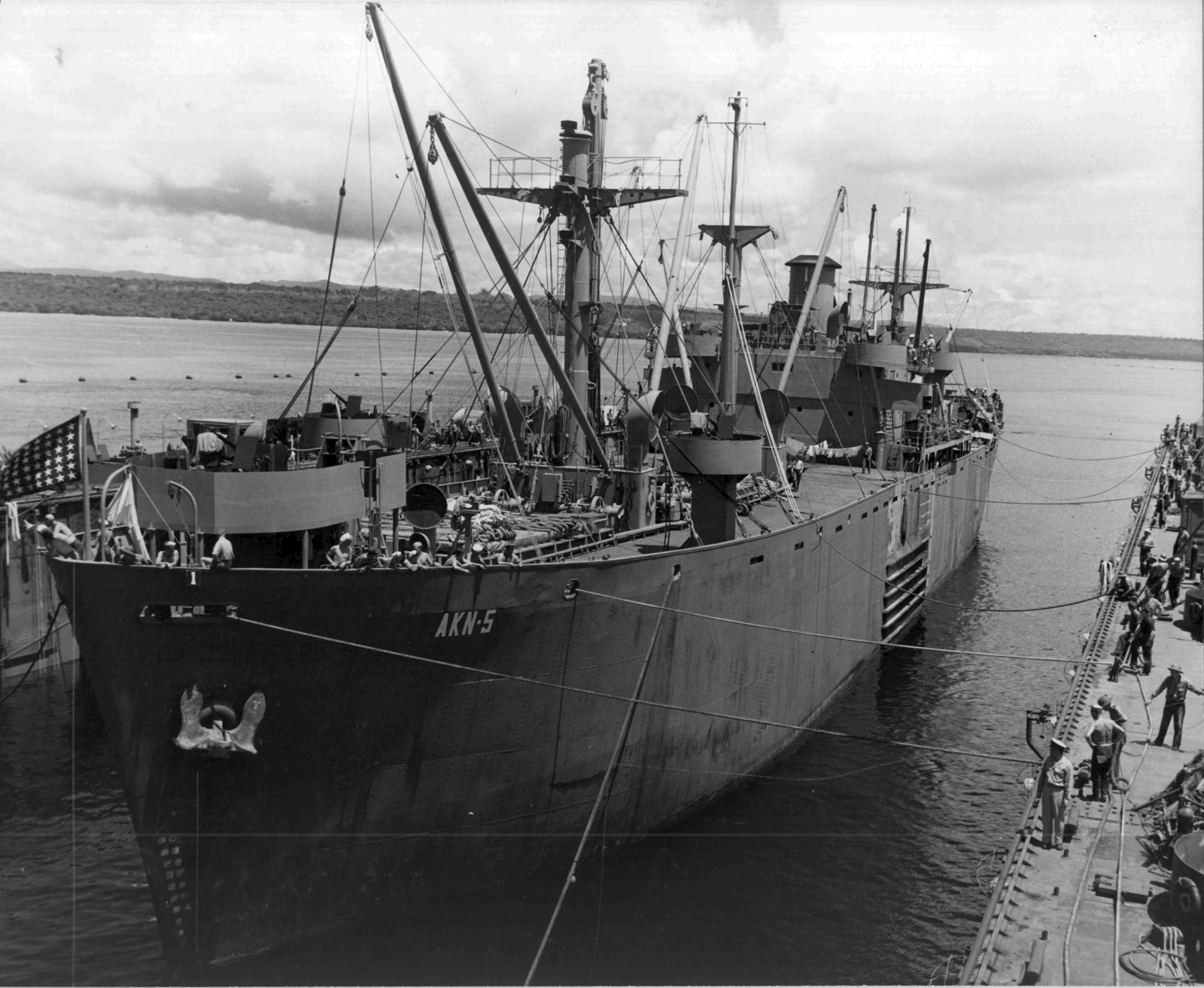
Zebra was a net cargo ship, and before that she was an ordinary Liberty. Permanente Metals, at Richmond Yard No. 1, laid the Maritime Commission hull 535 down on 18 March 1943 as Matthew Lyon, an EC2-S-C1. Mrs. Harry H. Feldhahn sponsored the launch on 11 April 1943. The War Shipping Administration took her on 26 April, and Dichmann, Wright and Pugh operated her. The Navy name is the striped animal. She was 441 feet 6 inches long, with a beam of 56 feet 11 inches and a draft of 28 feet 4 inches, and she made 12.5 knots. The Dictionary's full-load figure is 14,350 tons. NavSource prints 14,550, and a light displacement of 4,023. The complement was 228.
On 12 August 1943, bound for Espiritu Santo in the New Hebrides, she took a torpedo from the submarine I-11. NavSource puts the hit in No. 3 hold and a hole about 35 feet long in the port side, and says one man was hurt. She made port under her own power. Robert J. Cressman's chronology counts the people aboard as 41 merchant sailors and an Armed Guard of 18. She lay in Segond Channel for weeks, and the expectation was scrap.
Late in September a naval officer saw a net carrier in her. On 1 October 1943 the Navy took her from the War Shipping Administration on a bareboat charter and placed her in service as Zebra (IX-107). She was the only Navy ship of that name. The net work went well enough that the hull was rebuilt for it. NavSource and the cruise narrative redesignate her AKN-5 on 15 February 1944. She was commissioned on 27 February 1944, still in the drydock at Espiritu Santo, with Commander Robert Donald Abernethy of the Naval Reserve in command. A Dictionary summary line dates the AKN-5 number on that commissioning day. She was one of the Liberty hulls finished as net cargo ships, in the company of Indus and the others.
The first three months of the commission were spent at Espiritu Santo, finishing the partial conversion. On 1 June she began loading salvaged net, and on 8 June she sailed for New Caledonia. She was in Noumea on 11 June, unloaded, and took a general cargo for Fiji. She left on 19 June, reached Suva three days later, and then shifted to the other side of the island for the gear coming out of the Nandi nets. That load was finished on 5 July. She was back in Noumea on 8 July. After ten days she started a round of the old harbor defenses: Tongatapu, Bora Bora, Tutuila and Upolu in Samoa, and Funafuti. At each stop she landed some of the Noumea cargo and lifted the salvaged nets. She left Funafuti on 23 August and was in Noumea again on the 28th.
On 15 September she sailed closer to the fighting, and this voyage included her first net that she laid herself. Eniwetok held her from 24 September to 3 October. She entered Ulithi on 8 October and, with Sagittarius (AKN-2) and Tuscana (AKN-3), put a net around the anchorage. They were done on 10 November. She carried the unused gear on to the Palaus and entered Barnum Bay, near Peleliu, on 12 November, while the fighting on the island was still going. She assembled a net for a wharf that was about to be built, finished that on 14 November, and went north with two net tenders to Kossol Roads. Eleven days there produced more than two miles of net and the gear that held it. She left the Palaus on 25 November, touched Eniwetok on 4 December, and reached Pearl Harbor on 15 December. Twenty days of repairs followed, and then another load of net.
She stayed at Pearl Harbor through January 1945, waiting for orders, and sailed for Iwo Jima on 5 February. Eniwetok was a stop from 16 to 21 February. Two days out, the convoy was turned toward Saipan. Zebra, two net tenders, and a destroyer were told to keep on for Iwo because Keokuk (AKN-4) had been damaged. They arrived on 28 February. For forty-two days she laid net in bad weather and heavy seas, with the garrison still shooting, and she was the flagship for the minecraft there. She also oversaw the ship moorings and did salvage. That salvage included pulling Zuni (ATF-95) and LST-727 off the beach. She left Iwo on 11 April. The battle star NavSource and the Dictionary print runs only from 28 February to 16 March, a shorter window than the forty-two days and the April departure. One battle star.
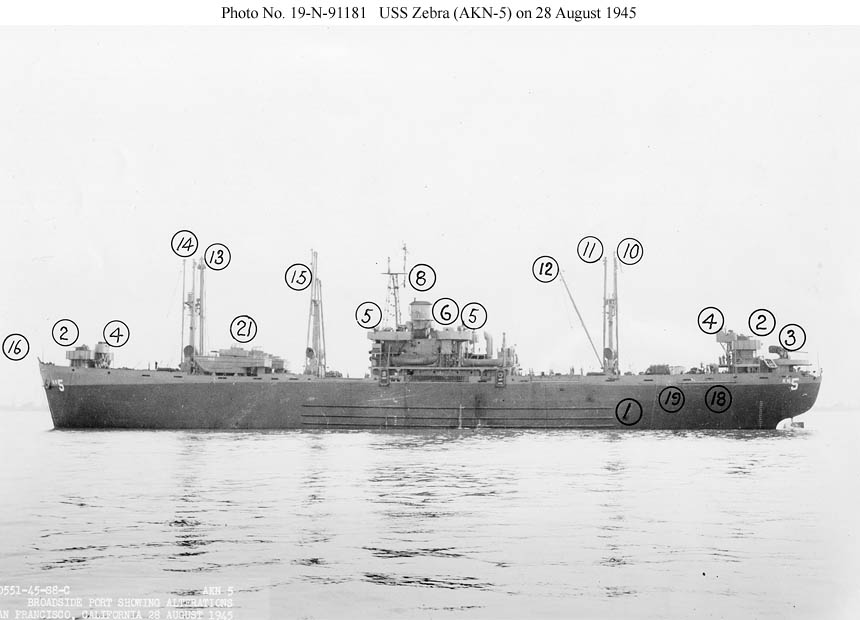
Eniwetok again on 18 April, Pearl Harbor on 28 April for four days, and San Francisco on 11 May, to finish the conversion. She went into the Moore Dry Dock yard at Oakland on 14 May. The work was not done when, on 25 July, she slipped across to Tiburon for net-laying trials. Those lasted until 3 August. She went back to Moore to finish, and on 26 August she made the full-power trial. The San Francisco photographs of 28 August show the battery fitted in that overhaul: one 5-inch/38 and four twin 40 mm mounts. The Dictionary prints one 5-inch and four 40 mm, and does not call them twins or date them. On 12 July, during the yard period, Lieutenant Commander William Gabriel Holly of the Naval Reserve relieved Abernethy.
She left San Francisco Bay on 31 August and was in Pearl Harbor on 8 September. Twelve days later, on 20 September, she headed west again to pick up salvaged net, with a small cargo of mine gear for the Marshalls command. Kwajalein on 30 September, then Iwo Jima a second time on 9 October. She loaded net and left on 29 October, reached Saipan on 1 November, put the gear on the stockpile there, and loaded passengers and equipment for home. NavSource's occupation-service dates, 7 to 30 October 1945, cover that second call at Iwo. She left Saipan on 15 November, stopped at Guam the next day, landed some sweep gear, and sailed on 29 November. Pearl Harbor on 11 December, out again on the 13th, the Canal Zone on 31 December, and Norfolk on 8 January 1946, reporting to the Fifth Naval District.
Holly decommissioned her at Norfolk on 21 January 1946. The same day she went back to the War Shipping Administration and the name Matthew Lyon. She was struck on 7 February 1946 and laid up at Lee Hall, in the James River reserve fleet. On 28 March 1972 Union Minerals and Alloys bought her for scrap. She was not sunk in the war.
A note on sources. The cruise, the torpedo, the bareboat charter, the South Pacific net circuit, Ulithi and the Palaus, the forty-two days at Iwo Jima, the pull of Zuni and LST-727 off the beach, the Oakland and Tiburon yard period, the second trip west, and the Norfolk decommissioning follow the Dictionary of American Naval Fighting Ships entry for Zebra. The 15 February 1944 redesignation, the two commands, and the occupation dates 7 to 30 October 1945 are NavSource. The Dictionary summary that dates AKN-5 on 27 February is the line carried in the public condensation of that entry. The 35-foot hole is NavSource. The count of 41 merchant sailors and 18 Armed Guard is Cressman's chronology. The full-load tons differ as stated. The August 1945 gun fit is the caption on Navy photographs 19-N-91181 through 19-N-91183. The scrap sale on 28 March 1972 is the Maritime Administration vessel history, which the Dictionary also records. NavSource prints the commanding officer as Holly William Gabriel. That is read here as William Gabriel Holly, the same last-name-first order as the Abernethy line above it.