Zuni was a fleet tug, named for the Zuni people of the Zuni River country in western New Mexico, near the Arizona line. She was a Navajo-class ship. Commercial Iron Works at Portland, Oregon, laid her down on 8 March 1943, launched her on 31 July 1943, and Mrs. J. J. O'Donnell sponsored her. The Navy commissioned her on 9 October 1943 as AT-95, with Lieutenant Ray E. Chance in command. The Dictionary of American Naval Fighting Ships gives her trial figures as 1,589 tons, 205 feet long, a beam of 38 feet 6 inches, a full-load draft of 15 feet 4 inches, 16.5 knots, a complement of 85, one 3-inch gun, and four 20 mm guns. On 15 May 1944 she was redesignated a fleet ocean tug, ATF-95.
Shakedown ended late in October 1943. On the 28th she reported to the Western Sea Frontier, and the next day she left Puget Sound for Kodiak. On 10 November she stood out of Kodiak with two barges. The weather was bad enough that both towlines parted. She kept contact with the second barge after it broke away, and then she was ordered to let it go and make for Seattle. On 1 December she was assigned to Service Squadron 2 and left Seattle the same day with one barge for Oakland. After repairs there she sailed west on 27 December with four cargo ships and reached Espiritu Santo at the end of January 1944.
Early in February she left the New Hebrides for Hawaii and entered Pearl Harbor on 17 February. For about a month the work was local. On 21 March she made a round trip to Canton Island and was back at Oahu on 9 April with two barges. On 20 April, her crew already calling her the Mighty Z, she left Pearl Harbor towing three barges for Majuro and returned to Hawaii on 11 May. A week after the redesignation she started the long Central Pacific tour, towing the floating dry dock ARD-16 into Kwajalein lagoon on 2 June. Service Squadron 12 kept her as a harbor tug until mid-July. She then took ARD-16 on to the Marianas, had a short part in the assault on Tinian on 24 July, and settled into trips between Eniwetok and the islands. Late in September she towed ARD-17 to the Palaus. For the first eighteen days of October she supported the force invading Peleliu.
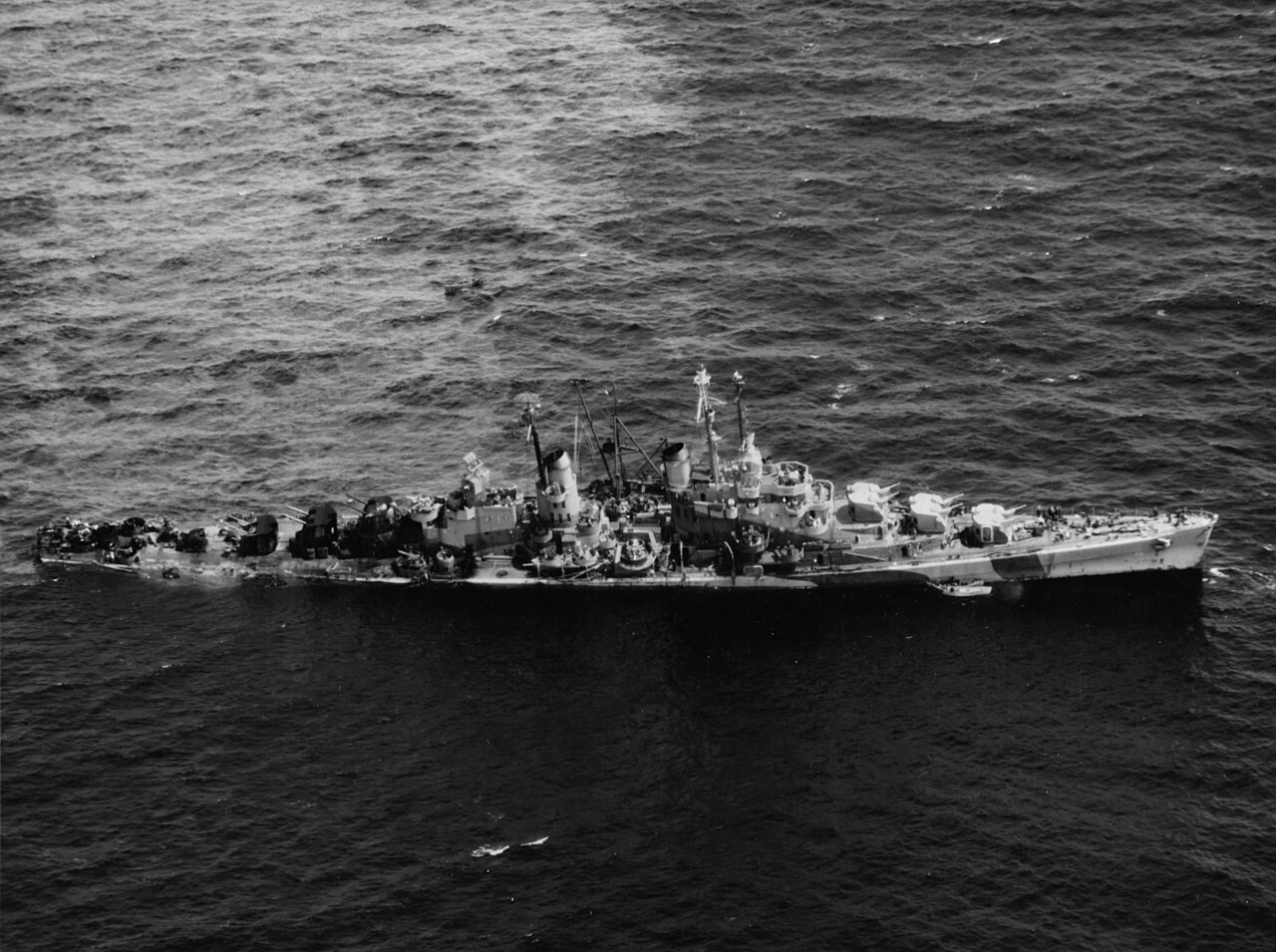
The next order was a wreck. Houston (CL-81) had taken two torpedoes in the air attacks that answered the fast carriers' raids on Okinawa and Formosa. Zuni relieved Pawnee (ATF-74) of the cruiser and towed her into Ulithi lagoon on 27 October. Admiral William F. Halsey commended Chance for that tow. She stayed five days, went to sea with a group of oilers, and was called again. Reno (CL-96) had been torpedoed off San Bernardino Strait on the night of 3 November by the submarine I-41. The cruiser nearly capsized. The two crews kept her afloat, and Zuni towed her 1,500 miles back to Ulithi.
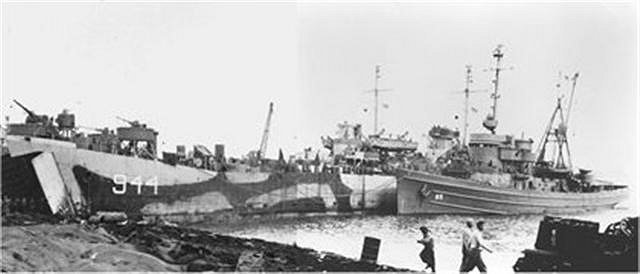
She remained at Ulithi for the rest of November and most of December. In December she brought in the disabled merchantman John B. Floyd and made one cruise by herself east of the Philippines. On 29 December she sailed with Task Group 30.8, the replenishment group for Task Force 38, and stayed off Luzon for nearly a month. She was back at Ulithi on 28 January 1945 with engine repairs to make. In February she went to sea again and reached Iwo Jima three days after the assault of 19 February. For thirty-one days she worked the anchorage. She pulled a transport off a sand bar. LST-944 had lost one engine, and Zuni gave her power for the run to the beach, then stayed alongside so the landing ship could hold herself in the surf while the Army's 506th 90 mm antiaircraft battalion, attached to the 3rd Marine Division, went ashore. The Navy history calls that use of a tug to help drive a landing ship onto a beach a first. The ordinary jobs were broached boats and submerged fuel hose.
The shallows were as hard on her as on the ships she was saving. On 23 March 1945, while she was trying to pull LST-727 clear, a broken towline fouled her anchor and her propeller and she grounded on Yellow Beach. Two of her men were killed. Her keel was broken and her sides were holed. Zebra and ATR-52 pulled her off. Temporary repairs were made, and she was towed to Saipan, then on to Pearl Harbor, which she reached at the end of May. The yard kept her more than fourteen weeks. The war ended while she was there. Chance had been relieved on 1 April, still in that aftermath, by Lieutenant John Savage Malayter of the Naval Reserve. Malayter turned her over on 2 July to Lieutenant Ross Russell Williams, also of the Reserve. In September, Lieutenant (junior grade) Ulysse S. Grant Early, Jr., took her, and in April 1946 Lieutenant James John Jeske had her through the decommissioning.
She went back to duty on 15 September 1945 and stayed with the Pacific Fleet into the start of 1946, then moved to the Atlantic and the Eighth Naval District. On 29 June 1946 she was decommissioned and transferred to the Coast Guard. Her name was struck on 19 July. The Coast Guard commissioned her as Tamaroa, WAT-166, redesignated her WATF-166 in 1956 and WMEC-166 in 1966, and decommissioned her on 1 February 1994. On 10 May 2017 the hull was sunk as a reef off the Delaware-New Jersey coast. She had earned four battle stars. She was not sunk in the war.
A note on sources. The war cruise follows the Dictionary of American Naval Fighting Ships entry for Zuni (AT-95), including the trial dimensions, the parted tow off Alaska, the Houston and Reno tows, the thirty-one days at Iwo Jima, and the grounding on 23 March 1945 while she was working on LST-727. NavSource's photograph caption puts that grounding on the job of helping LST-944 beach. The Navy history separates the two: LST-944 was the powered beaching, and LST-727 was the ship she was trying to save when she herself went ashore. The keel date is 8 March 1943 in that history and in Stephen S. Roberts's class list. NavSource prints 8 May 1943. The March date is the one used here. NavSource's armament line adds twin 40 mm mounts. The gun line in the story is the Dictionary's trial line. The five commands and their dates are the NavSource list for ATF-95, credited there to Wolfgang Hechler and Ron Reeves. The Dictionary names only Chance, at the commissioning. The four battle stars and the campaign windows are NavSource's. The Coast Guard names, the 1 February 1994 decommissioning, and the 10 May 2017 reefing are on the same NavSource page.