
Boyajian's star
KIC 8462852 · TIC 185336364 · Tabby's star
- Position
- 20h 06m 15.45s, +44° 27′ 24.8″
- TESS magnitude
- 11.35
- Where
- Cygnus, about 450 pc. Not in the V345 Lac field.
- Signal
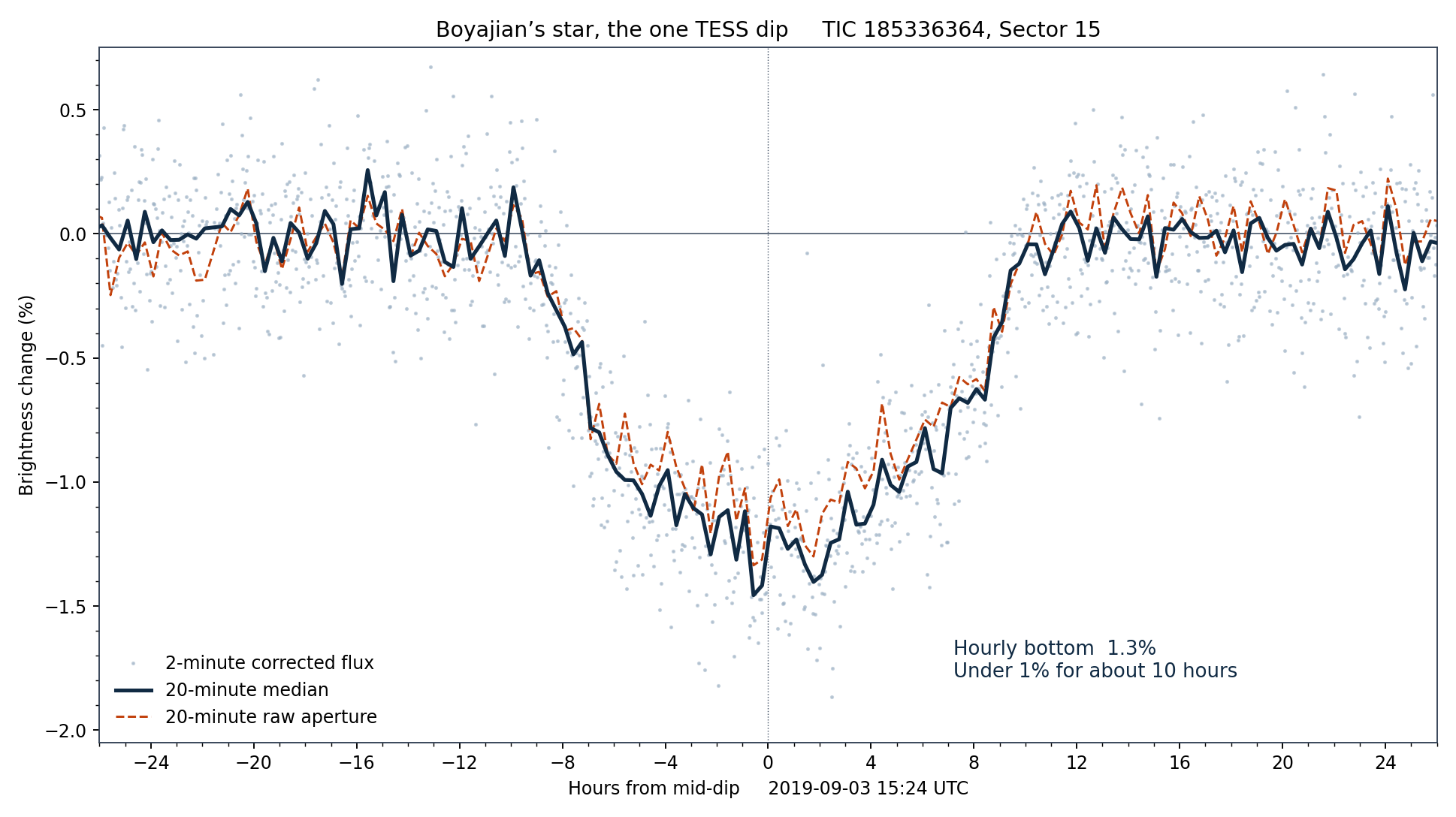
- One TESS dip, not a repeating eclipse. Hourly minimum 1.33 percent on 2019 September 3. About ten hours below 1 percent.
What TESS shows
TESS watched this star in sectors 14, 15, 41, 54, 55, 81, and 82, from 2019 through 2024. Sector 75 puts the star in a CCD gap, and that visit is not used. One dip is in the light curve. It is centered on 2019 September 3 at 15:24 UTC. Against a local continuum the hourly corrected flux is 1.33 percent down at 17:00 UTC, and the hourly means stay below 1 percent for about ten hours. The raw aperture has the same shape. The image centroid drifts by about 0.02 pixel and does not step when the flux drops. The other six usable sectors stay flat. A twelve-hour mean in those sectors stays under a tenth of a percent.
Kepler recorded ten dips from 2009 to 2013. The deep ones are 16 percent on 2011 March 5, 21 percent on 2013 March 1, and 8 percent on 2013 April 18. Ground telescopes recorded more dips in 2017 and 2018, days to weeks long and deeper in the blue. Those dips do not share one period. A scan of the twelve deep events does not cluster them on one phase.
Three times do fall on 776.10 days. The interval from the 16 percent dip to the TESS dip is 3104.40 days. Divided by four, that is 776.10 days. The 8 percent dip, which was not used to set it, falls 0.35 day early. The 21 percent dip misses that ruler by 49 days. The 2011 and 2013 events last days and are asymmetric. They are not repeats of the one-day TESS dip. The 0.88-day signal in the Kepler curve, with the dips cut out, is about 0.009 percent. That is the spot-like signal. It does not make the percent-level dips.
Taken alone, the TESS dip has the length of a transit on a 776-day orbit. With the published mass and radius, 1.43 solar masses and 1.58 solar radii, that orbit is 1.86 AU. An opaque body that removes 1.33 percent of the light would be about 1.8 Jupiter radii if the transit is central. The central transit would last about 26 hours, with a flat bottom of about 21 hours. The measured dip is rounder. The hourly means are below 1 percent for about 10 hours, and the flat portion is about five hours. The length is in the neighborhood. The shape is softer than a sharp planetary limb.
The light curves
Finder chart
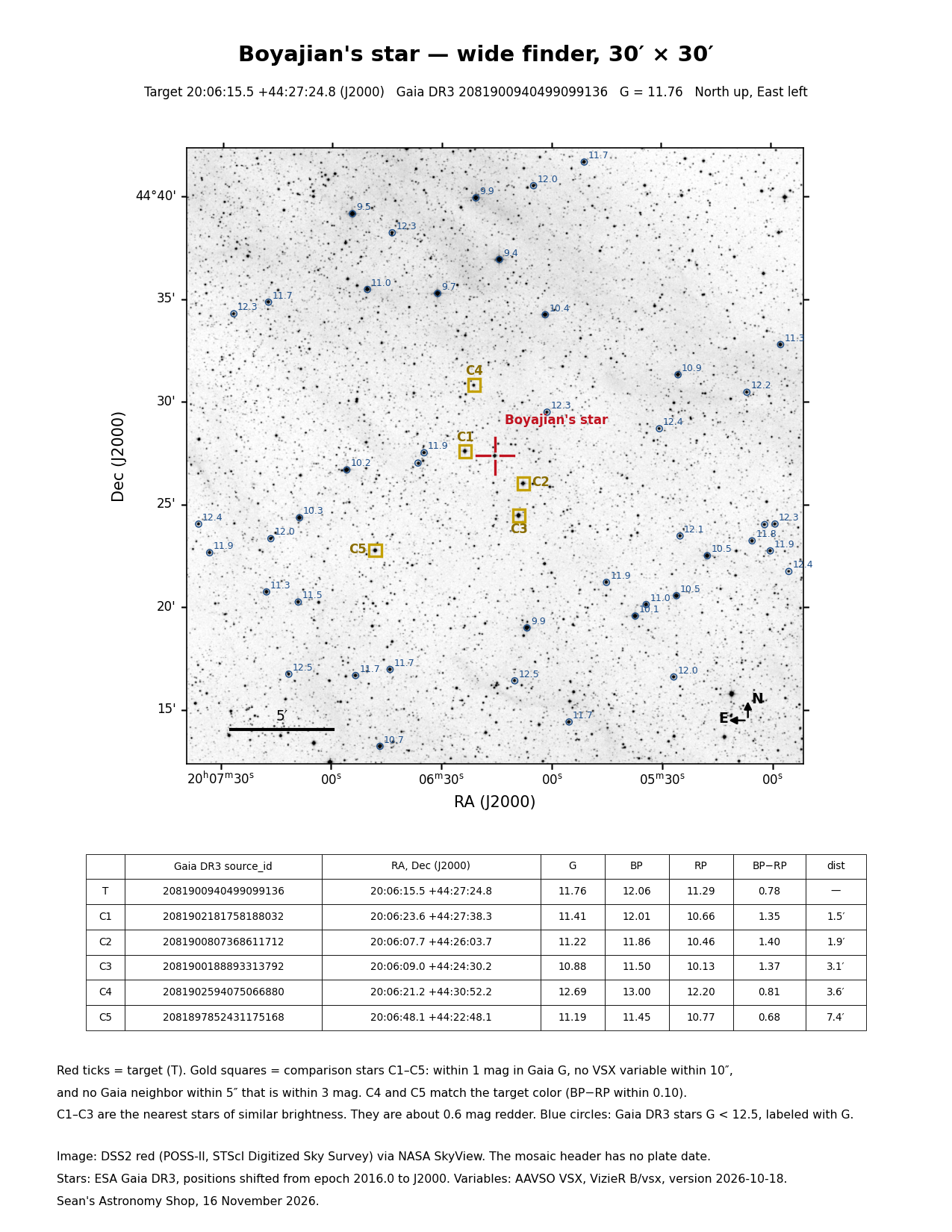
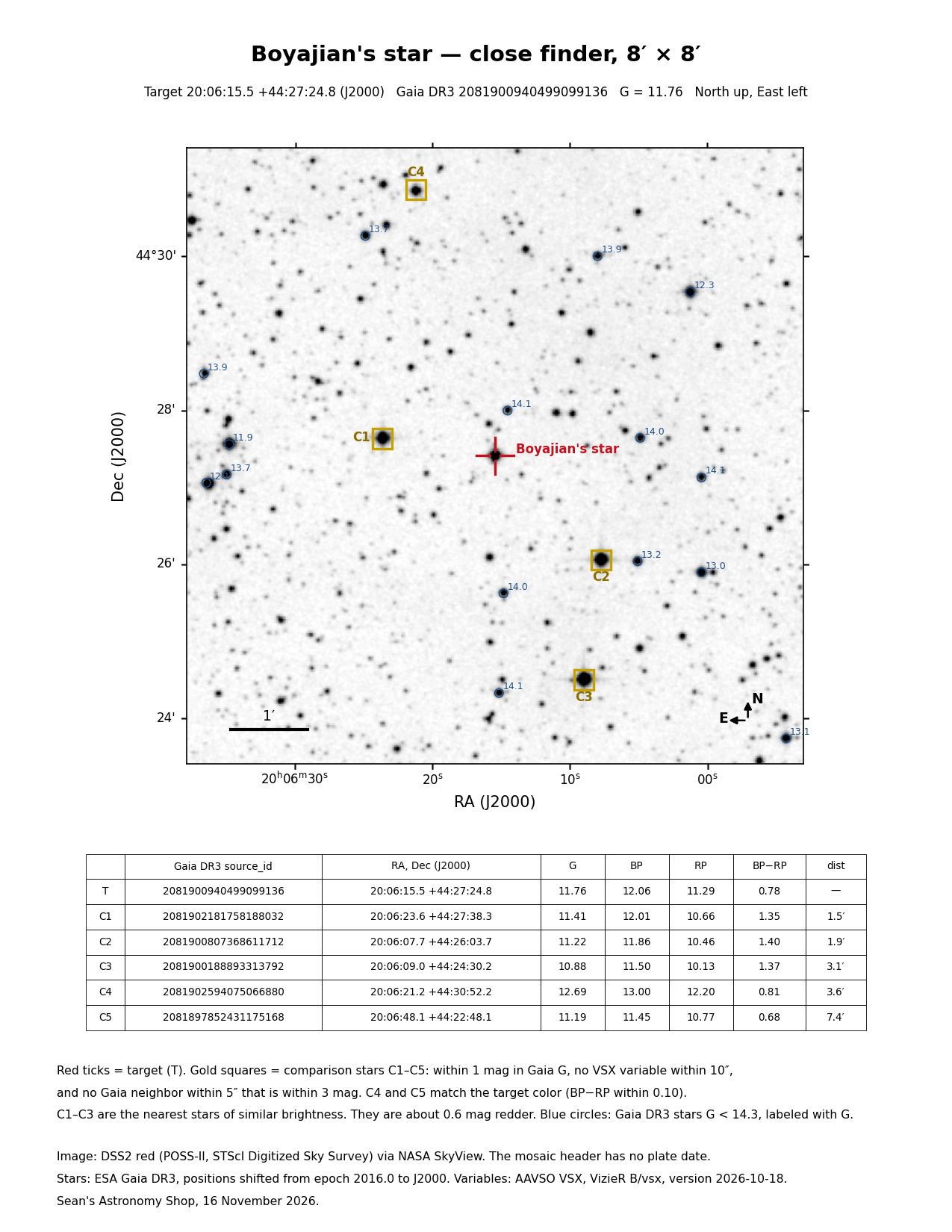
Real sky images (DSS2 red) with Gaia DR3 stars overlaid. North is up, east is left, J2000. Red tick marks point at the target (Gaia DR3 2081900940499099136, G = 11.76). Gold squares C1 to C5 are comparison stars of similar brightness. Tap an image for the full-size printable chart.
| Gaia DR3 | RA, Dec (J2000) | G | BP | RP | From target | |
|---|---|---|---|---|---|---|
| C1 | 2081902181758188032 | 20:06:23.6 +44:27:38.3 | 11.41 | 12.01 | 10.66 | 1.5′ |
| C2 | 2081900807368611712 | 20:06:07.7 +44:26:03.7 | 11.22 | 11.86 | 10.46 | 1.9′ |
| C3 | 2081900188893313792 | 20:06:09.0 +44:24:30.2 | 10.88 | 11.50 | 10.13 | 3.1′ |
| C4 | 2081902594075066880 | 20:06:21.2 +44:30:52.2 | 12.69 | 13.00 | 12.20 | 3.6′ |
| C5 | 2081897852431175168 | 20:06:48.1 +44:22:48.1 | 11.19 | 11.45 | 10.77 | 7.4′ |
C1 to C3 are the nearest stars within 1 mag in Gaia G. They are about 0.6 mag redder in BP−RP than the target. C4 and C5 match its color (BP−RP within 0.10). None has a close companion or a VSX entry within 10 arcsec. Images: DSS2 red (POSS-II, STScI Digitized Sky Survey) via NASA SkyView. Stars: ESA Gaia DR3, positions shifted from epoch 2016.0 to J2000.
VSX
Already known. This note does not file a new star.
Next date to test
2028 March 4, 01:04 UTC. That is cycle 8 if the 2011 March 5 dip is cycle 0 and this TESS dip is cycle 4. It is a date to test, not a published eclipse.
From southern California the center is 17:04 PST on March 3, still daylight. The only dark window with the star well up is about 03:30 to 05:00 PST on the mornings of March 3 and March 4, low in the east before dawn. A telescope in the Canary Islands or in Europe has the star high through the middle of that night. A repeat of the TESS dip would be symmetric, about a day long, around 1 percent or shallower, and within about a day of 01:04 UTC. A miss, or a dip tens of days away, retires the clock.
The return on 2026 January 17 already passed. From California the star transited in daylight, so that night taught nothing.
Help with a measurement
The useful night is 2028 March 4. A symmetric dip of about a day, near 1 percent or less, within a day of 01:04 UTC, would be the TESS event again. Leave an email if you want a reminder before that night.
The note
A single TESS dip of Boyajian's star and a 776-day timing alignment (PDF)
20-minute medians of the dip (CSV)
This page uses the public TESS SPOC and QLP light curves and the published dip times cited in the note. The 776-day spacing aligns three events. It is not the period of the dips. A date on that spacing is a test, not a confirmation.