
TIC 197755333
TESS eclipses near V345 Lac · Planet-sized dips
TIC 197755333 · Unconfirmed shallow fades. No standing period. Low confidence.
- Position
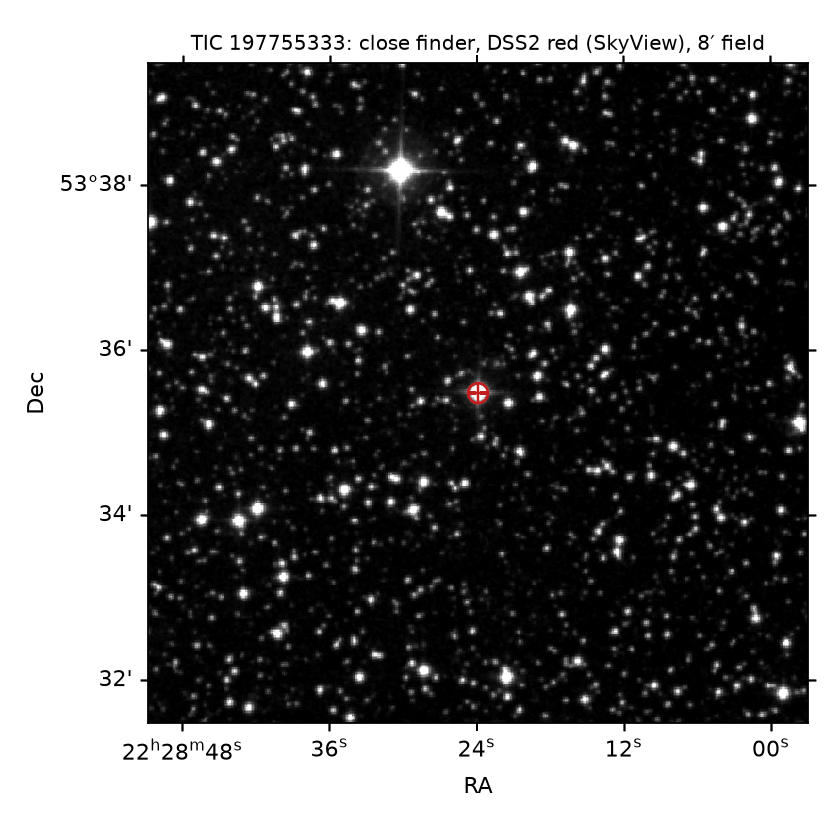
- 22h 28m 23.88s, +53° 35′ 29.0″ (J2000). RA 337.09951°, Dec +53.59140°
- TESS magnitude
- 10.061
- Temperature
- 7,044 K, radius 1.52 solar radii (TIC v8.2). Spectral type is not given in the TIC fields used here.
- Where
- 1.785° from V345 Lac, to the southeast, in the 1.70–1.80° ring
- TESS sectors
- 16, 17, 56, 57, 83, 84
- Median dip
- 0.54% deep, 5.4 h, 6 counted dips
- Status
- Unconfirmed dips. Not a planet claim. Found 18 Nov 2026. Not filed with VSX. Not checked from the ground.
Next listed dip
21 Nov 2026, 06:22 UTC 20 Nov, 22:22 PST
± 4.0 h Low confidence
BTJD 4365.769, on the 0.5717-day period used by the Planet-sized dips page. The live page recomputes this time when it loads. The research note lists the times as of 18 November 2026, 12:00 UTC.
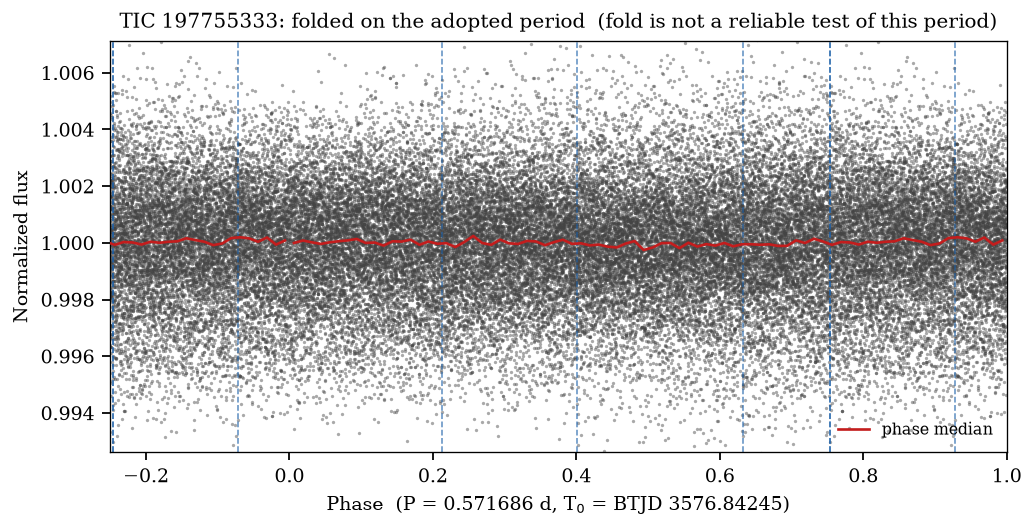
Every period that fits all the dips is ruled out by TESS coverage. This one, 0.5717 days (the gap divided by 3), missed the fewest predicted times (108).
Best guess
Unconfirmed shallow fades. No standing period. Low confidence. Every period that fits all six dips is ruled out by TESS coverage. The pages fall back to 0.5716857 days, the gap divided by 3, because it missed the fewest predicted times, but it still missed 108 of them. The formal window of ±4 hours around the next time is only the timing error if that period were correct, which the coverage says it is not. It should not be treated as a firm prediction. No formal period uncertainty was fitted (the fallback carries a period variance of zero). This is not a planet claim.
Dip shape
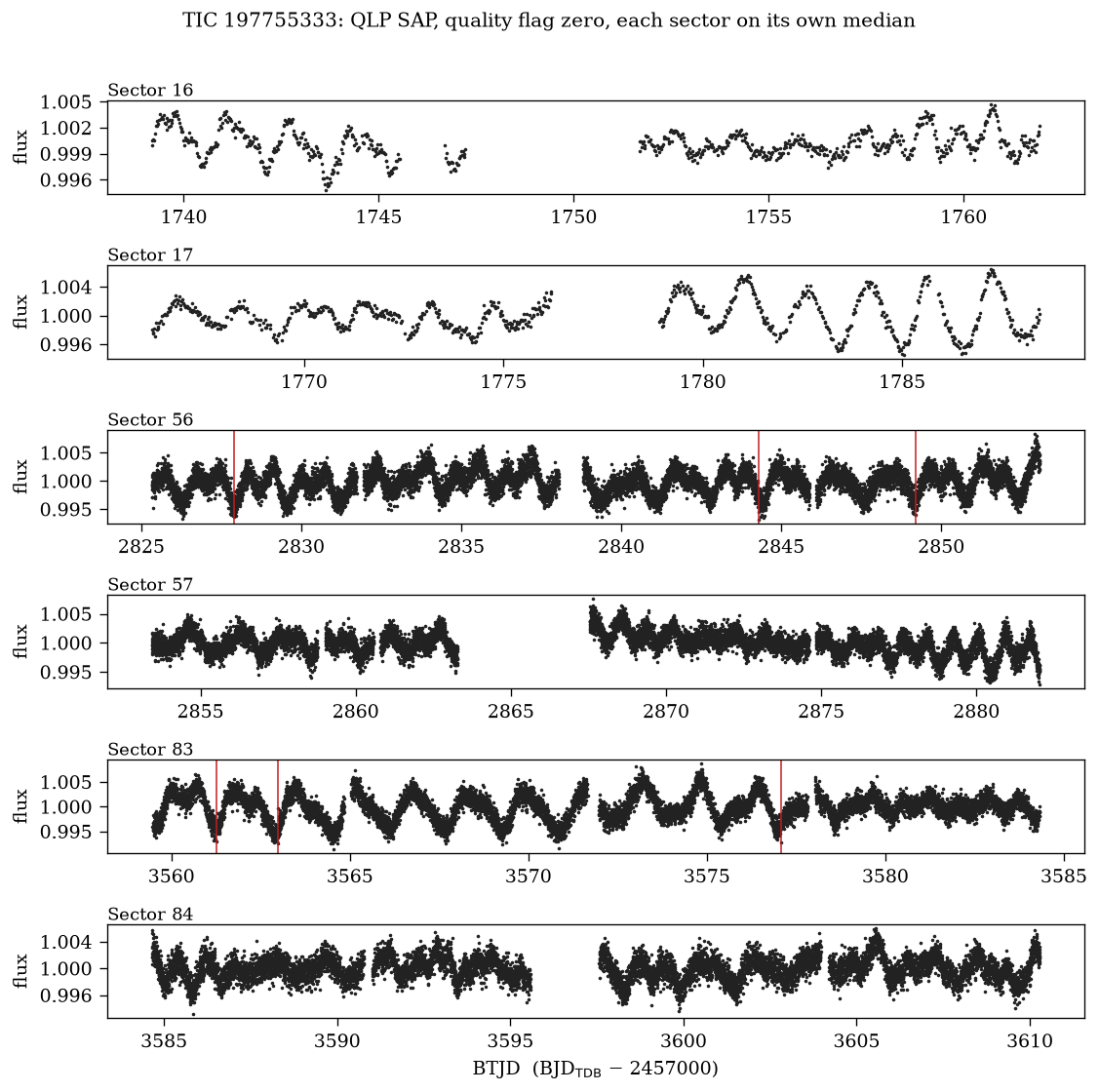
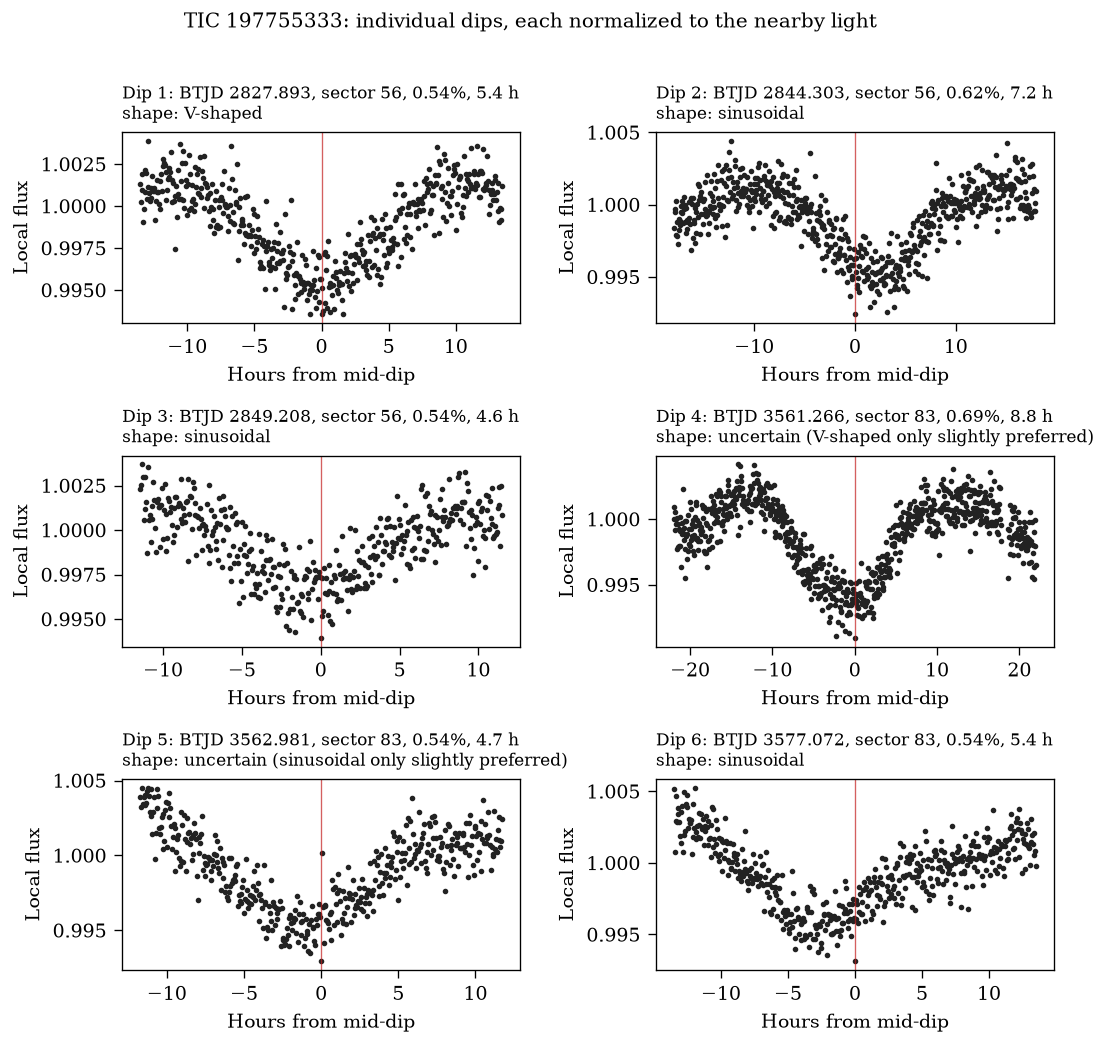
Six dips of 0.54 to 0.69 percent were counted, in sectors 56 and 83. They are among the shallowest in this list. The fades look like broad, shallow U or V shapes, a few hours long, with no flat bottom. At half a percent the shape is close to the point scatter. A fold on the 0.5717-day fallback is not a test of a real period: that period is already ruled out by TESS coverage, and the phase median is flat.
The light curve
Finder chart
What the scan measured
- 6 clean dips of at least 0.5 percent, median depth 0.54 percent, median duration 5.4 hours.
- TIC radius 1.52 solar radii; a depth conversion (not a planet measurement) gives about 1.12 Jupiter radii. Contamination ratio 0.166.
- No VSX entry within 10 arcsec and no Gaia DR3 eclipsing binary within 5 arcsec recorded in the scan.
The note
Research note (PDF): TIC 197755333
These pages use the public TESS Quick-Look Pipeline and catalog positions. Unconfirmed dips. Not a planet claim. Not filed with VSX. Not checked from the ground.