
TIC 328034764
TYC 3973-963-1 · Gaia DR3 2197919247114410240
- Position
- 22h 05m 29.99s, +55° 33′ 58.8″
- V magnitude
- 11.14
- Where
- 126.5 arcmin west-northwest of V345 Lac, 2.109°, in the 2.10–2.20° ring
- Signal
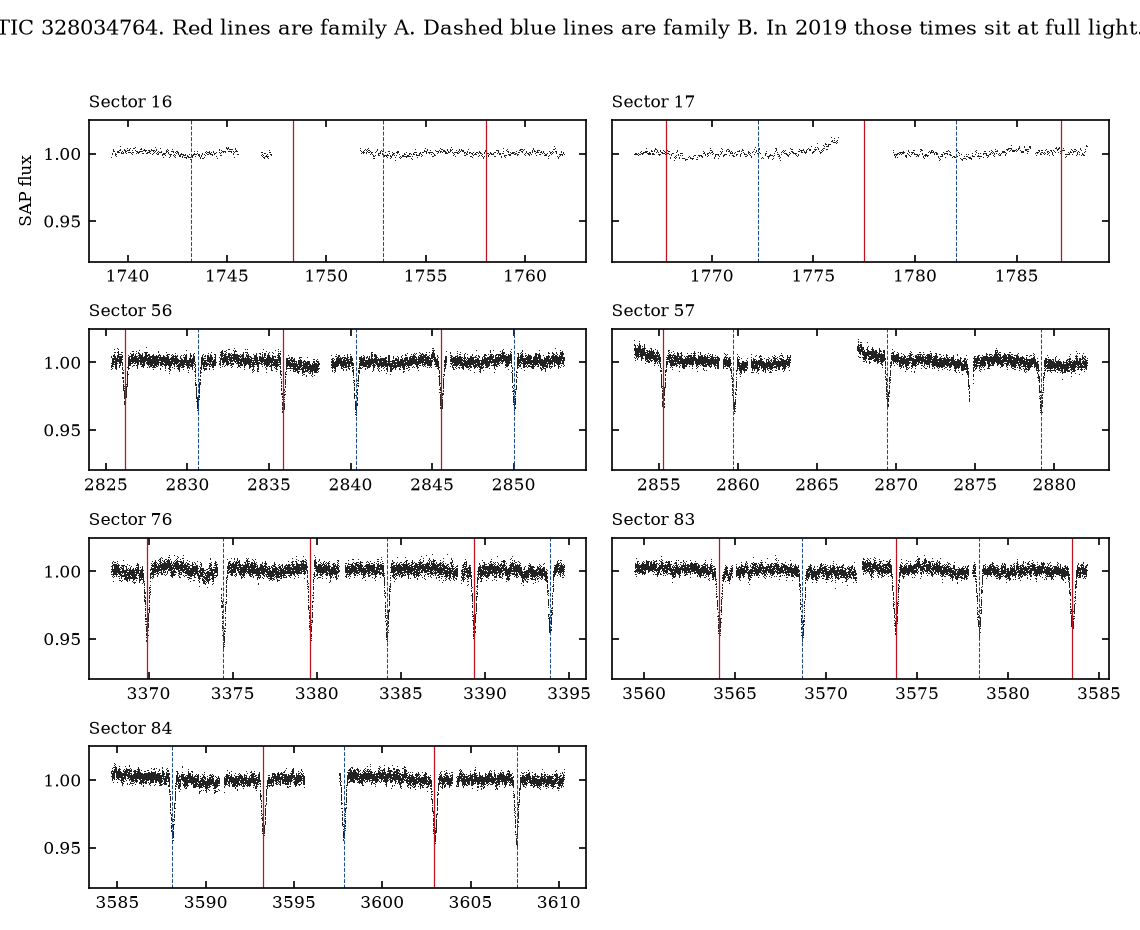
- Fade, cause open. About 0.04 mag in 2022 and 0.05 to 0.06 mag in sectors 76, 83, and 84. Absent in 2019.
What TESS shows
Twelve minima in one family, from sectors 56, 57, 76, 83, and 84, give
Min = BTJD 3369.91172 + 9.71001 E
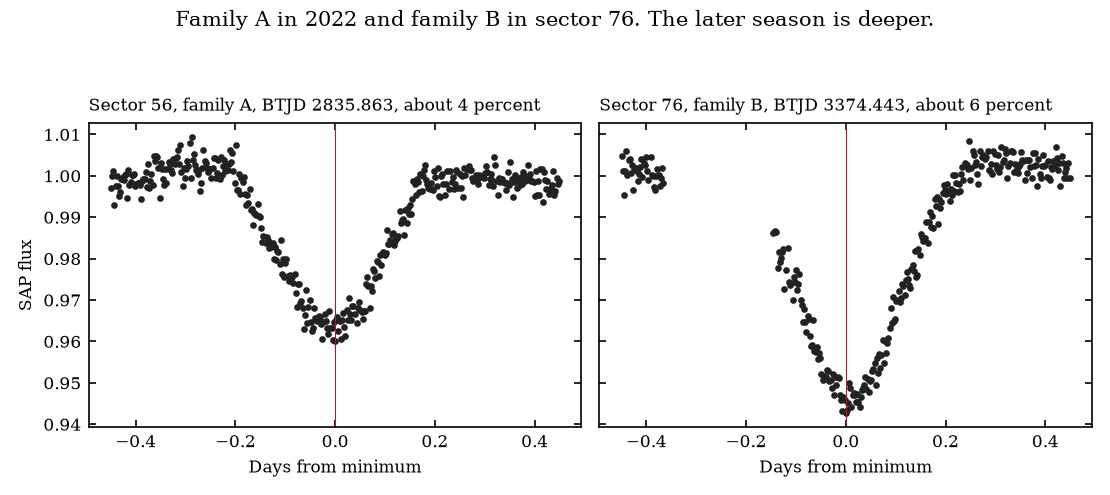
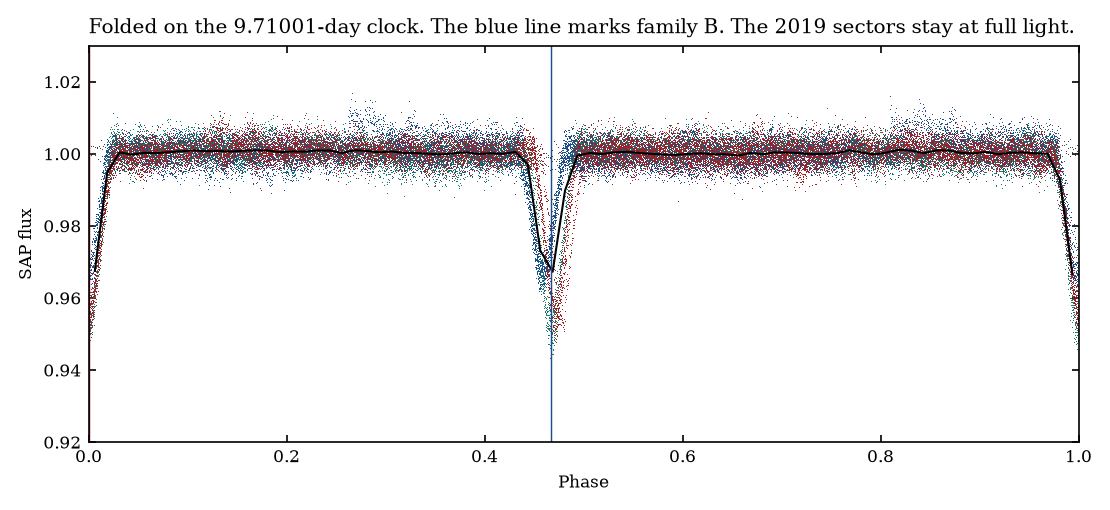
Those times scatter by 27 minutes rms. The largest residual is 43 minutes. In 2022 the aperture falls to about 0.96 of the sector median, 0.04 mag, for about 2 to 3.5 hours below 0.975. In sectors 76, 83, and 84 the floor is about 0.95, 0.05 to 0.06 mag, and the fade lasts about 5 to 6 hours. A second family has about the same depth in a given season. In 2022 it follows by 4.43 to 4.47 days. In the later sectors the gap is 4.54 to 4.60 days, and the last one, BTJD 3607.618, is 4.69 days after its family-A minimum. Against one phase the second family runs from −168 minutes to +186 minutes, so that separation is not adopted.
Sectors 16 and 17 stay at full light on this clock. Seven predicted times inside those sectors have a minimum flux of 0.995 to 0.997, and two more land in data gaps. Camera 3 CCD 1 is flat in sector 17 and dips in sectors 57 and 84. Camera 3 CCD 2 dips in sector 56 and in sector 83. Sector 77 is in the TESSCut footprint and has no QLP file. A known field sag near BTJD 3591 and another near BTJD 3604 do not fall on these minima.
The centroid shift in the deep sectors is a few thousandths of a pixel: 0.0015 in sector 76, 0.0075 in sector 83, and 0.0045 in sector 84. Sector 57 shifts by 0.047 pixel. A 5 percent loss on the star 32 arcsec away would move the centroid by about 0.08 pixel, so that star is not the whole dip. TIC 328034754, G = 13.08, T = 12.71, is 14 arcsec away and has about 0.14 of the target’s TESS flux. TIC 328034781, G = 12.28, T = 11.17, is 32 arcsec away and has about 0.56. Those two ratios match the catalog contamination ratio of 0.685. That ratio is not turned into an intrinsic depth. The note does not claim that either neighbor fades.
Gaia DR3 2197919247114410240 gives G = 11.025, BP − RP = 0.664, parallax 0.636 ± 0.485 mas, and RUWE 36.7. The parallax is not a distance. The TIC header lists 8364 K, 2.15 solar radii, and 474 parsecs, and those labels are not adopted. The Gaia number on the TIC row is the DR2 source. SIMBAD lists no spectral type and no papers. VSX has no row for this star. The ASAS-SN discovery list has no entry within 2.4 arcmin. ZTF J220540.33+553400.3, 88 arcsec away, has a period of 9.660 days and is about 7 magnitudes fainter. That period does not phase these minima, and the star is too faint to supply the dip. The note is not a VSX submission.
A possible reading
One reading of these timings is a 9.71-day pair whose orbit is slightly off center, with the tilt of that orbit changing. A third star is the usual thing that does both at once. The cause stays open, and nothing here is filed.
The gap from family A to family B, plus the gap back, stays near 9.71 days in every season. That is one orbit, with two events per revolution. Two unrelated stars in the aperture would drift through each other. Family A stays on the line above: twelve times, 27 minutes rms, and a worst miss of 43 minutes. Family B does not hold one separation. It follows by 4.43 to 4.47 days in 2022 and by 4.54 to 4.60 days in sectors 76, 83, and 84, about two hours closer to halfway. The last fade, BTJD 3607.618, is 4.69 days after its family-A minimum. That slide is the long axis of an ellipse turning. On a 9.7-day orbit the ordinary tidal turn of that axis is much slower. A third star pulling on the pair is what speeds it up. Family B still wanders by an hour or two inside a single season, so that turn has not settled into a smooth line.
Both fades are missing in 2019, short and about 0.04 mag in 2022, then longer and 0.05 to 0.06 mag in 2024. They change together, on cameras that saw full light in 2019. That is a pair that was missing the line of sight and is now crossing it more deeply, a grazing cut first and a fatter cut later. The same outside pull tips the orbit. SS Lacertae and HS Hydrae are the known cases, caught while their eclipses were turning off. Here the same kind of change would be running the other way, with the fades coming on. The light between the fades stays flat. A starspot that slides in longitude and grows darker usually leaves a wave through the rest of the cycle.
The star 14 arcsec away is still inside the pixel. The star 32 arcsec away is too still, in the deep sectors, to be the whole dip. Gaia RUWE 36.7 means a single-star catalog entry does not describe this system. The 15 November and 20 November windows are the test. Both fades still a few hundredths of a magnitude, with the second one still sliding, fits this picture. One fade gone, or the depth back down near the 2022 size, means the tilt is still moving and 2024 was one view of it.
The light curves
Finder chart
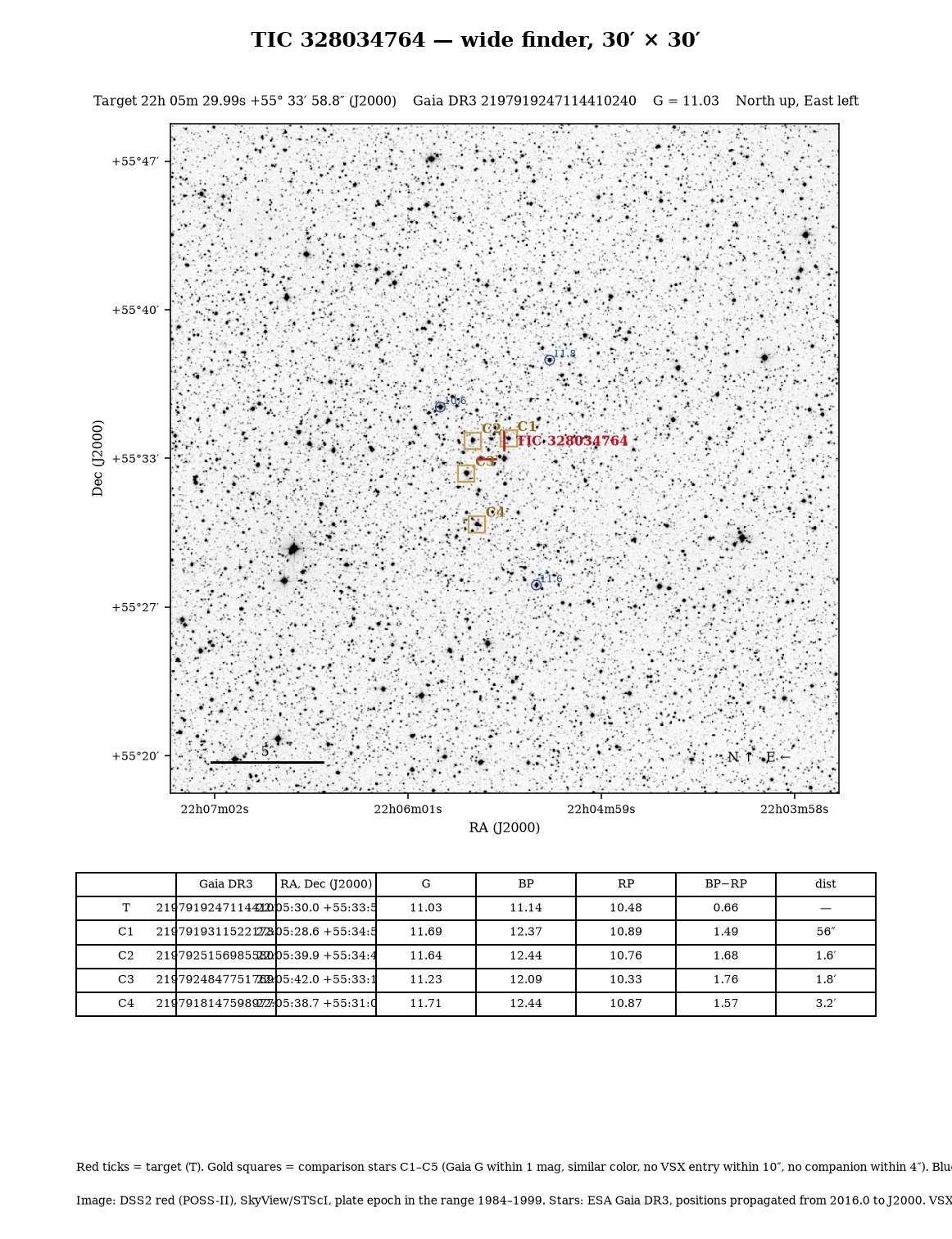
Real sky images (DSS2 red) with Gaia DR3 stars overlaid. North is up, east is left, J2000. Red tick marks point at the target (Gaia DR3 2197919247114410240, G = 11.03). Gold squares C1 to C4 are comparison stars of similar brightness. Tap an image for the full-size printable chart.
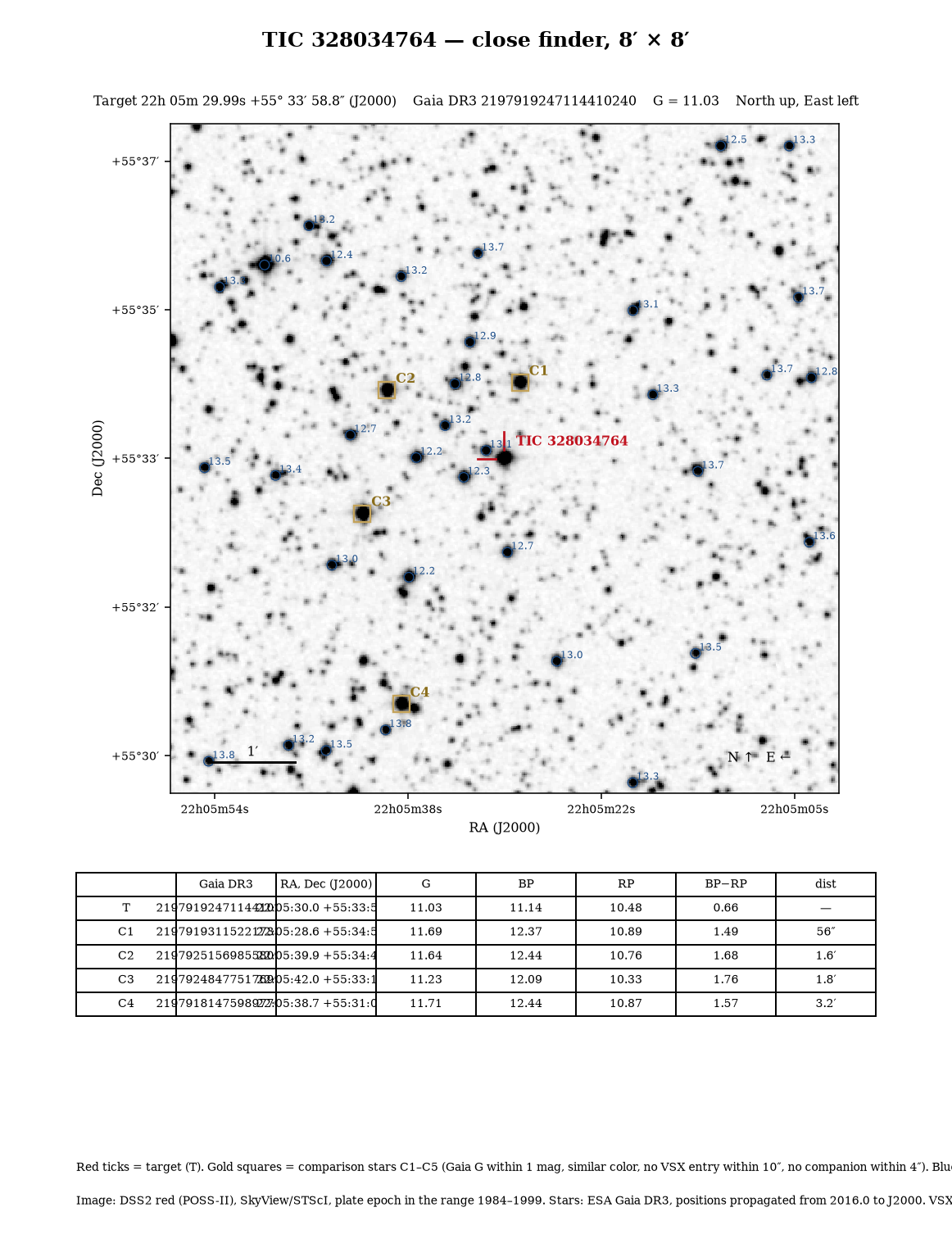
| Gaia DR3 | RA, Dec (J2000) | G | BP | RP | From target | |
|---|---|---|---|---|---|---|
| C1 | 2197919311522173312 | 22:05:28.6 +55:34:53.5 | 11.69 | 12.37 | 10.89 | 56″ |
| C2 | 2197925156985580928 | 22:05:39.9 +55:34:48.1 | 11.64 | 12.44 | 10.76 | 1.6′ |
| C3 | 2197924847751769984 | 22:05:42.0 +55:33:19.6 | 11.23 | 12.09 | 10.33 | 1.8′ |
| C4 | 2197918147598977024 | 22:05:38.7 +55:31:02.8 | 11.71 | 12.44 | 10.87 | 3.2′ |
Comparison stars are within about 1 mag of the target in Gaia G, have similar color, no close companion, and no VSX entry within 10 arcsec. Images: DSS2 red (POSS-II, STScI Digitized Sky Survey). Stars: ESA Gaia DR3.
VSX
Not filed. Held for more data. A repeating fade is in the later TESS sectors, and the cause is not known. VSX has no row for this star.
Next two windows
- Window 1Family A, one of the two repeating fades. TESS times scatter by 27 minutes rms, and the worst miss is 43 minutes. 25 Nov 2026, 12:57 UTC · 25 Nov, 04:57 PST Pacific · 25 Nov, 13:57 CET central Europe
- Window 2Family B, the other fade. In TESS it follows by 4.4 to 4.6 days, and that gap is not constant, so this time can miss by a couple of hours. 30 Nov 2026, 01:51 UTC · 29 Nov, 17:51 PST Pacific · 30 Nov, 02:51 CET central Europe
Give the family-A window about an hour. The twelve TESS times scatter by 27 minutes, and the worst miss is 43 minutes. Give the family-B window a couple of hours. That gap runs from 4.4 to 4.6 days and is not one separation. The two fades have about the same depth in a given season. Keep the 14 arcsec star and the 32 arcsec star in their own apertures. These times have not been checked from the ground.
Help with a measurement
A ground night on this V = 11.1 star is the measurement that is missing. Keep TIC 328034754, 14 arcsec away, and TIC 328034781, 32 arcsec away, in their own apertures. The family-A middle can be off by about an hour. The family-B window is a couple of hours wide. If the signal has continued, the fade is a few hundredths of a magnitude. Pick a window if you can try.
The note
A repeating fade that needs more data: TIC 328034764 (PDF)
These pages use the public TESS Quick-Look Pipeline and catalog positions. The fade repeats, and the cause is open. A listed time is a window. If you observe, write down which star was in the aperture.