
TIC 328040887
TESS eclipses near V345 Lac · Planet-sized dips
TIC 328040887 · Unconfirmed pair of shallow dips. The period is a guess from two events. Low confidence.
- Position
- 22h 05m 25.65s, +54° 20′ 31.4″ (J2000). RA 331.35687°, Dec +54.34205°
- TESS magnitude
- 11.068
- Temperature
- 6,939 K, radius 1.67 solar radii (TIC v8.2). Spectral type is not given in the TIC fields used here.
- Where
- 1.958° from V345 Lac, to the west, in the 1.90–2.00° ring
- TESS sectors
- 16, 17, 56, 57, 83, 84
- Median dip
- 1.26% deep, 3.2 h, 2 counted dips
- Status
- Unconfirmed dips. Not a planet claim. Found 18 Nov 2026. Not filed with VSX. Not checked from the ground.
Next listed dip
24 Nov 2026, 14:40 UTC 24 Nov, 06:40 PST
± 4.0 h High confidence
BTJD 4369.114, on the 71.0387-day period used by the Planet-sized dips page. The live page recomputes this time when it loads. The research note lists the times as of 18 November 2026, 12:00 UTC.
Best guess
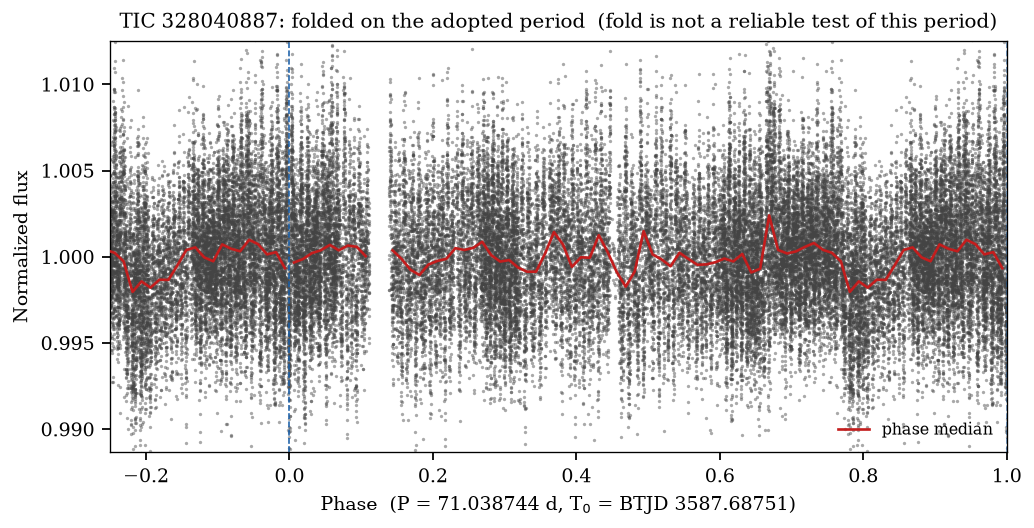
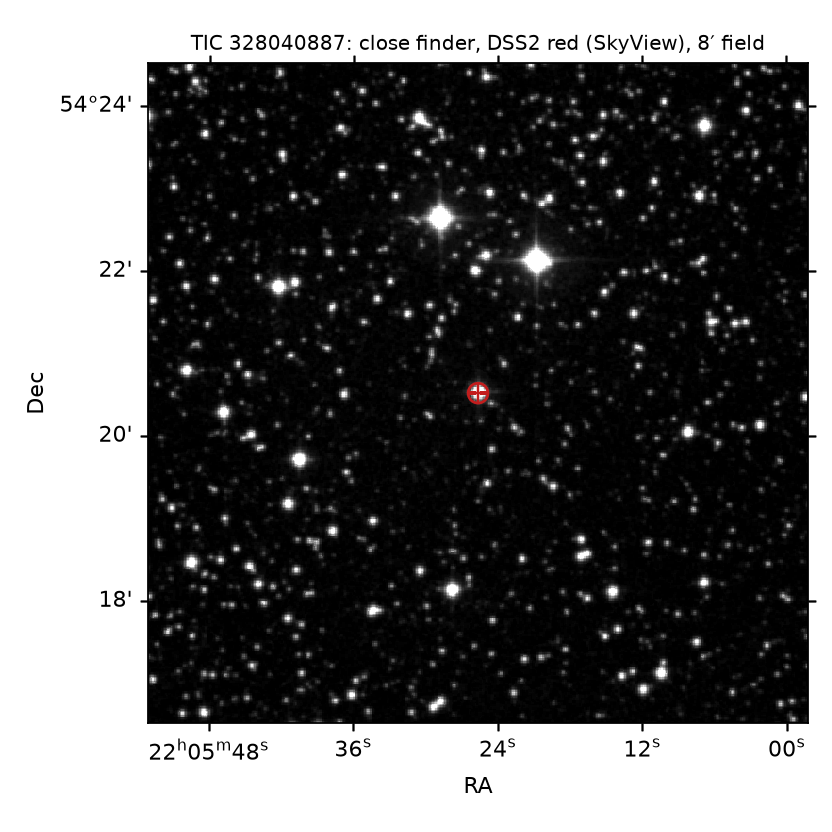
Unconfirmed pair of shallow dips. The period is a guess from two events. Low confidence. With only two dips, every integer division of the 710.387-day gap from 1 through 10 remains open, because TESS coverage does not rule them out. The pages show the soonest upcoming time, which belongs to the shortest alias, 71.038744 ± 0.00474 days. The ±4 hour window around that time applies only if that particular alias is the true period. The true period is not known. A VSX eclipsing-binary entry, Gaia DR3 2005565151031156736 (type E), lies 28 arcsec away and shares TESS pixels with this star, so the dips may not belong to TIC 328040887. This is not a planet claim.
Dip shape
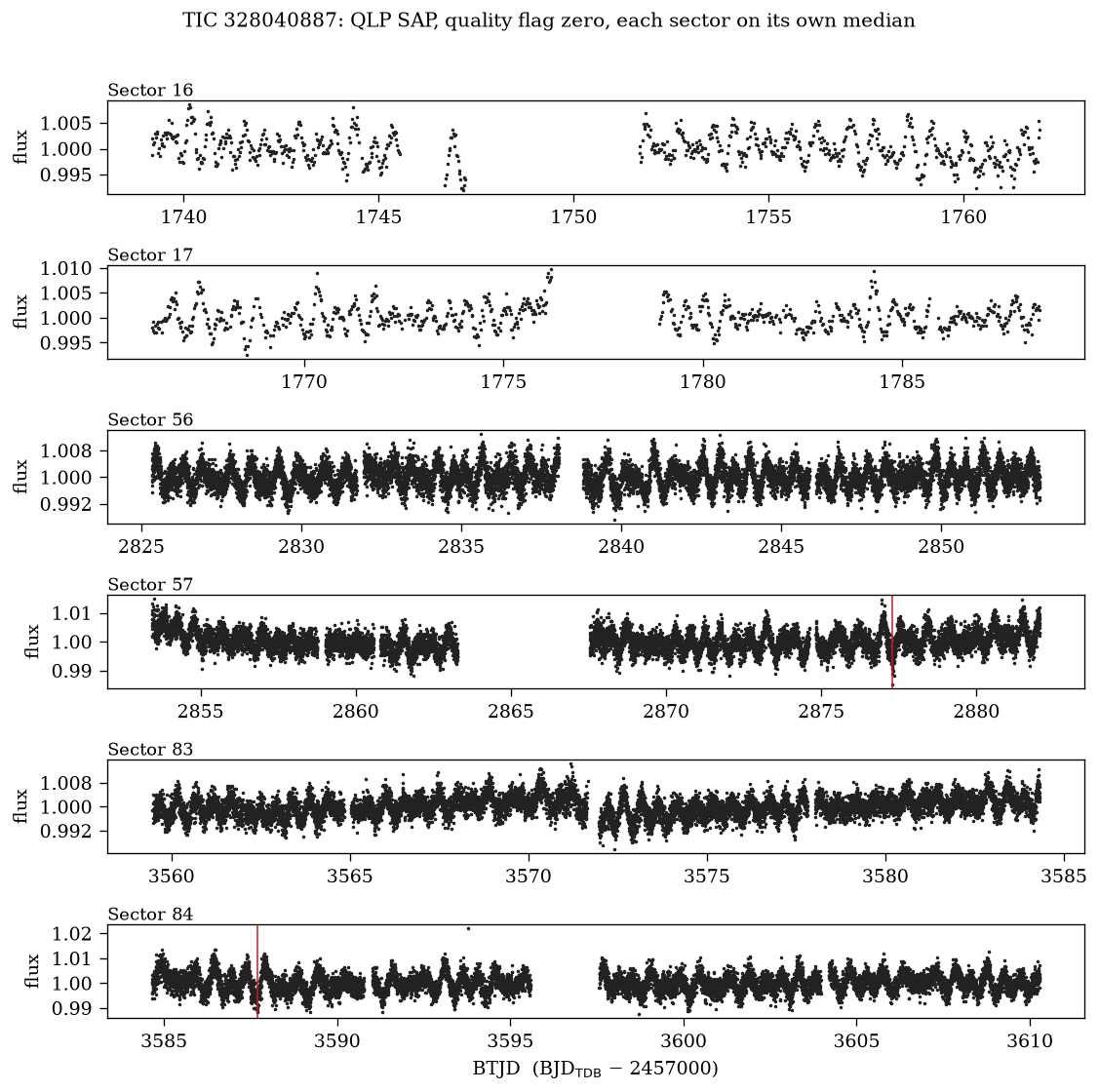
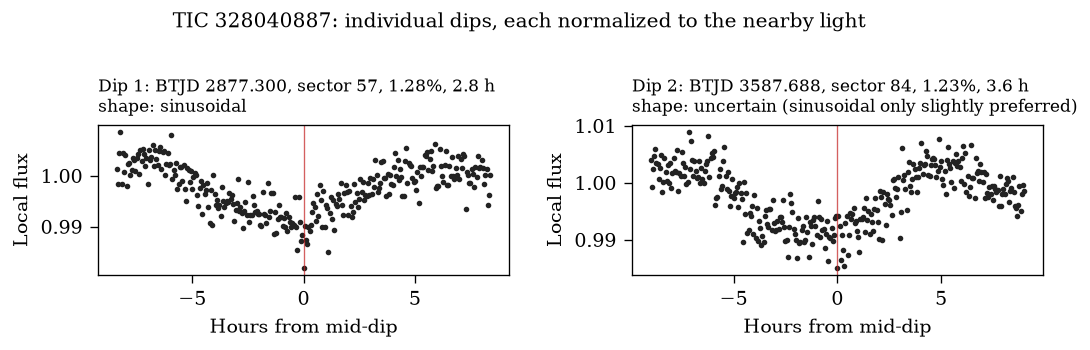
Only two dips were counted, 1.28 and 1.23 percent deep, 710.387 days apart, one in sector 57 and one in sector 84. Neither has a clear flat bottom. Both are consistent with a rounded U or a shallow V. A sinusoidal shape is not required by the data, and it is not ruled out at this signal-to-noise. A fold on any single alias of the 710-day gap, including the 71.0387-day alias used for the next-time prediction, is not a reliable test: two points can be phased on any of those aliases.
The light curve
Finder chart
What the scan measured
- 2 clean dips of at least 0.5 percent, median depth 1.26 percent, median duration 3.2 hours.
- TIC radius 1.67 solar radii; a depth conversion (not a planet measurement) gives about 1.86 Jupiter radii. Contamination ratio 0.094.
- A VSX entry lies 10 to 30 arcsec away: Gaia DR3 2005565151031156736 (E), 28" away.
The note
Research note (PDF): TIC 328040887
These pages use the public TESS Quick-Look Pipeline and catalog positions. Unconfirmed dips. Not a planet claim. Not filed with VSX. Not checked from the ground.