
TIC 329021911
TESS eclipses near V345 Lac · Planet-sized dips
TIC 329021911 · Possible eclipse or blended eclipse, not a confirmed planet. Moderate confidence in the period; low confidence in the source.
- Position
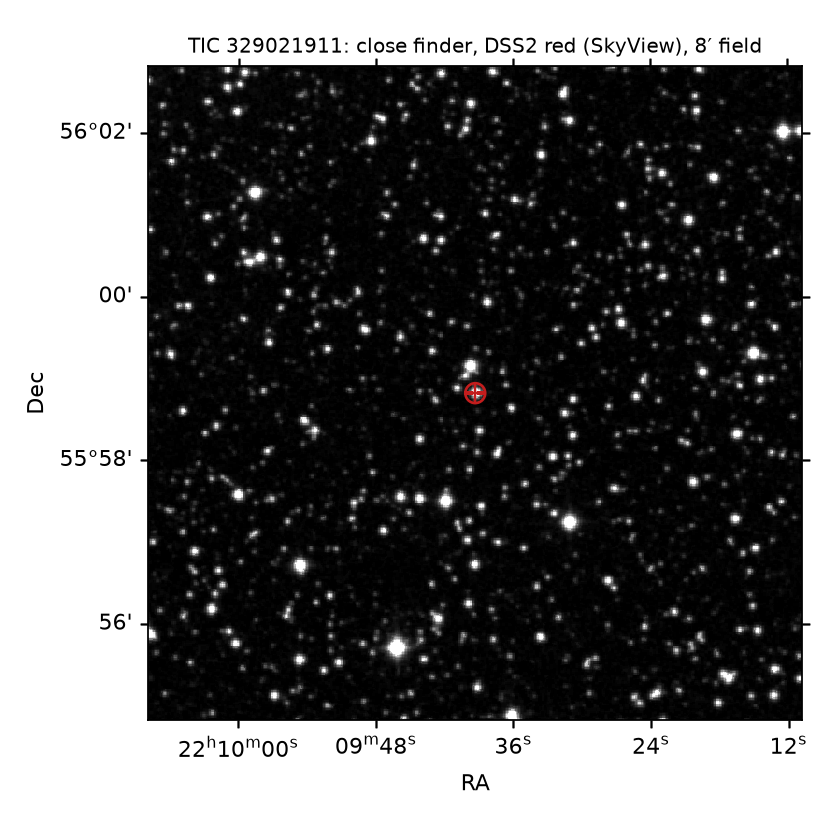
- 22h 09m 39.33s, +55° 58′ 49.4″ (J2000). RA 332.41388°, Dec +55.98040°
- TESS magnitude
- 12.692
- Temperature
- 4,920 K, radius 0.70 solar radii (TIC v8.2). Spectral type is not given in the TIC fields used here.
- Where
- 1.834° from V345 Lac, to the northwest, in the 1.80–1.90° ring
- TESS sectors
- 16, 17, 56, 57, 83, 84
- Median dip
- 4.68% deep, 4.6 h, 3 counted dips
- Status
- Unconfirmed dips. Not a planet claim. Found 18 Nov 2026. Not filed with VSX. Not checked from the ground.
Next listed dip
2 Dec 2026, 16:32 UTC 2 Dec, 08:32 PST
± 4.0 h High confidence
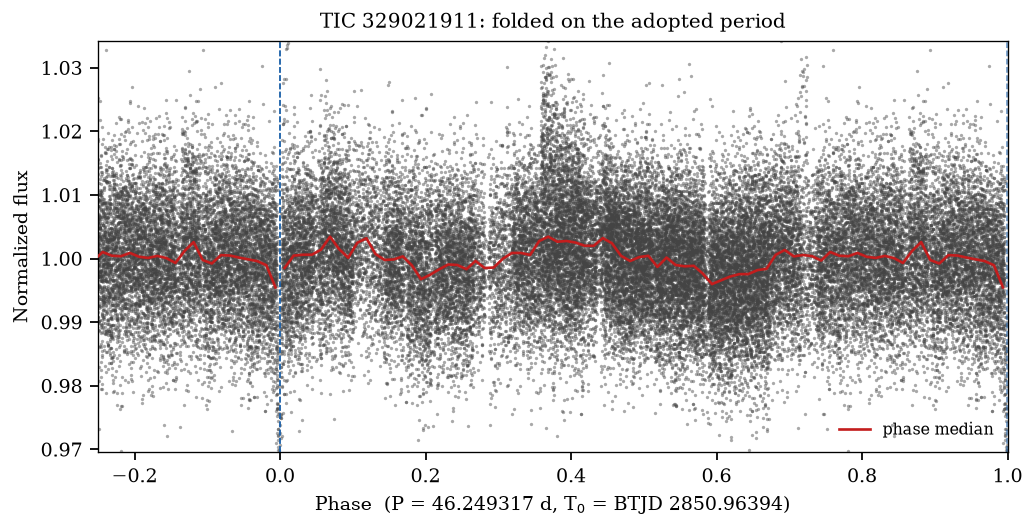
BTJD 4377.191, on the 46.2493-day period used by the Planet-sized dips page. The live page recomputes this time when it loads. The research note lists the times as of 18 November 2026, 12:00 UTC.
Best guess
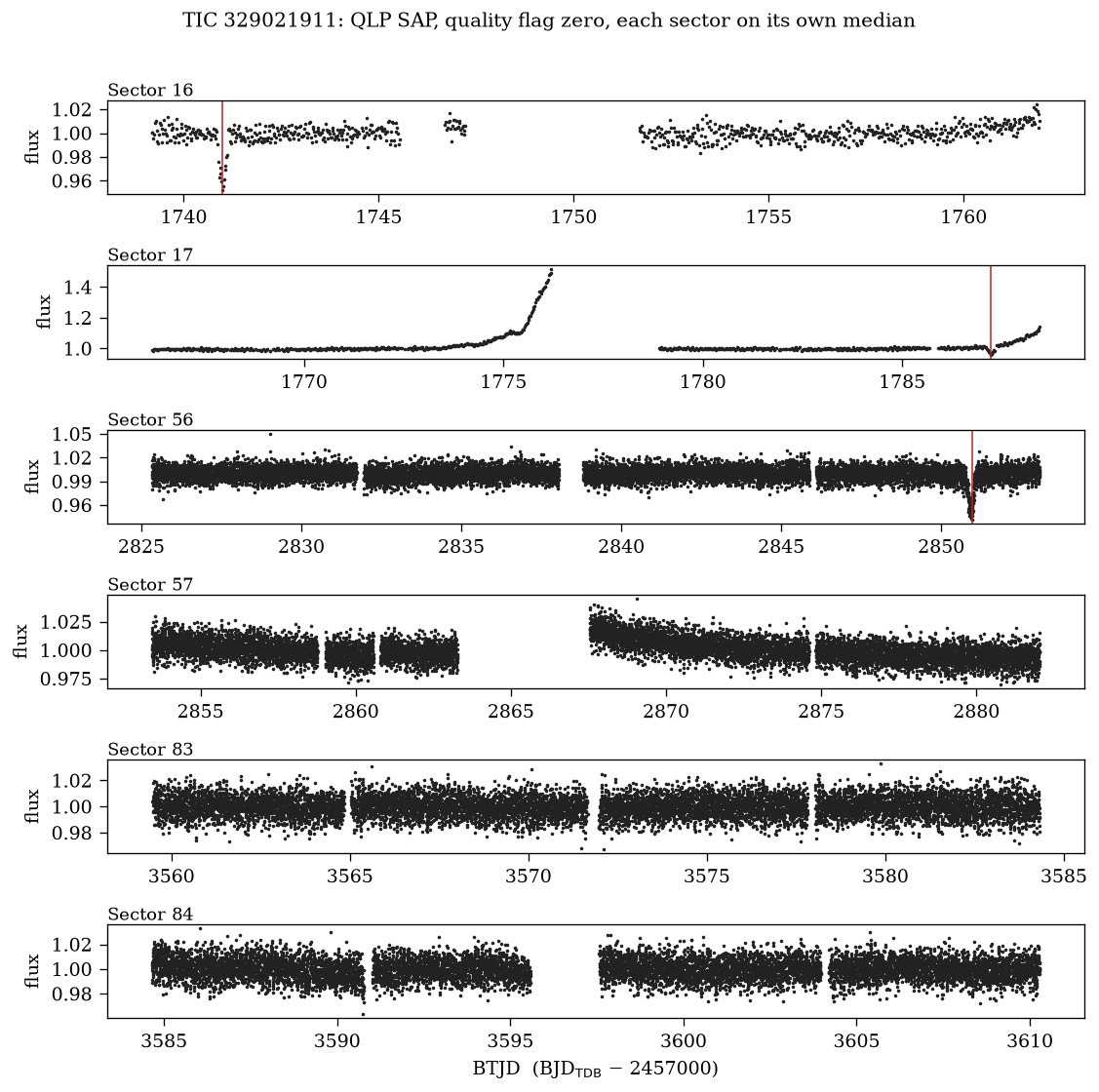
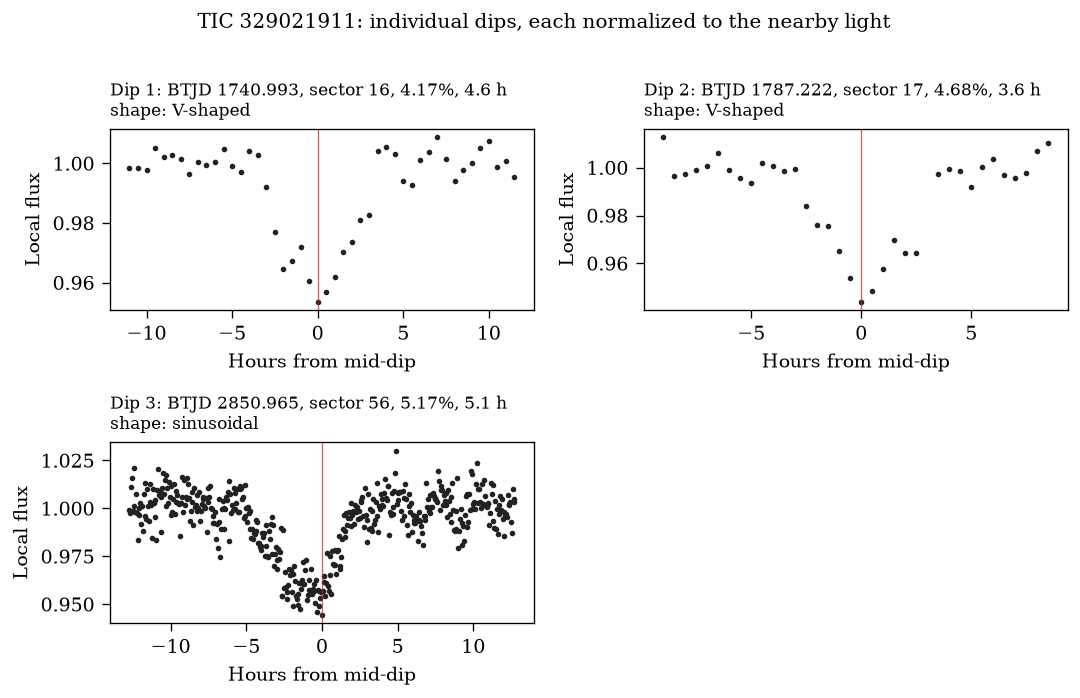
Possible eclipse or blended eclipse, not a confirmed planet. Moderate confidence in the period; low confidence in the source. A period of 46.249317 ± 0.002595 days fits all three dips and is not ruled out by TESS coverage: of the periods tried, it is the one open candidate, and it missed none of the predicted times that had good data. That is a high-confidence period in the sense used on the Planet-sized dips page. It is not a confirmation that a planet, or even this star, is the source of the light loss. The TIC contamination ratio is 1.034, and the same three dips appear in TIC 329021941, only 0.3 arcmin away. TESS pixels are 21 arcseconds wide, so the fades may belong to the neighbor or to a third star in the aperture. The V/U shape is consistent with a grazing eclipse or a blended eclipse, not with a clear flat-bottomed transit. This is not a planet claim.
Dip shape
The three counted dips, of 4.17, 4.68 and 5.17 percent, are the deepest in this set of twelve stars. Sectors 16 and 17 are 30-minute cadence, so each event is only a handful of points. Those two dips are V-shaped, or at most a short rounded U; they do not show a flat bottom. The sector 56 dip, at 200-second cadence, is also V- or U-shaped, with no clear flat stretch at minimum. None of the three looks like a box-shaped transit. A 9.71 c/d pulsation of 2.3 ppt is present in the light curve, far shallower than these 4.7 percent dips, so the pulsation does not explain them.
The light curve
Finder chart
What the scan measured
- 3 clean dips of at least 0.5 percent, median depth 4.68 percent, median duration 4.6 hours.
- TIC radius 0.70 solar radii; a depth conversion (not a planet measurement) gives about 1.50 Jupiter radii. Contamination ratio 1.034.
- Dips at the same times in TIC 329021941, 0.3 arcmin away (3 dips).
- No VSX entry within 10 arcsec and no Gaia DR3 eclipsing binary within 5 arcsec recorded in the scan.
- The light-curve check also found a 9.71 c/d pulsation of 2.3 ppt, far shallower than these dips of about 4.7 percent, so the pulsation does not explain them.
The note
Research note (PDF): TIC 329021911
These pages use the public TESS Quick-Look Pipeline and catalog positions. Unconfirmed dips. Not a planet claim. Not filed with VSX. Not checked from the ground.