
TIC 330136776
Gaia DR3 2198379736322859648
- Position
- 22h 13m 37.00s, +56° 44′ 42.9″
- V magnitude
- 11.77
- Where
- 132 arcmin north-northwest of V345 Lac, in the 2.10–2.20° ring
- Signal
- EA, period not fixed. Four eclipses, each to about half the light, 0.75 to 0.81 mag. The period is not fixed.
What TESS shows
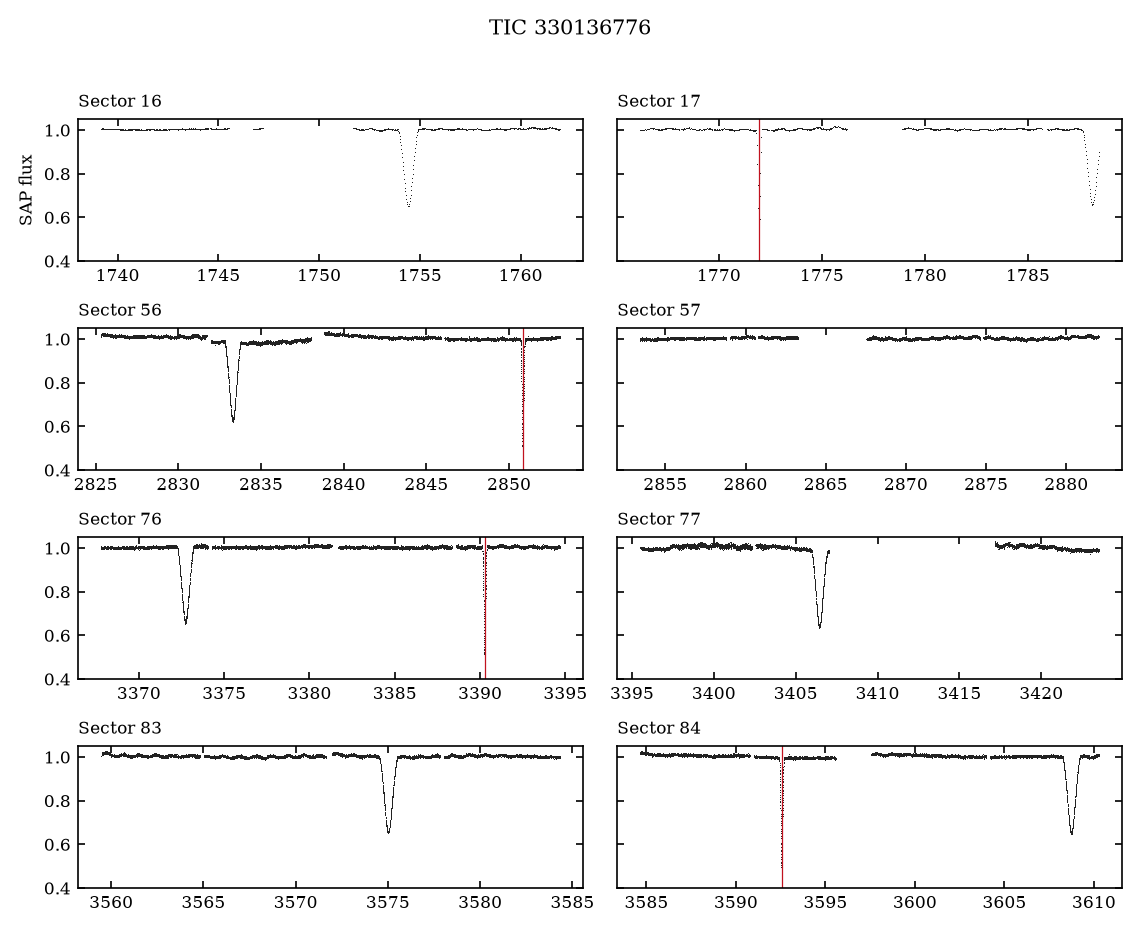
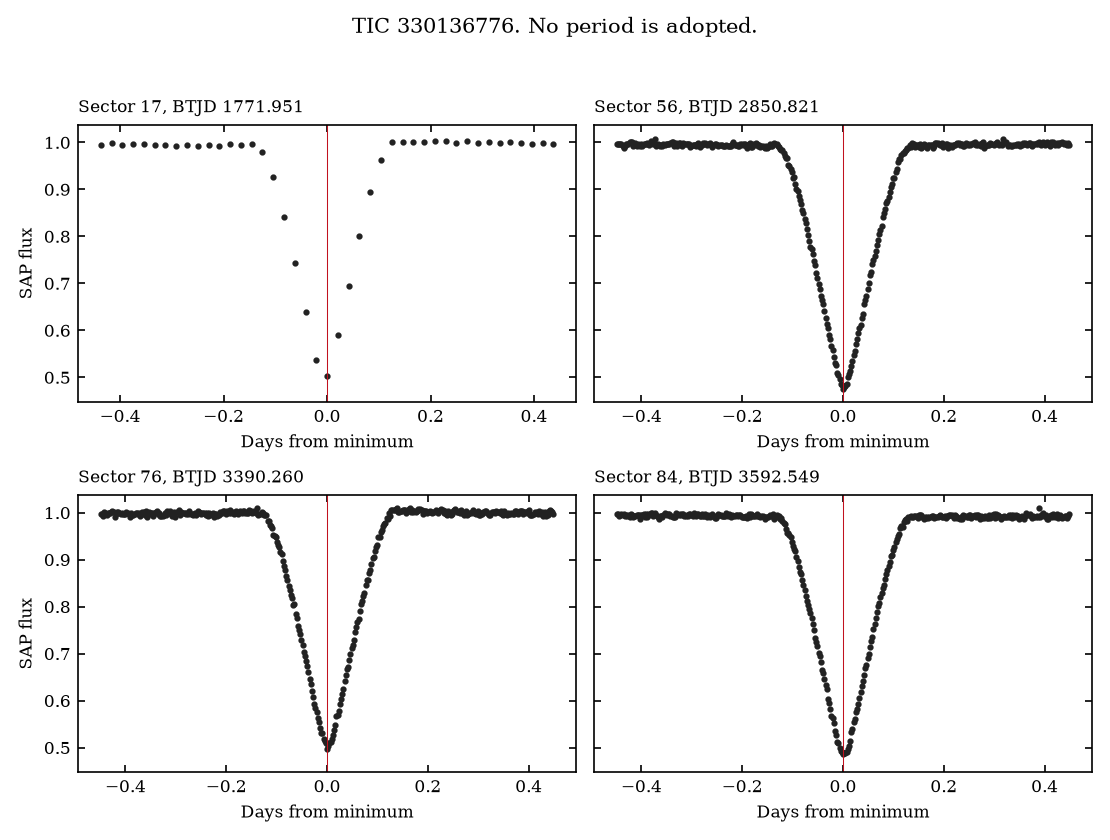
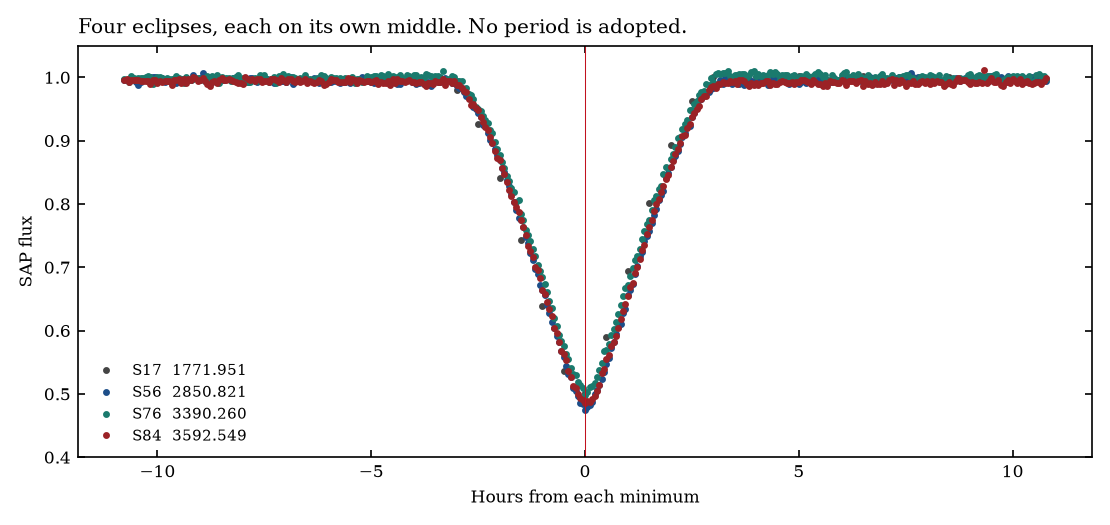
Four eclipses, and no period is adopted. The timed minima are BTJD 1771.951 in sector 17 (flux 0.502), BTJD 2850.821 in sector 56 (flux 0.475), BTJD 3390.260 in sector 76 (flux 0.498), and BTJD 3592.549 in sector 84 (flux 0.486). Each falls to about half the light, 0.75 to 0.81 mag. The light stays under 98 percent for 5.6 to 6.5 hours. The shapes match when each eclipse is aligned on its own middle. The detrended column reaches the same four floors.
The gaps are 1078.87, 539.44, and 202.29 days. A period of 67.43 days and a period of 33.71 days both still hide their other eclipses in the gaps between sectors, so neither is adopted. A trial at 22.48 days predicts minima inside sectors 56, 57, and 83 where the light stays full, and that period is rejected. This page does not predict the next eclipse.
The raw aperture column also shows notches of about 35 percent, near BTJD 1754.4, 1788.1, 2833.3, 3372.7, 3406.4, 3575.0, and 3608.7. Several of those notches repeat 33.7 days apart. The detrended column stays at full light through every one of them. The eclipse at BTJD 3592.549 falls 1.5 days after a known field sag at BTJD 3591.05. That sag is a 1.5 percent wiggle. A drop to half the light is a different event. The centroid shifts by 0.08 pixel.
Gaia DR3 2198379663295581440 lies 29 arcsec away at G = 12.86, 1.2 mag fainter, about a quarter of the combined light. The dip removes about half the light in the aperture, which is more than that neighbor can supply, so the target fades. Gaia gives G = 11.63, BP − RP = 0.80, parallax 1.512 ± 0.012 mas, and RUWE 0.86, about 660 parsecs. On the catalog radius of 2.46 solar radii, half the light is a companion of about 1.7 solar radii. The contamination ratio is 0.342, and that ratio is not turned into an intrinsic depth. The nearest VSX object is Gaia DR3 2198379942481282944, a rotator, 69 arcsec away. The note is not a VSX submission.
The light curves
Finder chart
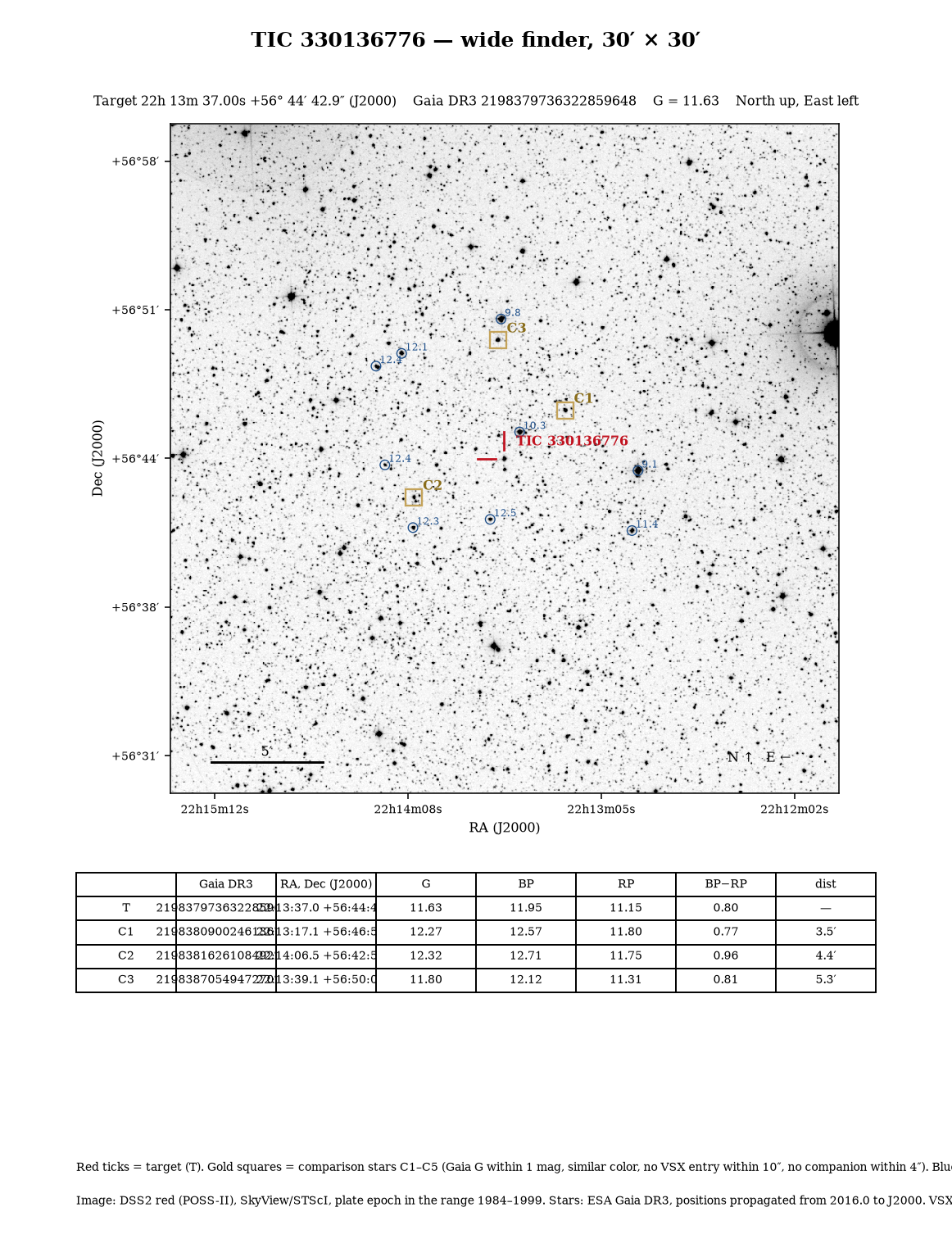
Real sky images (DSS2 red) with Gaia DR3 stars overlaid. North is up, east is left, J2000. Red tick marks point at the target (Gaia DR3 2198379736322859648, G = 11.63). Gold squares C1 to C5 are comparison stars of similar brightness. Tap an image for the full-size printable chart.
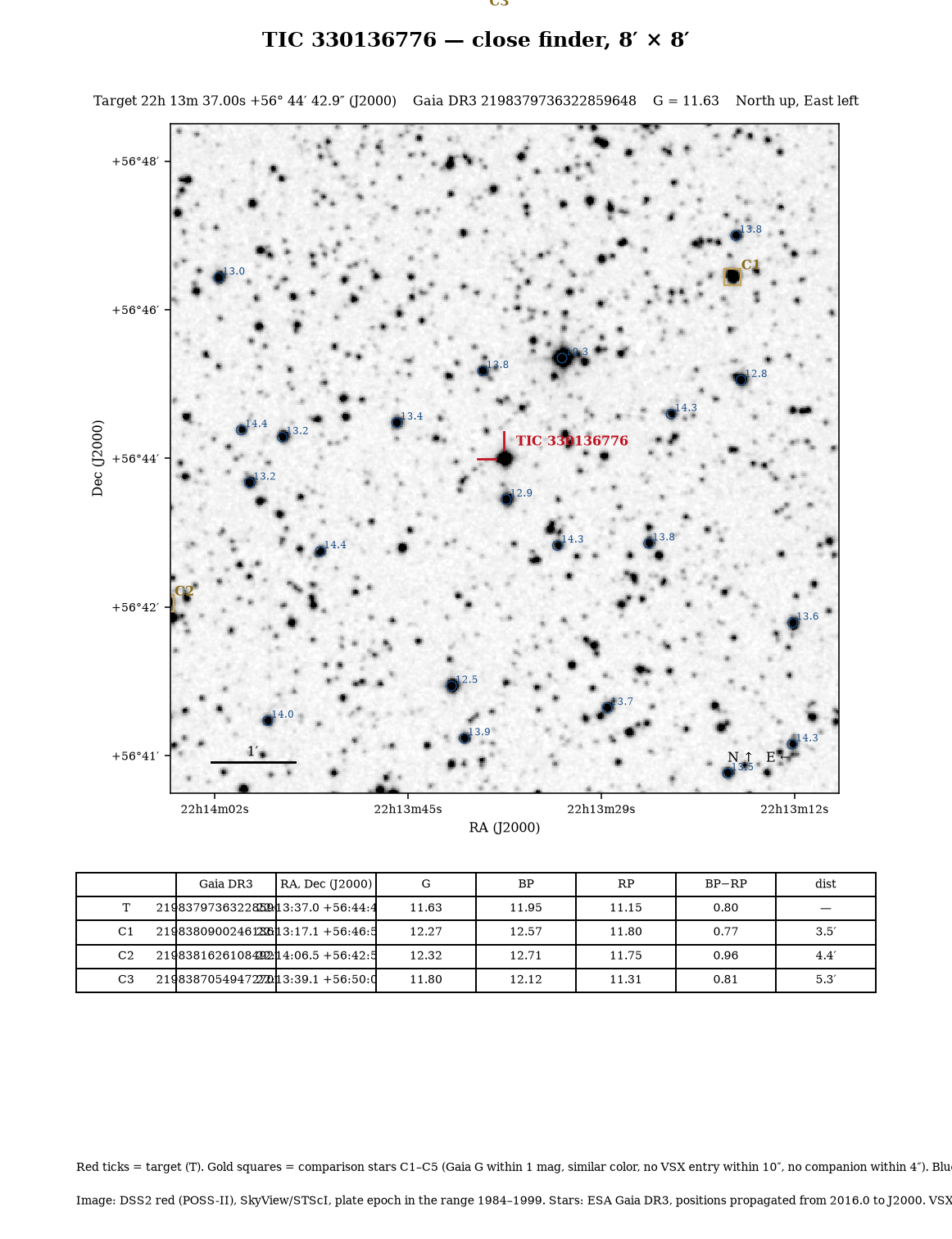
| Gaia DR3 | RA, Dec (J2000) | G | BP | RP | From target | |
|---|---|---|---|---|---|---|
| C1 | 2198380900246136704 | 22:13:17.1 +56:46:53.3 | 12.27 | 12.57 | 11.80 | 3.5′ |
| C2 | 2198381626108492288 | 22:14:06.5 +56:42:59.3 | 12.32 | 12.71 | 11.75 | 4.4′ |
| C3 | 2198387054947270272 | 22:13:39.1 +56:50:02.8 | 11.80 | 12.12 | 11.31 | 5.3′ |
Comparison stars are within about 1 mag of the target in Gaia G, have similar color, no close companion, and no VSX entry within 10 arcsec. Images: DSS2 red (POSS-II, STScI Digitized Sky Survey). Stars: ESA Gaia DR3.
VSX
Not filed. New addition from the 2.10–2.20° ring, 10 Nov 2026. Four eclipses do not pick one period. The nearest VSX object is a rotator 69 arcsec away.
Next date
There is no date to publish. Four eclipses leave more than one period that still hides its other eclipses in the TESS gaps. Both 67.43 days and 33.71 days still fit. The four minima are BTJD 1771.951, 2850.821, 3390.260, and 3592.549.
Help with a measurement
There is no eclipse date to sign up for. Four eclipses still allow 67.43 days and 33.71 days, and both hide the eclipses that would decide. Leave an email if you want a note when a period is real. A ground aperture should keep the G = 12.86 star 29 arcsec away out.
The note
Four deep eclipses and no adopted period: TIC 330136776 (PDF)
These pages use the public TESS Quick-Look Pipeline and catalog positions. A prediction is not a confirmation. If you observe, write down which star was in the aperture.