
TIC 330247030
TYC 3986-528-1 · Gaia DR3 2005420908854866432
- Position
- 22h 14m 23.88s, +54° 29′ 26.1″
- V magnitude
- 11.49
- Where
- 39 arcmin west of V345 Lac
- Signal
- EA, eclipses at both conjunctions. Primary about 11 percent. Secondary about 7.5 percent.
What TESS shows
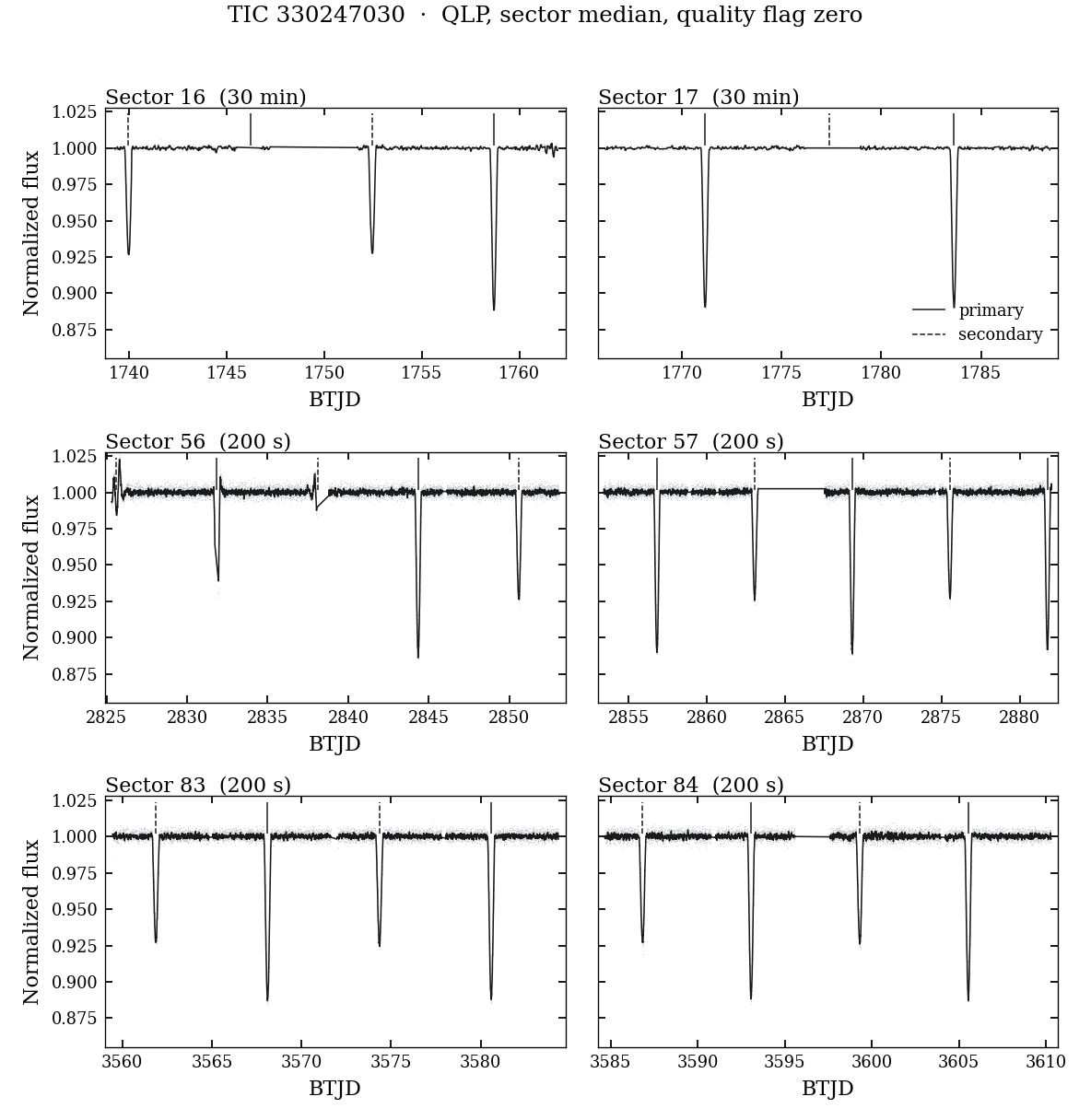
Eleven primary minima in sectors 16, 17, 56, 57, 83, and 84 give
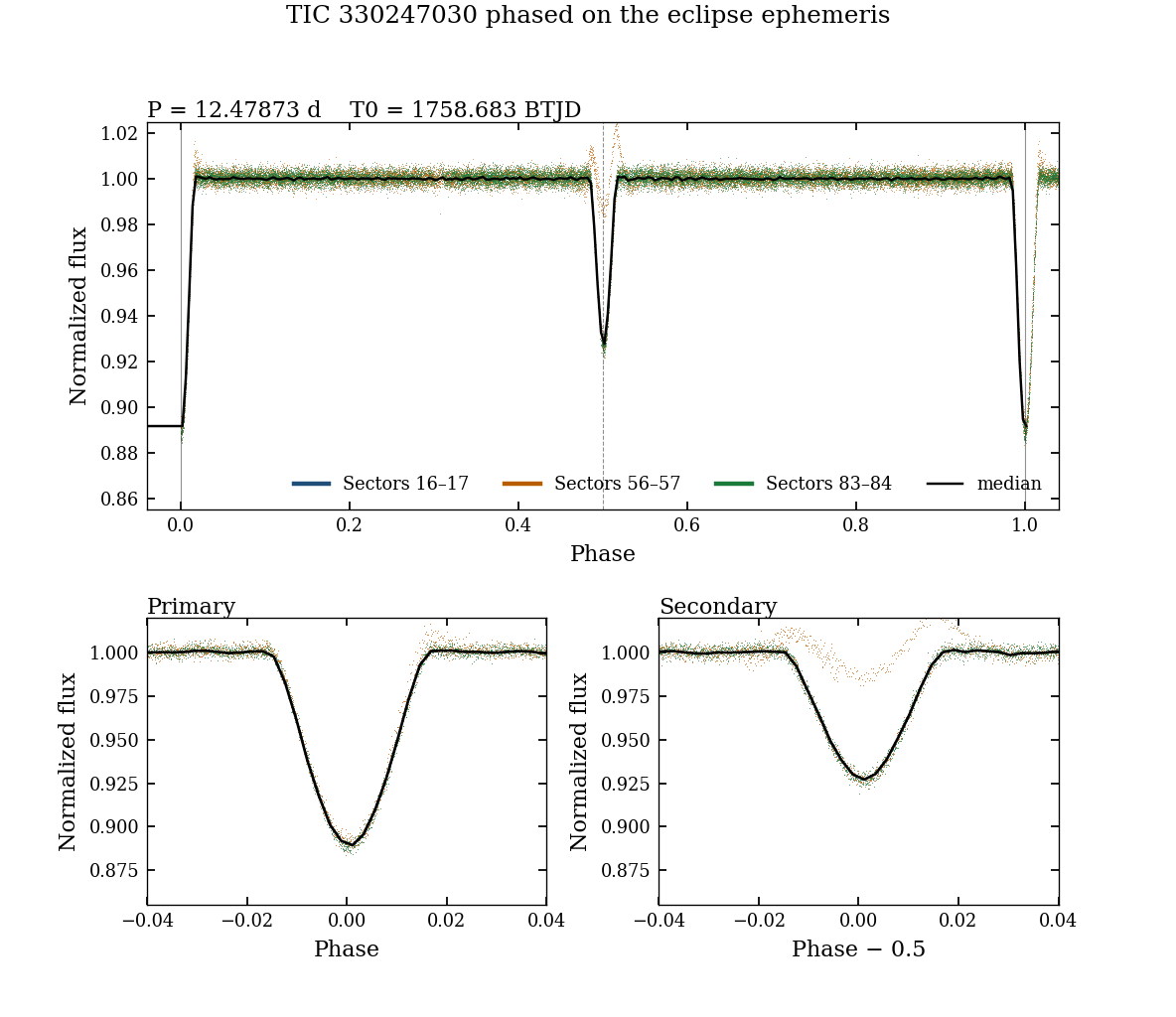
BJD 2458758.683 + 12.47873 E
The primary is 10.8 to 11.4 percent deep. A secondary at phase 0.501 is 7.2 to 7.6 percent deep. The minima are V-shaped and last about 0.40 days from start to end. The primary times scatter by 8 minutes rms and 19 minutes at worst.
VSX already lists this star as a Gaia variable of unspecified type, period 0.0246243 days, range 11.22 to 11.36 in G. The TESS 200-second light curve outside eclipse is flat at the 0.2 percent level and does not show that short period. The 12.5-day eclipses are the new result. The TIC contamination ratio is 0.31, and no centroid test has been done, so a neighbor inside the aperture is not ruled out.
The light curves
VSX
Already in VSX as a 35-minute variable. The 12.5-day eclipses are a revision, and that revision has not been sent.
Next two eclipses
- Eclipse 115 Oct 2026, 19:13 UTC · 15 Oct, 12:13 PDT Pacific · 15 Oct, 21:13 CEST central Europe
- Eclipse 228 Oct 2026, 06:43 UTC · 27 Oct, 23:43 PDT Pacific · 28 Oct, 07:43 CET central Europe
These two times are primaries, good to about 20 minutes. Each lasts about 10 hours from first contact to last. A secondary, about 7.5 percent deep, falls 6.25 days after each primary. The same neighbor warning applies: the aperture may contain more than this star.
Help with a measurement
A ground eclipse tells us the dip is on this star and not on a neighbor in the TESS pixel. Differential photometry is the right tool. Pick a date if you can try.
The note
Twelve-day eclipses of TIC 330247030 (PDF)
These pages use the public TESS Quick-Look Pipeline and catalog positions. A prediction is not a confirmation. If you observe, write down which star was in the aperture.