
BD+54 2721
TIC 330615780 · TYC 3986-232-1 · Gaia DR3 2006084017438486656 · WDS J22152+5530 A
- Position
- 22h 15m 11.18s, +55° 29′ 15.5″
- V magnitude
- 9.54
- Where
- 58 arcmin north-northwest of V345 Lac, just outside the 0.90° ring
- Signal
- Day-long fades, 100.8 days. Primary to about 40 percent of the aperture light. Secondary, 21.6 days later, to about 58 percent. Each lasts about a day.
What TESS shows
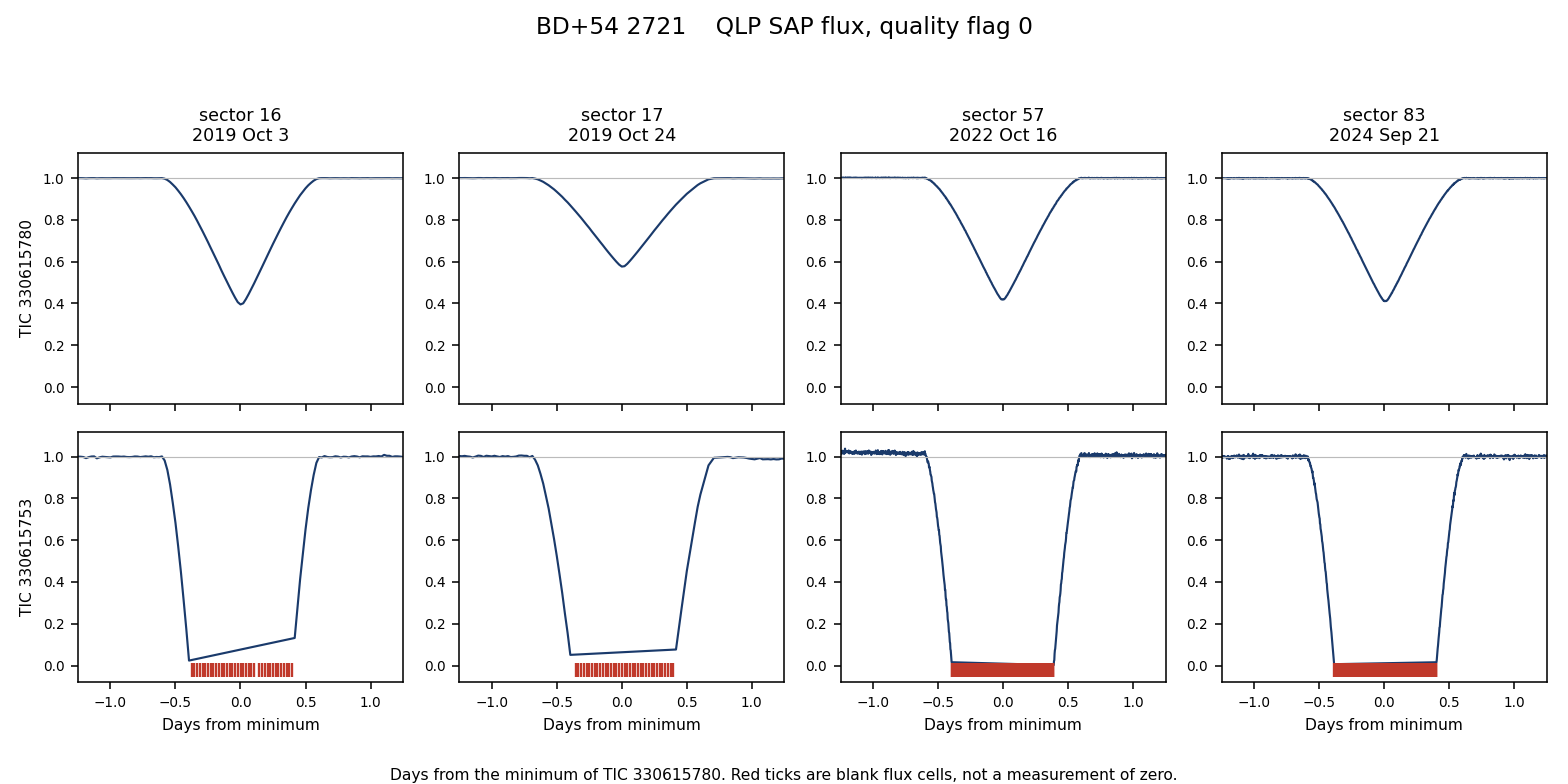
BD+54 2721 is a G0 giant, V = 9.54, about 351 parsecs away. QLP aperture flux with the quality flag at zero shows four fades. The three deep ones are one minimum:
Min I = BTJD 1759.785 + 100.84635 E
Min II follows Min I by 21.562 days, phase 0.214. The clock errors on the three primaries are about a minute. The secondary is the one shallower fade, and its phase is fixed by that single event.
- 3 Oct 2019, 06:44 UTC, BTJD 1759.785. Primary. Down to 40 percent, about 1.0 mag.
- 24 Oct 2019, 20:14 UTC, BTJD 1781.347. Secondary. Down to 58 percent, about 0.6 mag.
- 16 Oct 2022, 14:14 UTC, BTJD 2869.097. Primary, cycle 11. Down to 42 percent, about 0.9 mag.
- 21 Sep 2024, 12:21 UTC, BTJD 3575.019. Primary, cycle 18. Down to 41 percent, about 1.0 mag.
Each one takes about a day from full light back to full light. Nothing from 2 to 40 days fits. Half, a third, and a quarter of 100.8 days predict extra fades on dates these sectors cover, and the star is at full light there. The one other predicted minimum inside the sectors is the cycle-18 secondary, BTJD 3596.58, in a two-day gap in sector 84. Espin measured this as a double in 1898. The companion, BD+54 2721B = TIC 330615753, is 15 arcseconds north. Gaia puts both at the same distance, about 5300 AU apart, so that companion is not the cause of a one-day fade. Its TESS aperture goes blank through the bottom of each fade because most of that aperture is light from the giant. A dip search scored the blank as a 90 percent eclipse. It is not.
While the giant is faint, the measured centers of stars 47 and 71 arcseconds away move back away from it. The missing light belonged to BD+54 2721. The star sits on different camera pixels in 2019 and in 2024, and stars a few arcminutes away do not fade. In the later sectors the pipeline’s detrended flux deletes the dip. The raw aperture flux keeps it. The mean magnitude has been about 9.6 since 1898. The star is not in VSX, the Gaia variable tables, or the ASAS-SN variable catalog. The note has not been sent anywhere.
The light curves
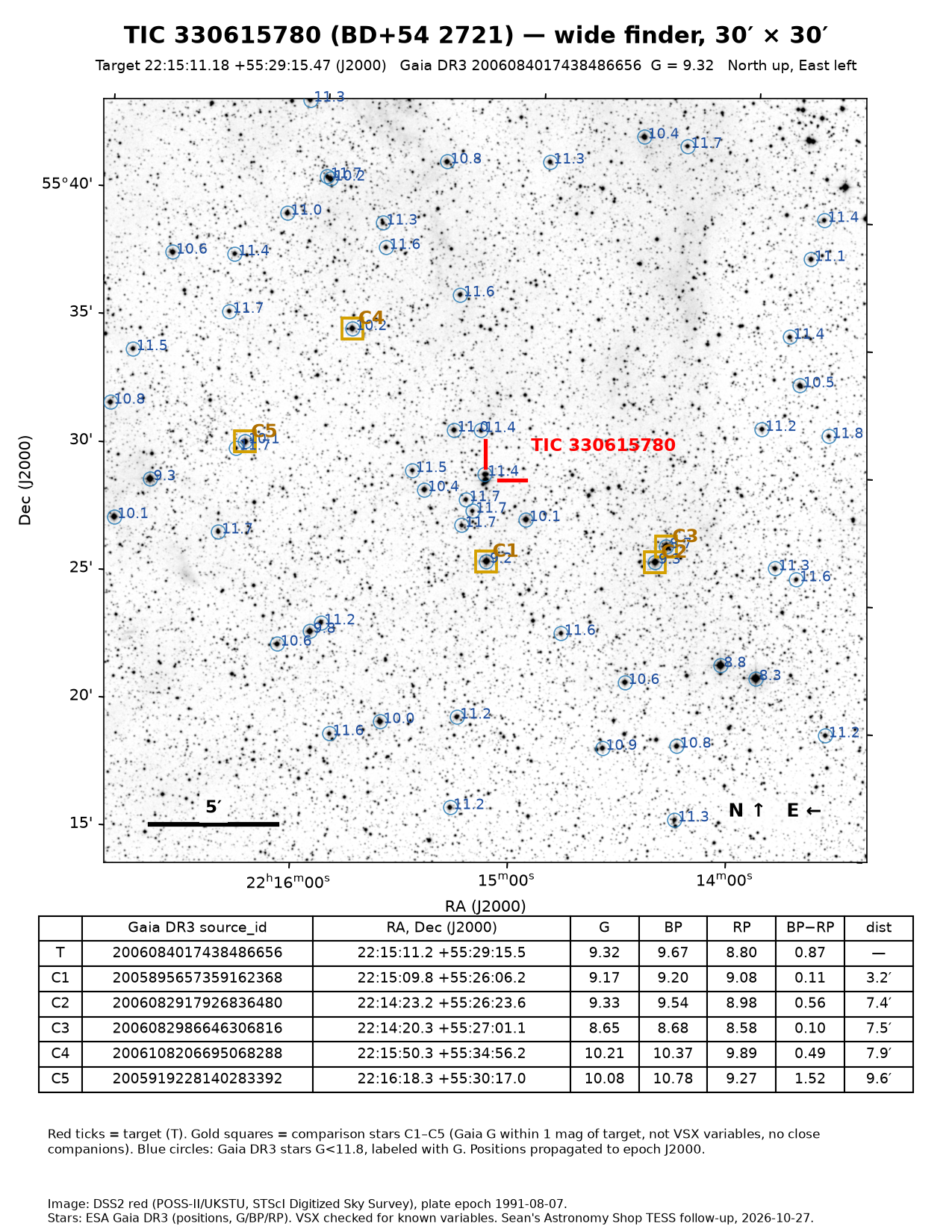
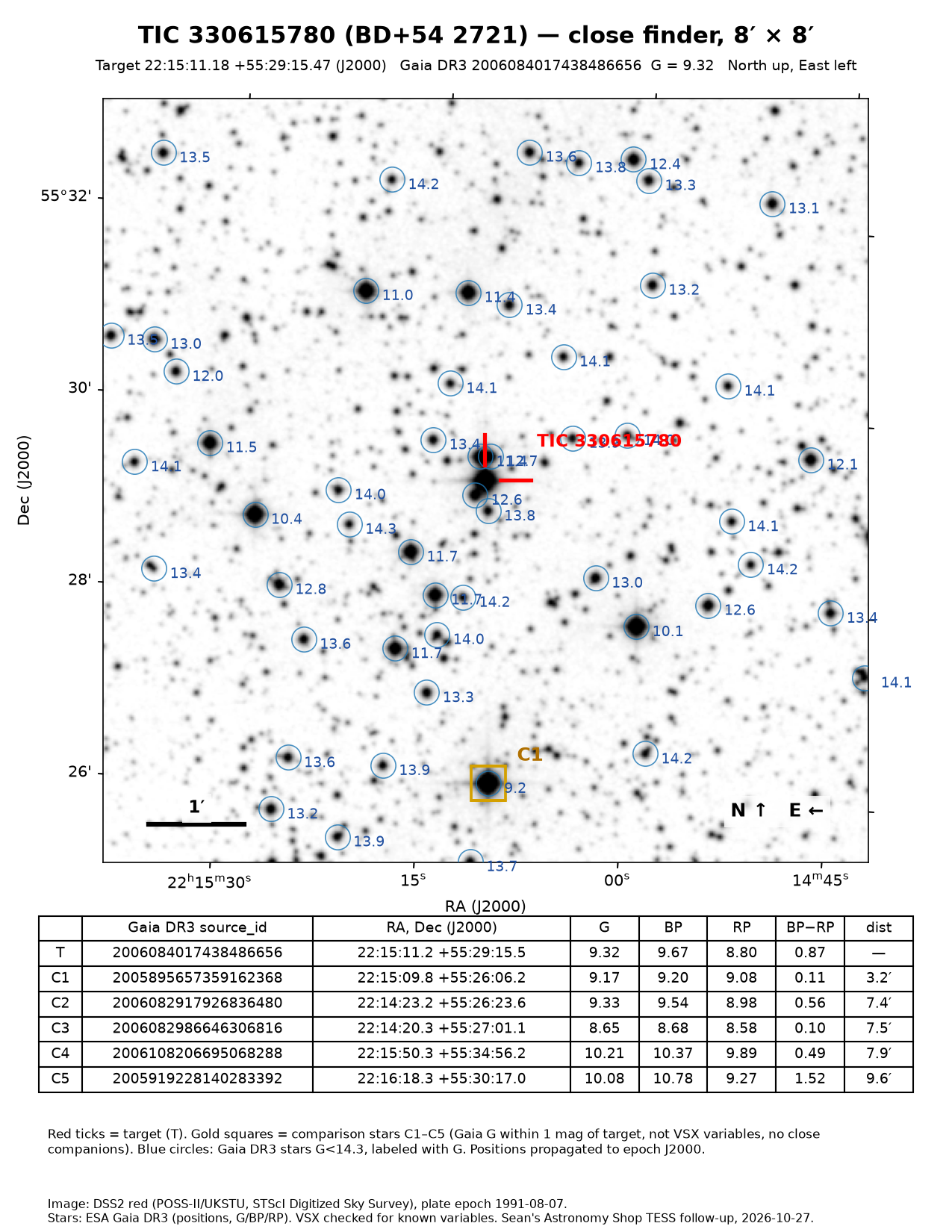
Finder chart
Real sky images (DSS2 red) with Gaia DR3 stars overlaid. North is up, east is left, J2000. Red tick marks point at the target (Gaia DR3 2006084017438486656, G = 9.32). Gold squares C1 to C5 are comparison stars of similar brightness. Tap an image for the full-size printable chart.
| Gaia DR3 | RA, Dec (J2000) | G | BP | RP | From target | |
|---|---|---|---|---|---|---|
| C1 | 2005895657359162368 | 22:15:09.8 +55:26:06.2 | 9.17 | 9.20 | 9.08 | 3.2′ |
| C2 | 2006082917926836480 | 22:14:23.2 +55:26:23.6 | 9.33 | 9.54 | 8.98 | 7.4′ |
| C3 | 2006082986646306816 | 22:14:20.3 +55:27:01.1 | 8.65 | 8.68 | 8.58 | 7.5′ |
| C4 | 2006108206695068288 | 22:15:50.3 +55:34:56.2 | 10.21 | 10.37 | 9.89 | 7.9′ |
| C5 | 2005919228140283392 | 22:16:18.3 +55:30:17.0 | 10.08 | 10.78 | 9.27 | 9.6′ |
Comparison stars are within about 1 mag of the target in Gaia G, have similar color, no close companion, and no VSX entry within 10 arcsec. Images: DSS2 red (POSS-II, STScI Digitized Sky Survey). Stars: ESA Gaia DR3.
VSX
Not filed. A 100.8-day clock fits the four TESS fades and the sectors do not contradict it. It has not been checked from the ground.
Next two eclipses
- Eclipse 1Primary minimum, the deep one. 7 Dec 2026, 06:55 UTC · 6 Dec, 22:55 PST Pacific · 7 Dec, 07:55 CET central Europe
- Eclipse 2Secondary minimum, the shallower one. 28 Dec 2026, 20:25 UTC · 28 Dec, 12:25 PST Pacific · 28 Dec, 21:25 CET central Europe
The deep minimum is about a magnitude in the TESS aperture and lasts about a day. The shallower one, 21.6 days later, is about 0.6 mag. Start the night before the listed middle and keep going through the next night. These times are the TESS fit, good to a few minutes on the three deep minima, and they have not been checked from the ground.
Help with a measurement
Pick a date below if you can measure the next one. The deep minimum is first, and the shallower one follows 21.6 days later. A frame from within a day of 3 Oct 2019, 24 Oct 2019, 16 Oct 2022, or 21 Sep 2024 would also show whether the giant was actually faint then.
The note
A 100.8-day fade of BD+54 2721, with no earlier record (PDF)
These pages use the public TESS Quick-Look Pipeline and catalog positions. A prediction is not a confirmation. If you observe, write down which star was in the aperture.