
TIC 330735422
TYC 3986-864-1 · Gaia DR3 2005042432021371392
- Position
- 22h 15m 56.93s, +54° 28′ 38.7″
- V magnitude
- 11.78
- Where
- 27 arcmin west of V345 Lac
- Signal
- EA, shallow primary. About 2.1 to 2.5 percent in the TESS aperture, lasting about four hours. A clear aperture on this star should go deeper, near 4 percent, if the fade belongs to it.
What TESS shows
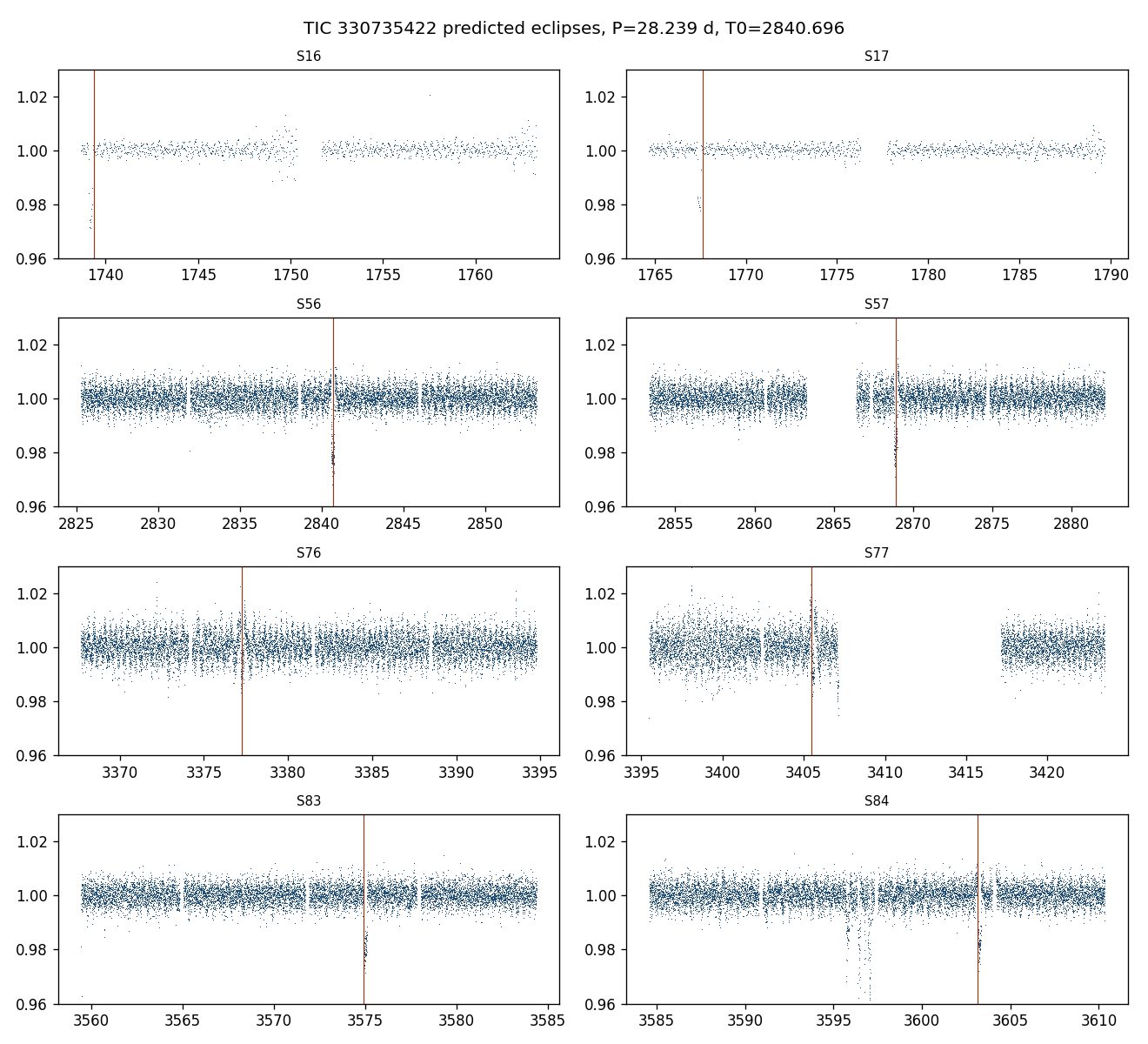
Eight sectors (16, 17, 56, 57, 76, 77, 83, and 84) show a repeating eclipse:
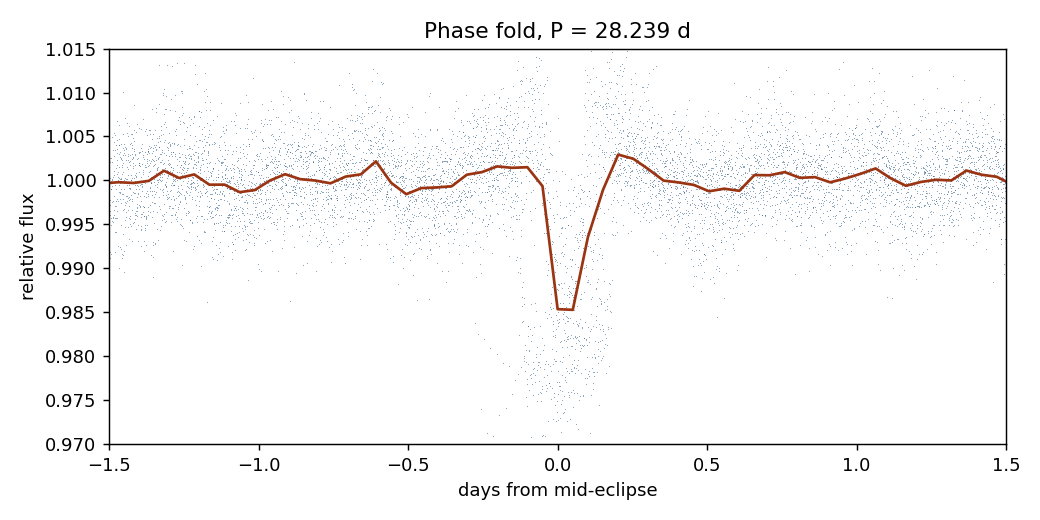
T0 = 2840.696 BTJD, P = 28.239 d
The depth in the TESS aperture is 2.1 to 2.5 percent. The width below the 1.2 percent level is 0.17 days, about four hours. The TIC contamination ratio is 0.75, so an uncontaminated aperture on this star should see about 4 percent if the fade is here. The cycle-to-cycle scatter of the clean mid-times is about 0.1 day. No secondary is seen. No centroid test has been done.
A different star, Gaia DR3 2005042401973253632, sits about 35 arcseconds away and has its own 21-minute variation. Keep it in a separate aperture. There is also an 8.4-arcsecond neighbor. About one pixel per arcsecond is a useful scale. A dip near BTJD 3596 is a bad TESS cadence, not a disk and not this eclipse.
The 23 October 2026 middle is afternoon in southern California and evening in Europe. The next middle is the evening of 20 November in Tustin, which is 21 November on the UTC clock.
The light curves
VSX
A VSX draft is saved. It is not in the public index. It gets submitted after TIC 330739083 is accepted. The draft has to say that a neighbor may be the star that fades.
Next two eclipses
- Eclipse 123 Oct 2026, 20:42 UTC · 23 Oct, 13:42 PDT Pacific · 23 Oct, 22:42 CEST central Europe
- Eclipse 221 Nov 2026, 02:26 UTC · 20 Nov, 18:26 PST Pacific · 21 Nov, 03:26 CET central Europe
Start at least three hours before the predicted middle and keep going three hours after. The mid-time itself can be off by about two hours, and the fade lasts about four hours. A visual glance will not show a 0.03-magnitude dip. A camera, with exposures of a few minutes that you then average, can.
Help with a measurement
Two groups are already willing to try TIC 330735422. More careful photometry still helps, especially if the 35-arcsecond neighbor is kept separate. If you are one of those groups, you can use this form too.
The note
A 28.24-day eclipsing binary recovered from TESS QLP photometry of TIC 330735422 (PDF)
These pages use the public TESS Quick-Look Pipeline and catalog positions. A prediction is not a confirmation. If you observe, write down which star was in the aperture.