
TIC 330739083
TYC 3986-1685-1 · Gaia DR3 2005897340986880640 · an A2 spectroscopic binary
- Position
- 22h 16m 29.87s, +55° 10′ 16.0″
- V magnitude
- 11.31
- Where
- 35 arcmin northwest of V345 Lac
- Signal
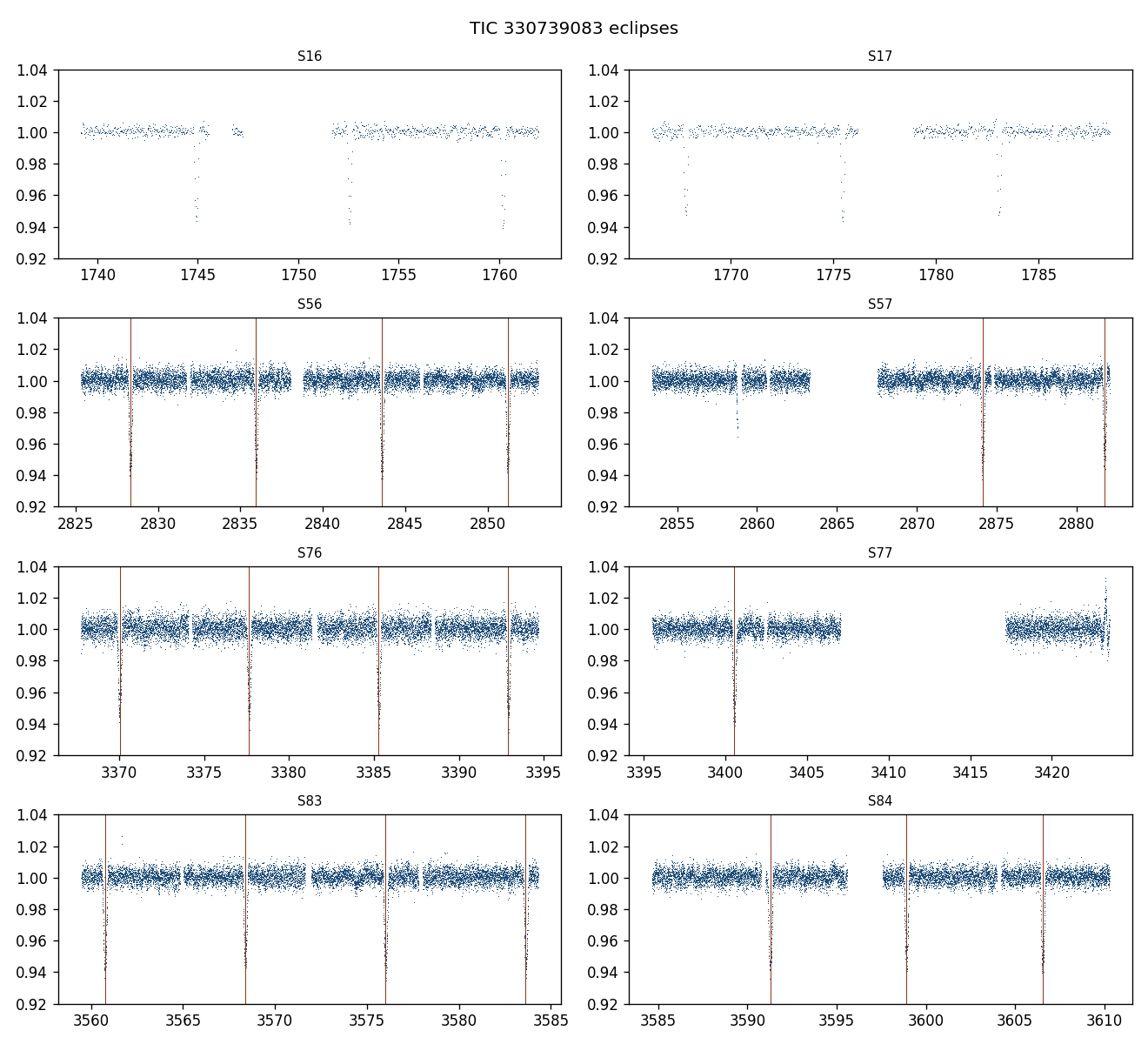
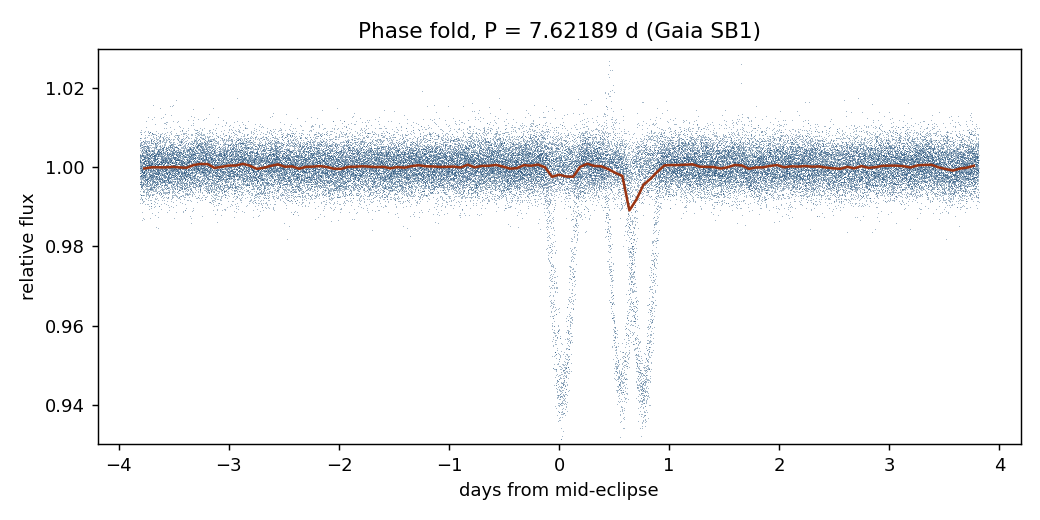
- EA, primary only in the TESS data. About 5.5 to 6.3 percent. No secondary eclipse in the phase fold.
What TESS shows
Gaia already published this star as a single-lined spectroscopic binary, period 7.62189 ± 0.00256 days. It was not catalogued as an eclipsing binary. Eighteen TESS eclipses, in sectors 56, 57, 76, 77, 83, and 84, fall on that orbit. The photometric epoch used in the note is the first clean minimum:
T0 = 2828.323 BTJD, P = 7.62189 d
The TESS eclipses are spaced by about 7.625 days, which matches the Gaia period inside the binning. No secondary eclipse shows up in the phase fold. The depth is 5.5 to 6.3 percent. No centroid test has been done. The adopted period is the Gaia period. By late 2026 the 0.003-day difference between that period and the raw TESS spacing has grown to about half a day, so the times below are a window.
The light curves
VSX
Submitted to VSX on 9 October 2026. It is in review under the name TIC 330739083. This was the first star filed from a new account, so the others wait until a moderator accepts it.
Next two eclipses
- Eclipse 1The two period clocks for cycle 197 disagree, so treat this as a window, not a minute.Earlier clock: 16 Oct 2026, 08:02 UTC · 16 Oct, 01:02 PDT Pacific · 16 Oct, 10:02 CEST central EuropeLater clock: 16 Oct 2026, 22:45 UTC · 16 Oct, 15:45 PDT Pacific · 17 Oct, 00:45 CEST central Europe
- Eclipse 2The two period clocks for cycle 198 disagree, so treat this as a window, not a minute.Earlier clock: 23 Oct 2026, 22:58 UTC · 23 Oct, 15:58 PDT Pacific · 24 Oct, 00:58 CEST central EuropeLater clock: 24 Oct 2026, 13:45 UTC · 24 Oct, 06:45 PDT Pacific · 24 Oct, 15:45 CEST central Europe
Watch the whole window, not one of the two clocks. The eclipse depth is about 6 percent. I do not have a measured duration to quote. No centroid test has been done.
Help with a measurement
A ground eclipse tells us the dip is on this star and not on a neighbor in the TESS pixel. Differential photometry is the right tool. Pick a date if you can try.
The note
Eclipses of the Gaia Spectroscopic Binary TIC 330739083 (PDF)
These pages use the public TESS Quick-Look Pipeline and catalog positions. A prediction is not a confirmation. If you observe, write down which star was in the aperture.