
TIC 330951195
Gaia DR3 2198463539721659136
- Position
- 22h 17m 10.72s, +56° 51′ 21.6″
- V magnitude
- 11.97
- Where
- 131 arcmin north of V345 Lac, 2.191°, near the edge of the 2.20° ring
- Signal
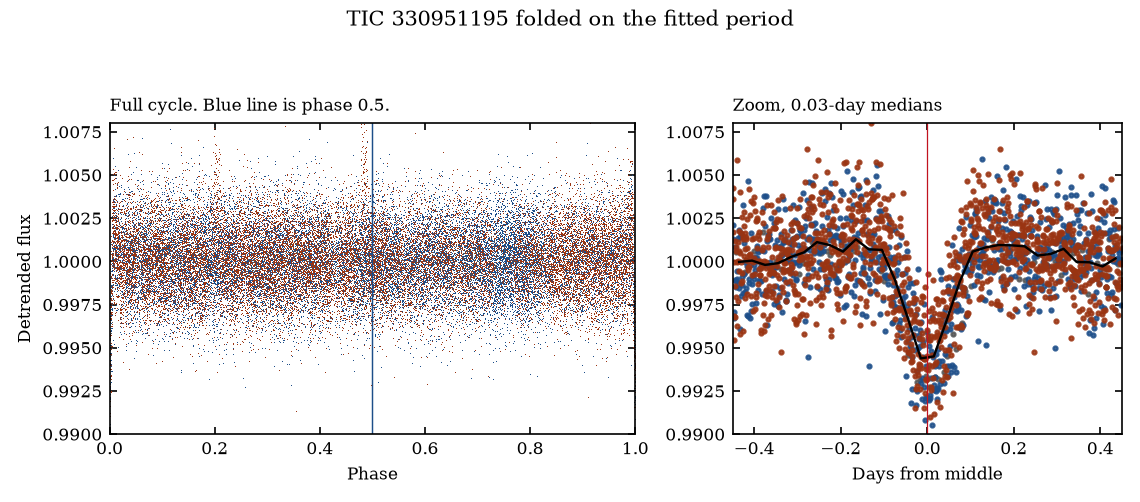
- Possible planet, 18.34 days. About 0.3 to 0.7 percent. The depth changes from dip to dip. Phase 0.5 stays flat.
What TESS shows
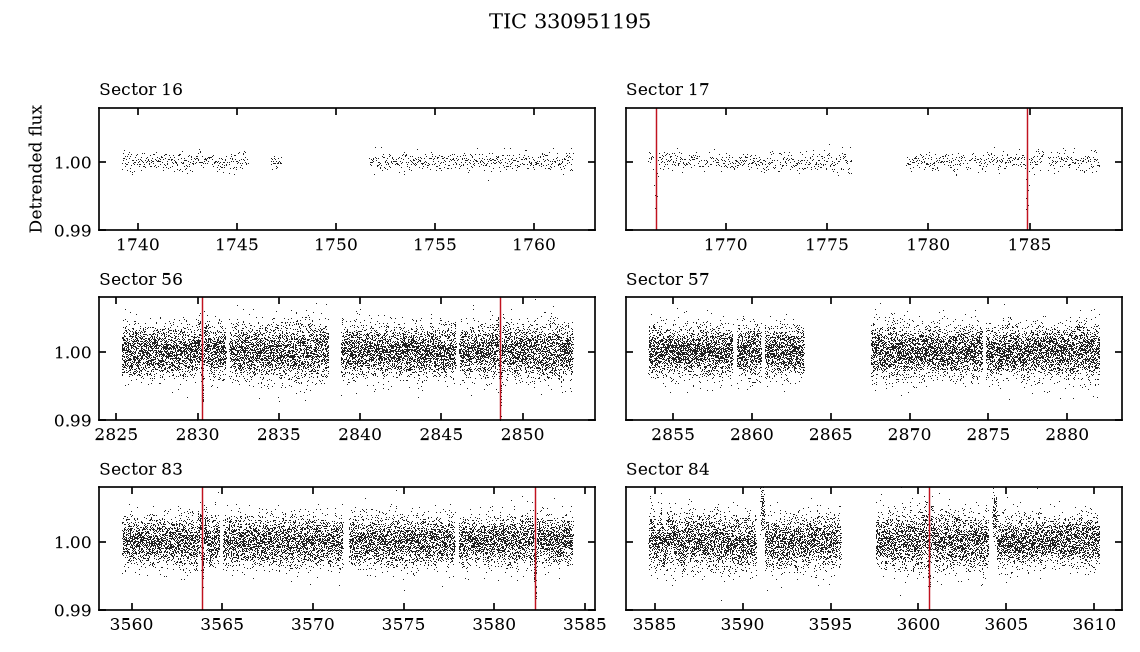
Seven dips in sectors 17, 56, 83, and 84 give
Min = BTJD 1766.5308 + 18.34066 E
Every predicted time that lands inside a sector is a dip. One time in sector 16 and one in sector 57 fall in gaps. The times scatter by 10 minutes rms. The largest residual is 23 minutes. The depth runs from about 0.3 percent to about 0.7 percent, and it changes from dip to dip. At phase 0.5, in the eight epochs TESS covered, the light stays within about 0.1 percent of full.
A spacing of 55 days lands on every third dip. The dips between those times are real, so the clock is 18.34 days. The centroid on these dips shifts by a few hundredths of a pixel. The nearest VSX object is Gaia DR3 2198464329995638784, a rotator 54 arcsec away, and that catalog row has no period. The TESS catalog lists no contamination ratio for this star. The catalog temperature and radius are not adopted, and the depth is not turned into a planet radius.
A repeating fade with a flat halfway phase is the pattern of a planet. The depth changing from dip to dip is why this stays a possible detection. The note is not a VSX submission.
The light curves

Finder chart
The position above is the TESS catalog place. A DSS finder with comparison stars is not drawn on this page yet. Use that position, and keep any neighbor inside an arcminute in its own aperture.
VSX
Not filed. Possible planet, 11 Nov 2026. The nearest VSX object is Gaia DR3 2198464329995638784, a rotator 54 arcsec away, and that row has no period. The depth is not turned into a radius.
Next two transits
- Transit 126 Nov 2026, 09:37 UTC · 26 Nov, 01:37 PST Pacific · 26 Nov, 10:37 CET central Europe
- Transit 214 Dec 2026, 17:49 UTC · 14 Dec, 09:49 PST Pacific · 14 Dec, 18:49 CET central Europe
The dip is a fraction of a percent and lasts a few hours. Start two hours before the predicted middle. The seven TESS times scatter by 10 minutes, and the worst miss is 23 minutes. A visual glance will not show it. A camera, with exposures of a few minutes that you then average, can. These times have not been checked from the ground.
Help with a measurement
A camera measurement on this star, with the rotator 54 arcsec away kept out of the aperture, is what would show the fade is here. The dip is a fraction of a percent. Pick a transit if you can try.
These pages use the public TESS Quick-Look Pipeline and catalog positions. The fade repeats and phase 0.5 stays flat where TESS covered it. This is a possible planet. It is not confirmed, and nothing here has been submitted to VSX. A listed time is a window of a couple of hours. If you observe, write down which star was in the aperture.