
TIC 341985596
TESS eclipses near V345 Lac · Star spots / rotational variables
TIC 341985596 · Possible rotational (star-spot) variable
- Position
- 22h 11m 44.49s, +53° 01′ 56.2″ (J2000). RA 332.93536°, Dec +53.03227°
- TESS magnitude
- 10.039
- Temperature
- 6,371 K, radius 1.52 solar radii (TIC v8.2)
- Where
- 1.939° from V345 Lac, to the south-southwest, in the 1.90–2.00° ring
- TESS sectors
- 16, 17, 56, 57, 83, 84
- Status
- Variable star candidate, not an eclipsing binary. Found 18 Nov 2026 scan. Not filed with VSX. Not checked from the ground.
Best guess
Possible rotational (star-spot) variable. The amplitude spectrum shows a tight group of frequencies between 1.949 and 2.003 c/d (1.4 to 2.5 ppt), periods near 0.5 days. Fitted separately by year, the strongest frequency is 2.000 c/d in sectors 16–17, 1.997 c/d in 56–57 and 1.954 c/d in 83–84, with amplitudes of 2.9, 3.5 and 1.5 ppt. A signal whose period and amplitude change from year to year fits evolving spots on a fast-rotating star at a TIC temperature of 6371 K. γ Doradus pulsation would give a similar group of close frequencies, so this is a possible classification. The fold is a smooth wave with no eclipse shape.
Listed on Star spots / rotational variables. This is a best guess from TESS data alone. It has not been checked with a spectrum or from the ground.
The light curve
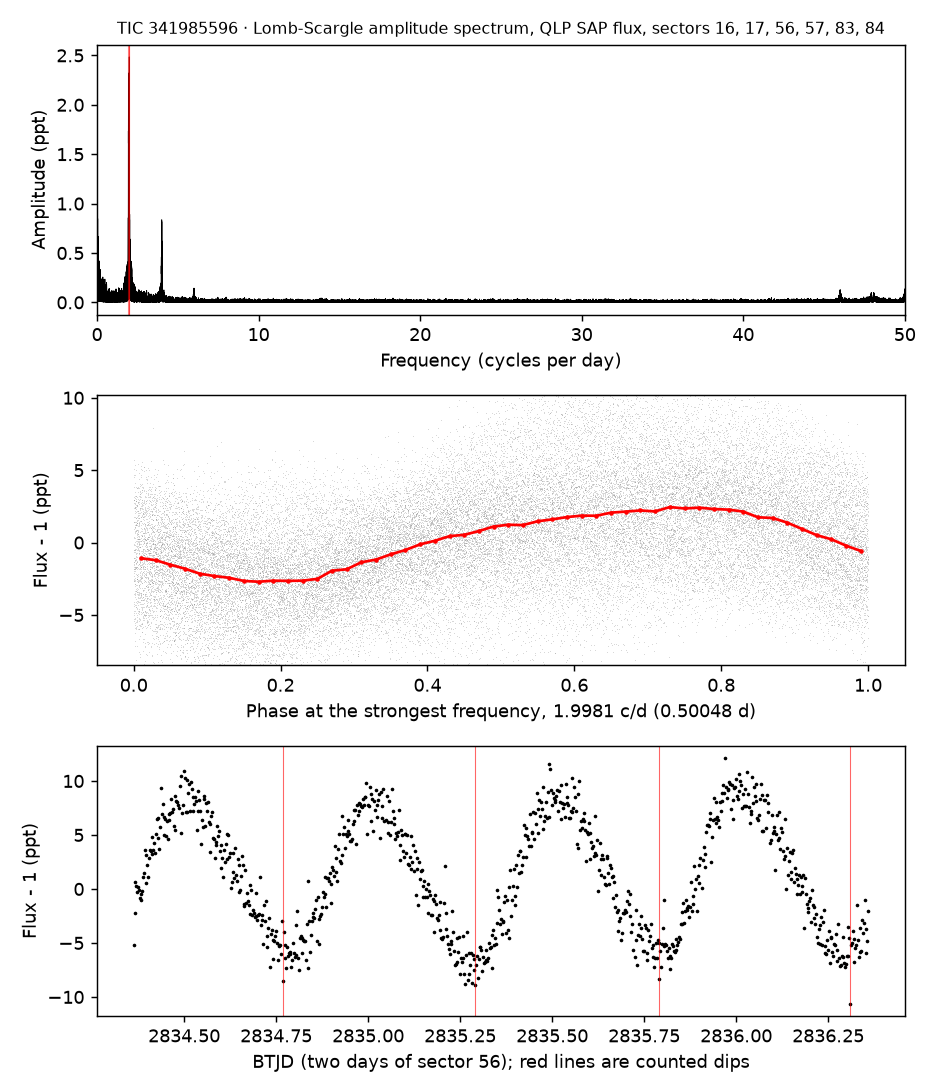
Frequencies
| Frequency | Period | Amplitude | Signal to noise |
|---|---|---|---|
| 1.998 c/d | 12.01 h | 2.50 ppt | 43.4 |
| 1.962 c/d | 12.23 h | 2.31 ppt | 45.7 |
| 1.949 c/d | 12.32 h | 1.61 ppt | 36.5 |
| 2.003 c/d | 11.98 h | 1.37 ppt | 37.5 |
| 1.979 c/d | 12.13 h | 1.03 ppt | 28.5 |
| 4.005 c/d | 5.99 h | 0.82 ppt | 40.3 |
The six strongest peaks, found one at a time with the previous ones removed. Signal to noise is the peak amplitude divided by the mean amplitude within 1 cycle per day after removal. A peak below about 0.1 c/d is usually instrumental.
What the scan measured
- 86 clean dips of at least 0.5 percent, median depth 0.79 percent, range 0.63 to 1.22 percent.
- Median spacing between dips 12.3 hours.
- Best scan period 0.50049 days. Folded on it, the box depth is 0.194 percent, much less than the dips themselves.
- No VSX entry within 10 arcsec and no Gaia DR3 eclipsing binary within 5 arcsec.
Follow-up
Photometry over several nights would show whether the period and amplitude drift as spots would. A spectrum would give the rotation speed. If you observe it, write down which star was in the aperture. TESS pixels are 21 arcseconds wide.
The note
Research note (PDF): TIC 341985596: possible rotational (star-spot) variable
These pages use the public TESS Quick-Look Pipeline and catalog positions. Variable star candidate, not an eclipsing binary. Found 18 Nov 2026 scan. Not filed with VSX. Not checked from the ground.