
TIC 343019899
TESS eclipses near V345 Lac · Planet-sized dips
TIC 343019899 · Unconfirmed pair of very shallow dips. The period is a guess from two events. Low confidence.
- Position
- 22h 18m 00.89s, +54° 19′ 08.4″ (J2000). RA 334.50370°, Dec +54.31900°
- TESS magnitude
- 10.062
- Temperature
- 5,769 K, radius 1.03 solar radii (TIC v8.2). Spectral type is not given in the TIC fields used here.
- Where
- 0.371° from V345 Lac, to the south-southwest, in the 0.30–0.40° ring
- TESS sectors
- 16, 17, 56, 57, 83, 84
- Median dip
- 0.55% deep, 4.7 h, 2 counted dips
- Status
- Unconfirmed dips. Not a planet claim. Found 18 Nov 2026. Not filed with VSX. Not checked from the ground.
Next listed dip
5 Jan 2027, 14:28 UTC 5 Jan, 06:28 PST
± 4.0 h High confidence
BTJD 4411.104, on the 74.9341-day period used by the Planet-sized dips page. The live page recomputes this time when it loads. The research note lists the times as of 18 November 2026, 12:00 UTC.
Best guess
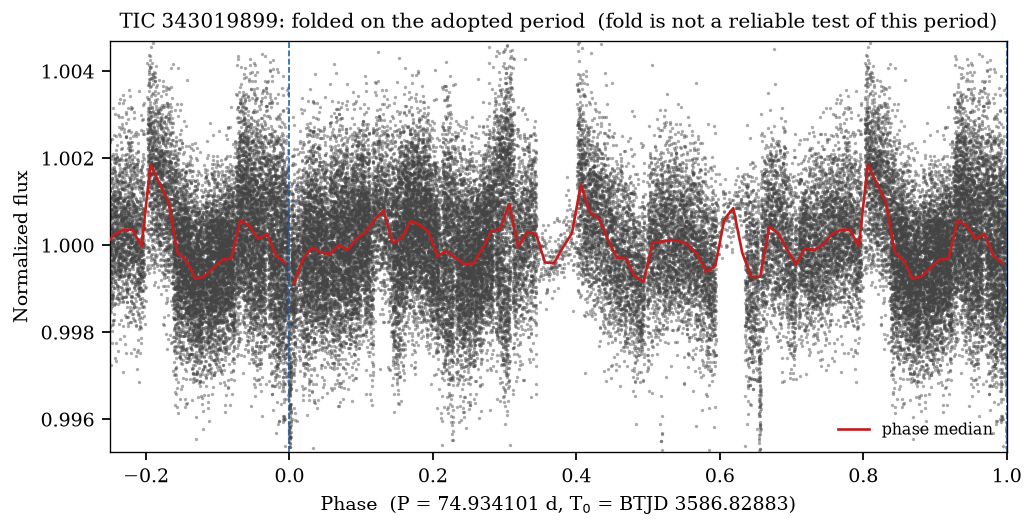
Unconfirmed pair of very shallow dips. The period is a guess from two events. Low confidence. As with any two-dip star, the 749.341-day interval and its integer divisions 2 through 10 are all still open. The pages show the soonest upcoming time, on the shortest alias, 74.934101 ± 0.00688 days. The ±4 hour window applies only if that alias is the true period, which is not known from two dips. No VSX entry lies within 30 arcsec. The events are real enough to have been counted by the scan, but they are among the shallowest in this list and have not been checked from the ground. This is not a planet claim.
Dip shape
Only two dips were counted, 0.55 and 0.56 percent deep, 749.341 days apart, in sectors 56 and 84. Both are shallow rounded U-shaped fades, a few hours long, with no flat bottom. At 0.55 percent the shape is close to the point scatter. A fold on a single alias of the 749-day gap is not a reliable test of the period.
The light curve
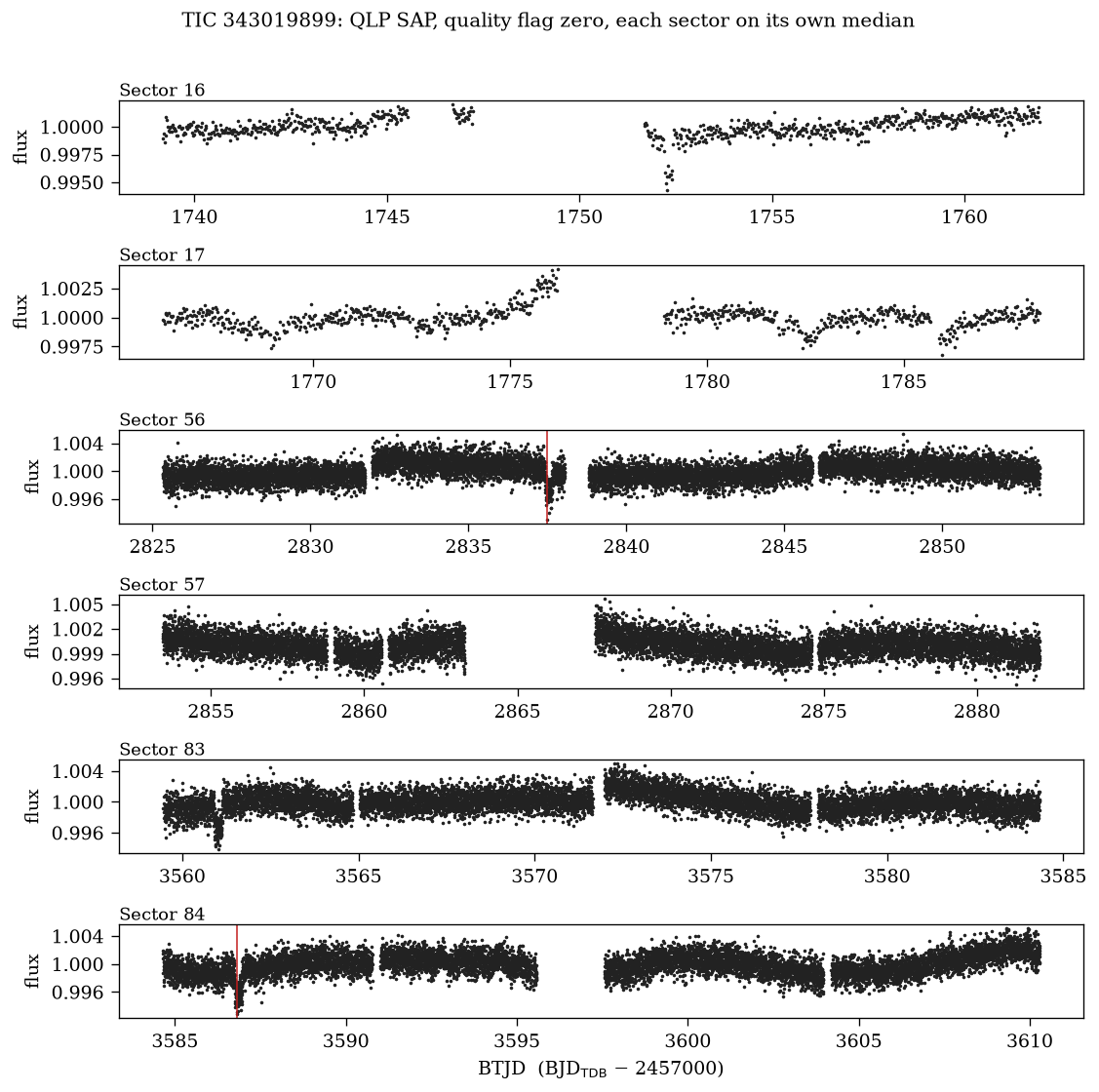
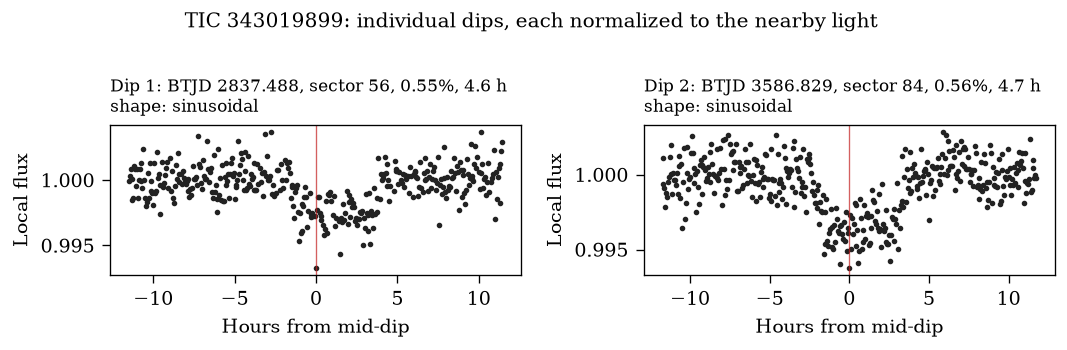
Finder chart
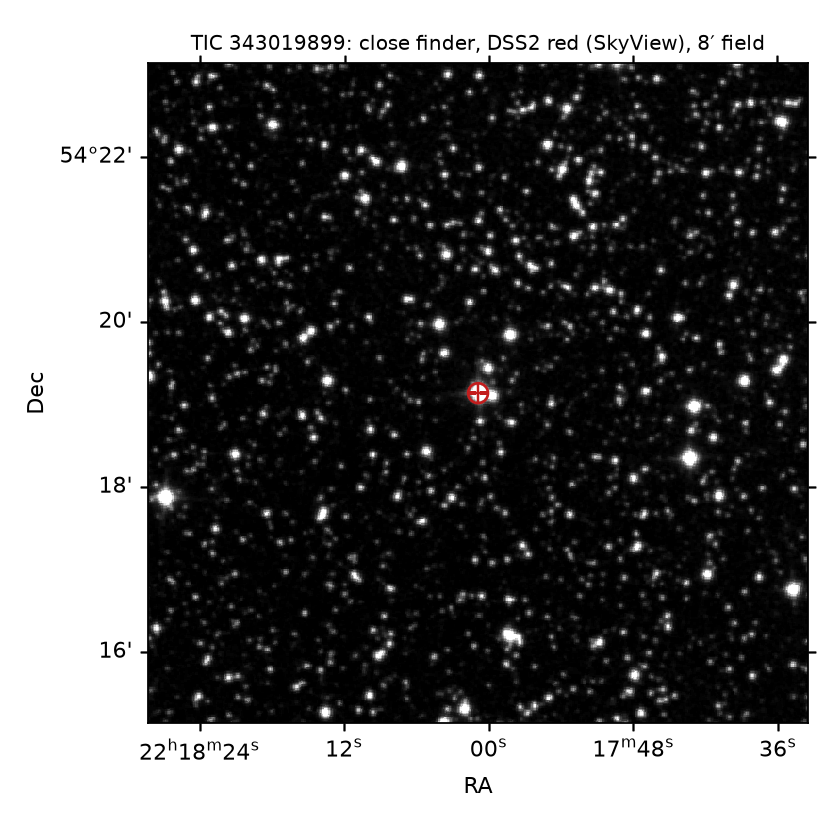
What the scan measured
- 2 clean dips of at least 0.5 percent, median depth 0.55 percent, median duration 4.7 hours.
- TIC radius 1.03 solar radii; a depth conversion (not a planet measurement) gives about 0.76 Jupiter radii. Contamination ratio 0.317.
- No VSX entry within 10 arcsec and no Gaia DR3 eclipsing binary within 5 arcsec recorded in the scan.
The note
Research note (PDF): TIC 343019899
These pages use the public TESS Quick-Look Pipeline and catalog positions. Unconfirmed dips. Not a planet claim. Not filed with VSX. Not checked from the ground.