
TIC 422106434 (Ground Confirmed)
TYC 3986-02206-1 · Gaia DR3 2005947815437527808 · 2MASS J22225190+5536497
- Position
- 22h 22m 51.91s, +55° 36′ 49.7″
- V magnitude
- 9.96
- Where
- 67 arcmin northeast of V345 Lac, in the 1.2° ring
- Signal
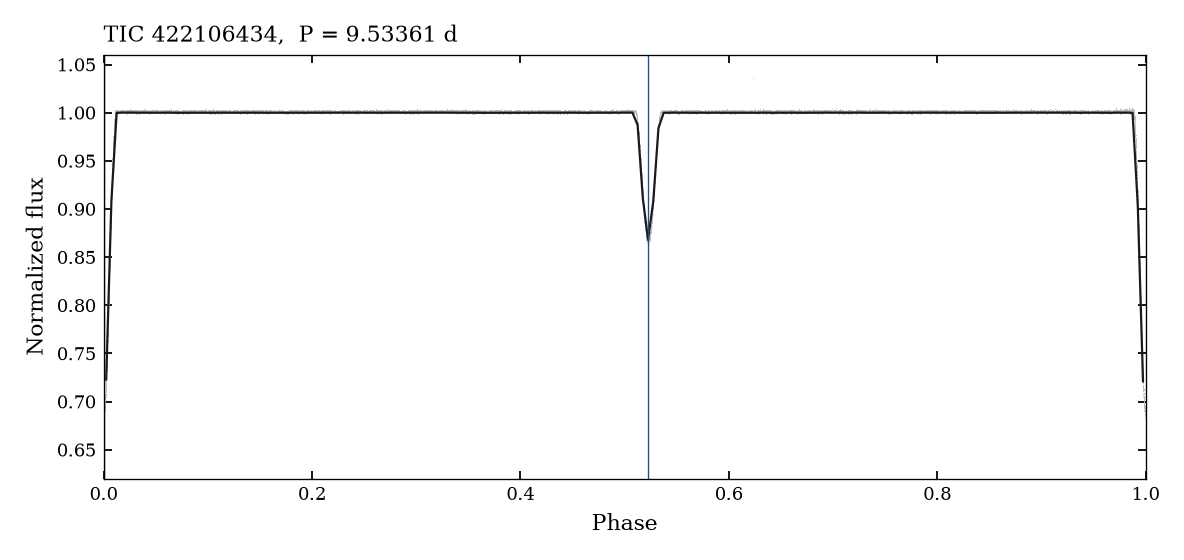
- EA, primary and secondary, 9.53 days. Primary about 0.41 mag, down to 68 percent of the light. Secondary about 0.16 mag, at phase 0.523.
What TESS shows
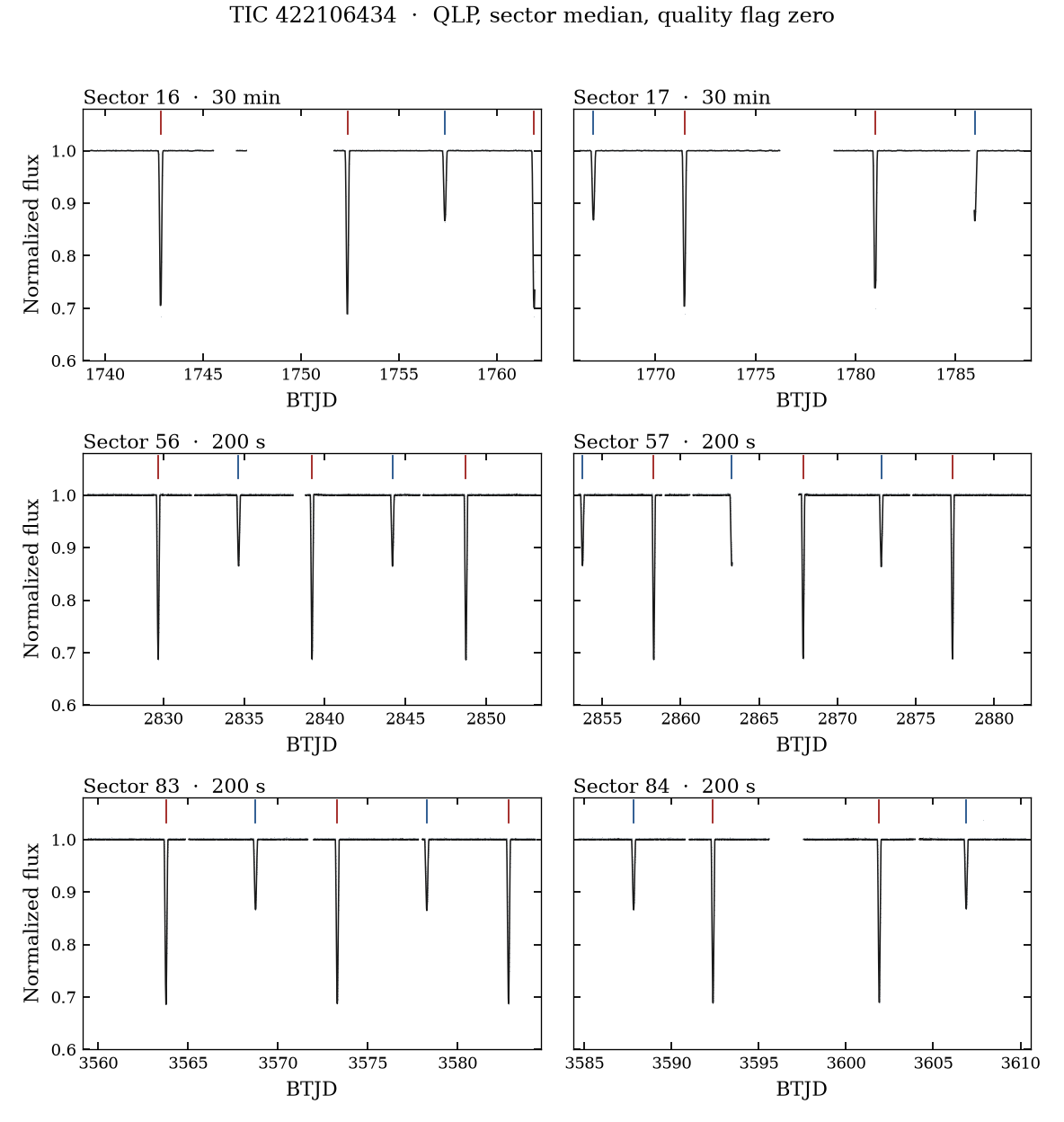
Sixteen deep minima in sectors 16, 17, 56, 57, 83, and 84 give
Min I = BTJD 1742.8501 + 9.533613 E
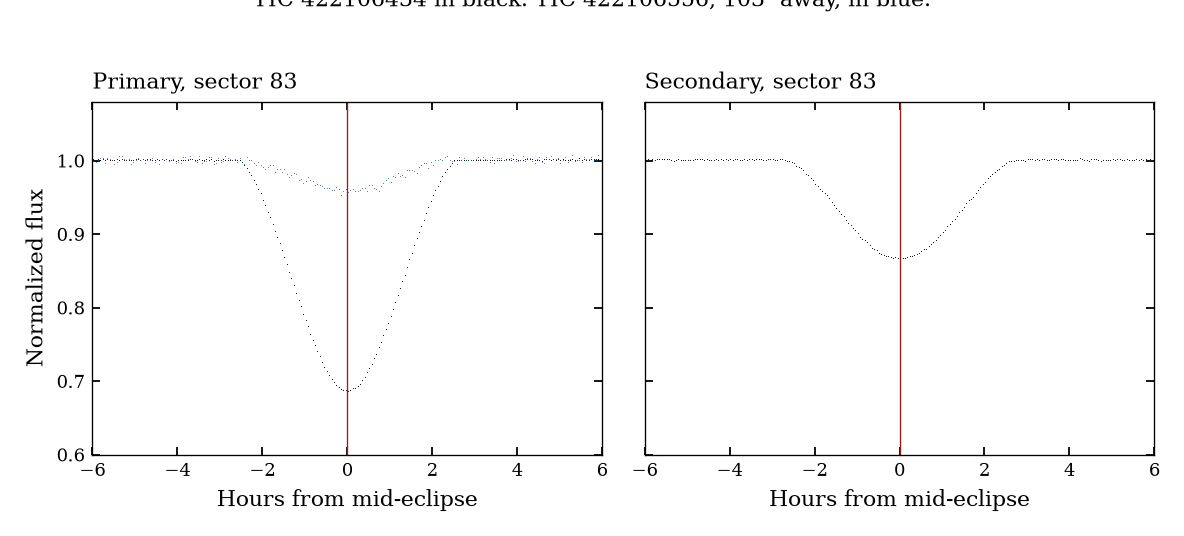
The deep minimum falls to 68 percent of the normal light, 0.41 mag. The part below 80 percent lasts about 2.1 hours, and the whole fade, from 98 percent back to 98 percent, lasts about 4.4 hours. A shallower minimum, 0.16 mag, falls at phase 0.523, which is 4.98 days later, about five hours past the halfway point. The sixteen times scatter by 4.8 minutes rms. The worst residual is 12 minutes.
The star is a solar-type dwarf at about 138 parsecs, G = 9.80, with a Gaia parallax of 7.23 mas. Neighbors contribute only 6.5 percent of its light in the TESS catalog aperture, and the eclipse is 32 percent deep, so the missing light is this star’s. The centroid barely moves. A star 103 arcsec away, TIC 422106556, fades about 5 percent at the same times. That is this eclipse, diluted. Stars elsewhere in the field stay at full light. The note is saved as a VSX draft and is not in the public index.
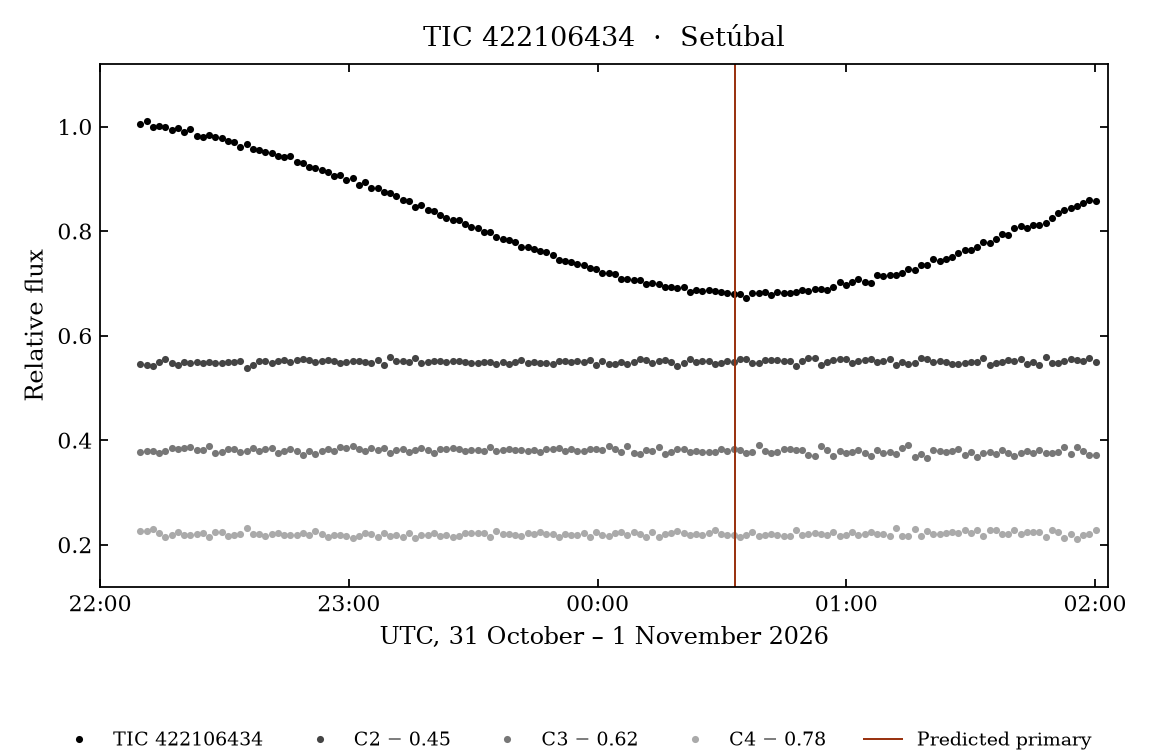
Alexandre Santana confirmed the primary from Setúbal, Portugal, on the night of 31 October to 1 November 2026. The telescope was his 8-inch Newtonian, with an IMX533 camera and a UV/IR cut filter. One hundred fifty-four exposures of 90 seconds run from 22:09 to 02:00 UTC. The middle is BJD 2461345.5292, 00:37 UTC, 3.8 minutes after the ephemeris above. The star fell to 0.682 of its opening light, 0.416 mag, and stayed under 80 percent of that light for 2.11 hours. Three comparison stars stayed level, and the star 22 arcsec away was outside the aperture. One minimum this close does not change the period.
Results from the data
TESS, Gaia, and the Setúbal night fix the period, the distance, and the two eclipses. The mass, radius, and spectral type of each star are still open. The numbers here are the TESS fit and the Gaia entry. Setúbal checks the deep eclipse only.
Measured
- Period
- 9.533613 days. The deep minimum is BJD 2458742.8501. Sixteen TESS times scatter by 4.8 minutes. Setúbal on 1 November 2026 landed 3.8 minutes late, inside that scatter. One ground point leaves the period as it is.
- Distance
- 138.3 parsecs, uncertain by 0.3. The Gaia parallax is 7.230 ± 0.015 mas.
- Deep eclipse
- 0.410 mag in TESS, down to 68.5 percent of the light. The star stays under 98 percent for 4.4 hours and under 80 percent for 2.11 hours. Setúbal measured 0.416 mag and the same 2.11 hours under 80 percent.
- Shallow eclipse
- 0.159 mag, down to 86.4 percent of the light, 4.3 hours under 98 percent. It falls at phase 0.523. The ground has not checked this minimum yet.
- The pair
- One Gaia source, G = 9.80. The blue-minus-red color is 0.80, about the color of the Sun. The single-star fit to the blended light is 5690 K and log g = 4.23, dwarf gravity. Absolute G is 4.09, about 1.7 times the Sun in the G filter, a little fainter than two Suns. Gaia published no orbit. The radial velocity is uncertain by 10 km/s.
What the eclipses require
- Shape
- Both minima come to a point. The 200-second points show no flat bottom, so any total phase is shorter than a few minutes. The deep eclipse blocks 31 percent of the light and the shallow one blocks 14 percent. Two total eclipses would account for the whole light, and 31 plus 14 is 45 percent, so they are not both total. The depth is the light blocked at mid-eclipse. In a partial eclipse that is smaller than the light share of the star in front. Which star is hotter stays open.
- Orbit shape
- The shallow minimum falls 5.2 hours after halfway. The shift is far larger than the 4.8-minute scatter of the deep minima, so the orbit is eccentric. For an eclipse this close to edge-on, the shift fixes e cos ω at 0.036, and the eccentricity is at least 0.036. The angle is still open. The two eclipses last 4.4 and 4.3 hours, almost the same, so the durations leave the eccentricity and the angle tangled together.
- Sizes
- The 4.4-hour deep eclipse puts the two radii, added together, at least about 6 percent of the separation. The measured width is the time spent under 98 percent of normal light, a little inside the true contacts, and an off-center eclipse needs larger stars to last this long. Six percent is a floor. On the mass scale below, that floor is about 1.2 solar radii if the pair weighs one Sun and about 1.5 solar radii if it weighs two. Each radius on its own is still open.
- Separation
- The separation follows only after the two masses are added, and the masses are not measured. If the pair weighs one Sun the separation is 0.088 AU, about 19 solar radii. At one and a half Suns it is 0.10 AU. At two Suns it is 0.11 AU, about 24 solar radii. At 138 parsecs that span is 0.6 to 0.8 milliarcseconds, inside the one Gaia source.
Still open
- The mass of each star.
- The radius of each star.
- Which star is hotter, and a spectral type for each star. The blended light looks solar.
- A radial-velocity orbit that could weigh the pair.
The light curves
Finder chart
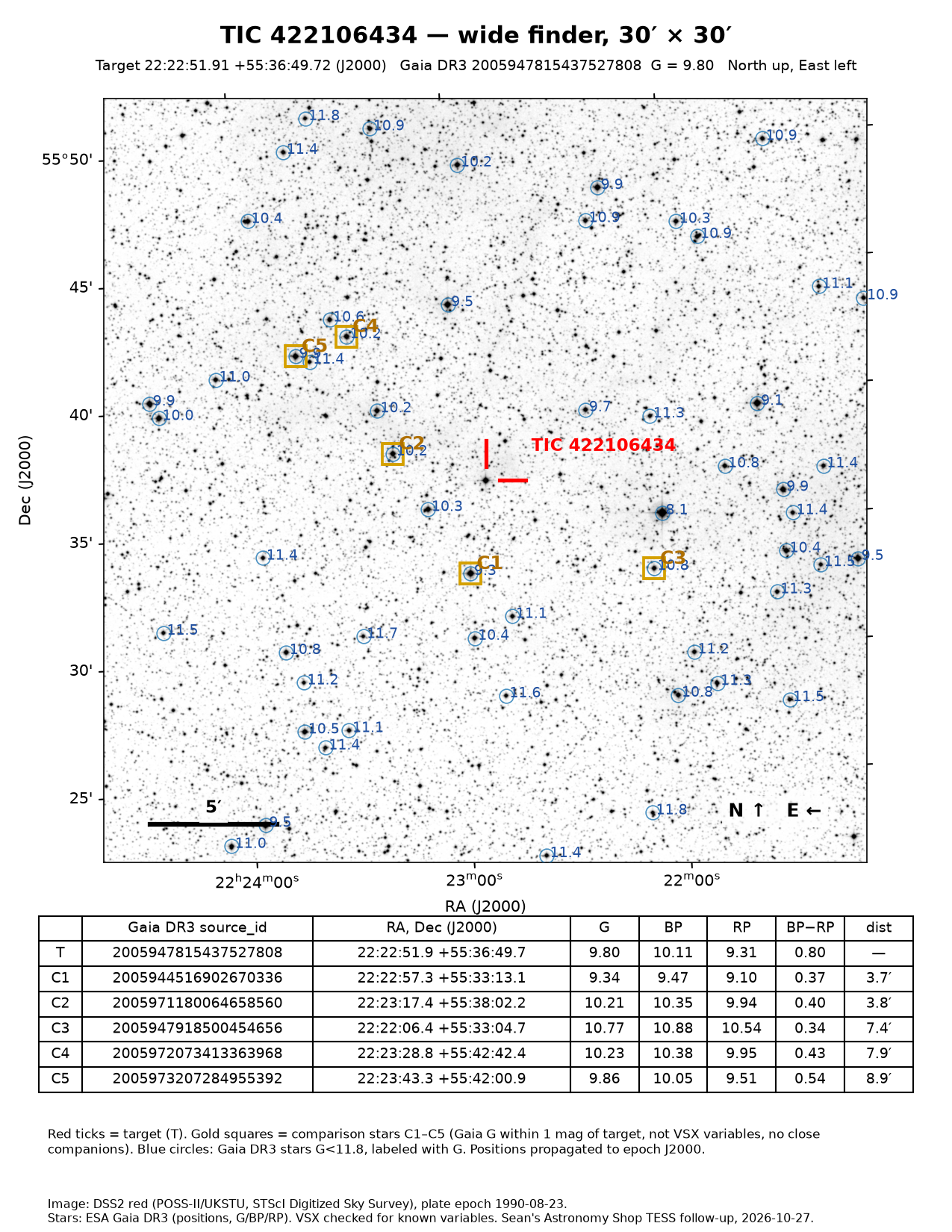
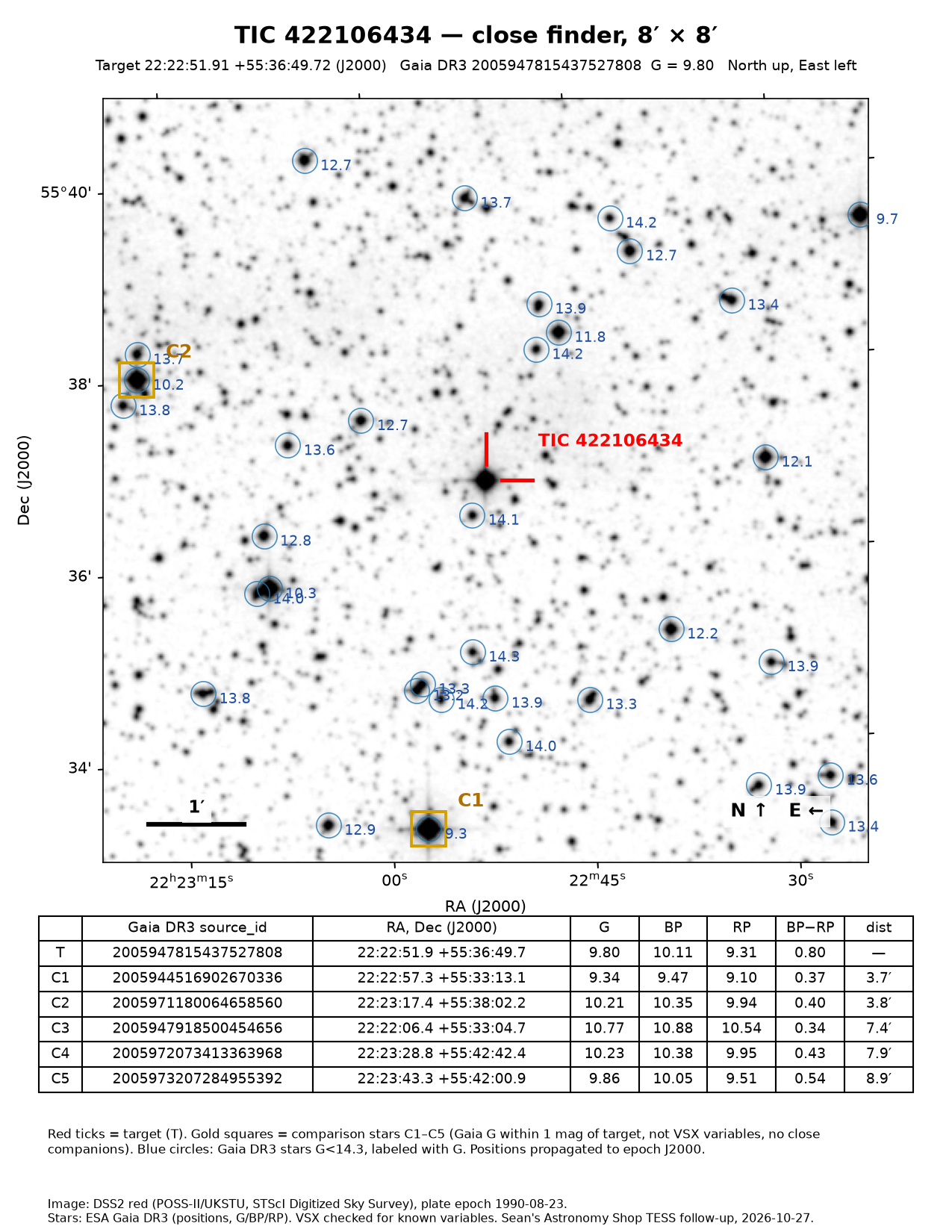
Real sky images (DSS2 red) with Gaia DR3 stars overlaid. North is up, east is left, J2000. Red tick marks point at the target (Gaia DR3 2005947815437527808, G = 9.80). Gold squares C1 to C5 are comparison stars of similar brightness. Tap an image for the full-size printable chart.
| Gaia DR3 | RA, Dec (J2000) | G | BP | RP | From target | |
|---|---|---|---|---|---|---|
| C1 | 2005944516902670336 | 22:22:57.3 +55:33:13.1 | 9.34 | 9.47 | 9.10 | 3.7′ |
| C2 | 2005971180064658560 | 22:23:17.4 +55:38:02.2 | 10.21 | 10.35 | 9.94 | 3.8′ |
| C3 | 2005947918500454656 | 22:22:06.4 +55:33:04.7 | 10.77 | 10.88 | 10.54 | 7.4′ |
| C4 | 2005972073413363968 | 22:23:28.8 +55:42:42.4 | 10.23 | 10.38 | 9.95 | 7.9′ |
| C5 | 2005973207284955392 | 22:23:43.3 +55:42:00.9 | 9.86 | 10.05 | 9.51 | 8.9′ |
Comparison stars are within about 1 mag of the target in Gaia G, have similar color, no close companion, and no VSX entry within 10 arcsec. Images: DSS2 red (POSS-II, STScI Digitized Sky Survey). Stars: ESA Gaia DR3.
VSX
A VSX draft was saved on 15 October 2026. The star is not in the public index, and Gaia does not list it as a variable. The draft waits while TIC 330739083 is the one star in review. The primary was confirmed from the ground on 1 November 2026.
Next two eclipses
- Eclipse 1Secondary minimum, the shallower one. 25 Nov 2026, 01:45 UTC · 24 Nov, 17:45 PST Pacific · 25 Nov, 02:45 CET central Europe
- Eclipse 2Primary minimum, the deep one. 29 Nov 2026, 14:59 UTC · 29 Nov, 06:59 PST Pacific · 29 Nov, 15:59 CET central Europe
The deep minimum is 0.41 mag and lasts about four hours. The shallower one, 0.16 mag, follows 4.98 days later. These times are the TESS fit. The largest residual in the sixteen deep minima is 12 minutes. The primary on 1 November 2026 was observed from Setúbal and landed 3.8 minutes late. The shallower minimum has not been checked from the ground. Keep the star 22 arcsec away out of the aperture. It is five magnitudes fainter and is not the eclipsing star.
Help with a measurement
The primary was confirmed from Setúbal on 1 November 2026. Another night still helps, especially the 0.16 mag minimum. Pick a date if you can try.
The note
A 9.53-day eclipsing binary: TIC 422106434 (PDF)
Ground confirmation, 1 November 2026 (PDF)
Setúbal measurements, 31 October to 1 November 2026 (AstroImageJ table)
The primary on 1 November 2026 was confirmed from Setúbal. Later times on this page are still the TESS fit. If you observe, write down which star was in the aperture.