
TIC 422108893
GSC 03986-01462 · Gaia DR3 2006044022708105344 · 2MASS J22225316+5608062
- Position
- 22h 22m 53.17s, +56° 08′ 06.1″
- V magnitude
- 11.93
- Where
- 94 arcmin north-northeast of V345 Lac, 1.574°, in the 1.50–1.60° ring
- Signal
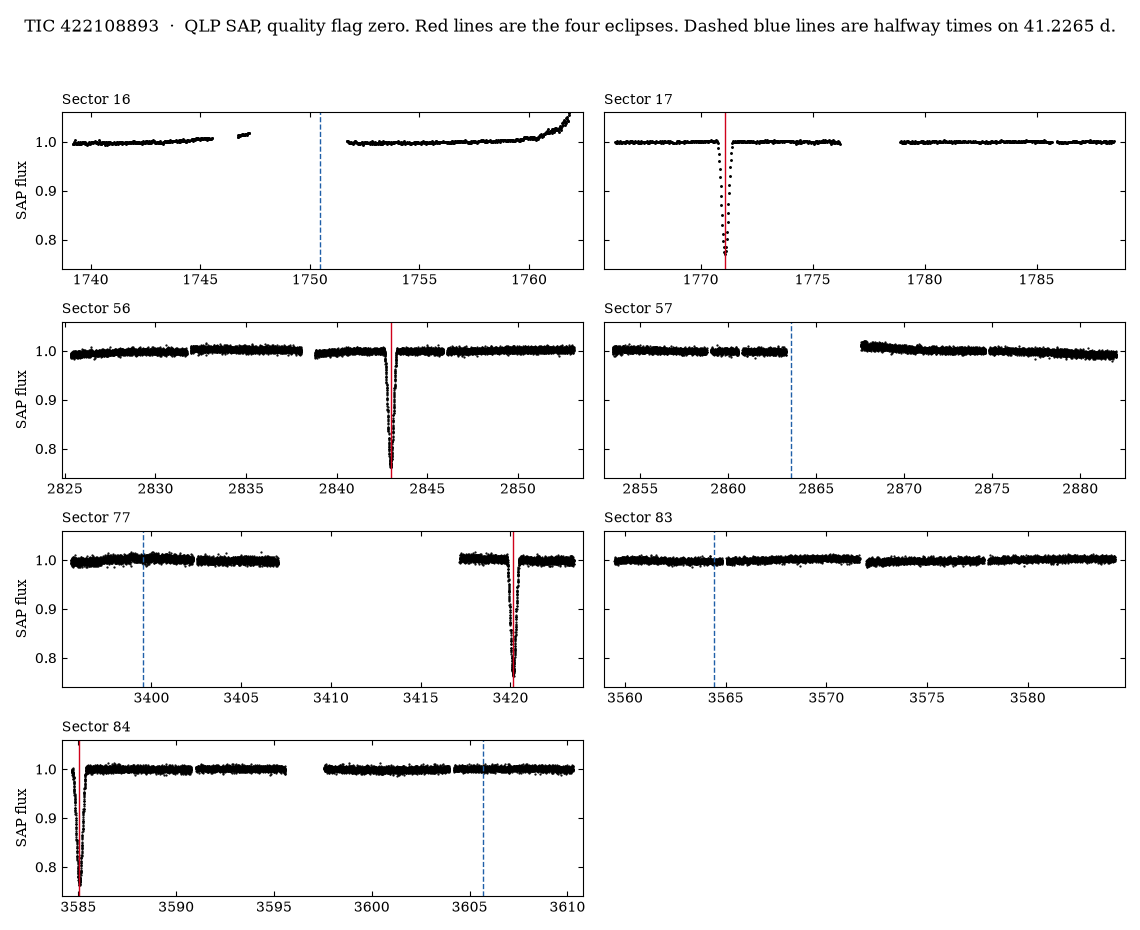
- New candidate, period unsettled: 41.23 or 82.45 days. Four eclipses, each about 23 percent, 0.29 mag, and about 0.65 day long. No secondary deeper than about 0.15 percent.
What TESS shows
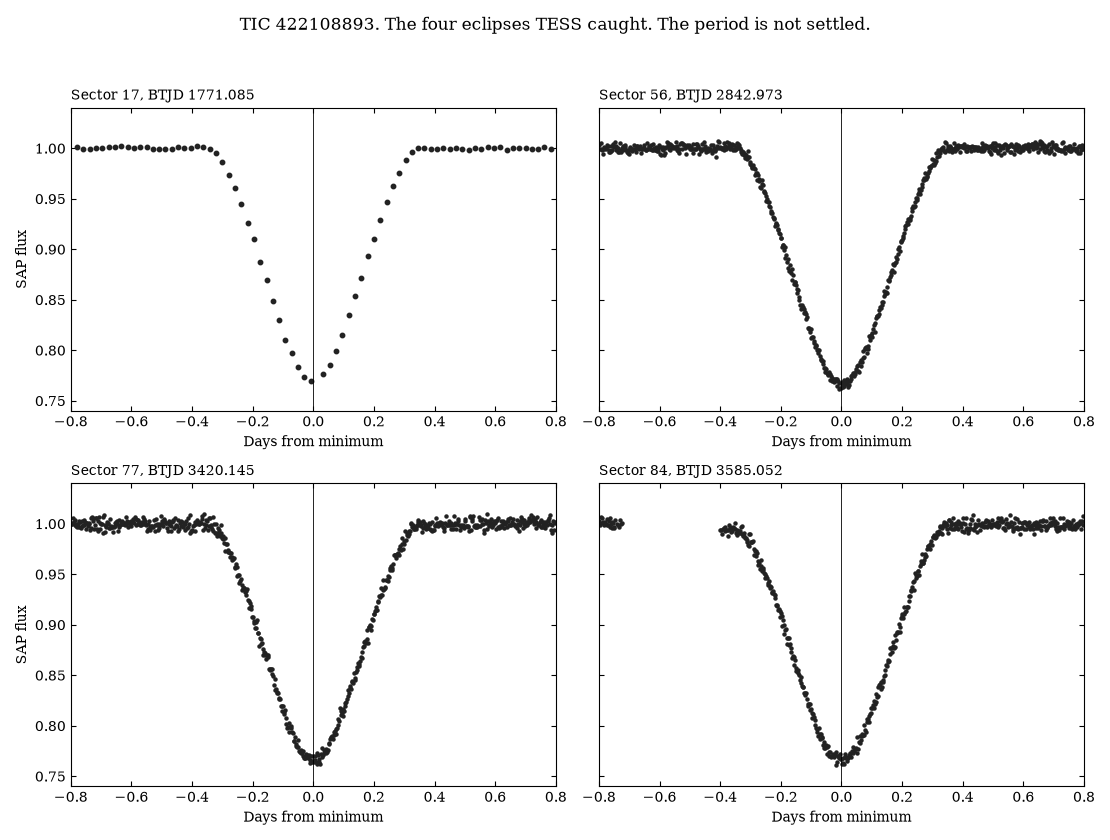
Four eclipses, one each in sectors 17, 56, 77, and 84, at BTJD 1771.0848, 2842.9734, 3420.1452, and 3585.0515. They fit
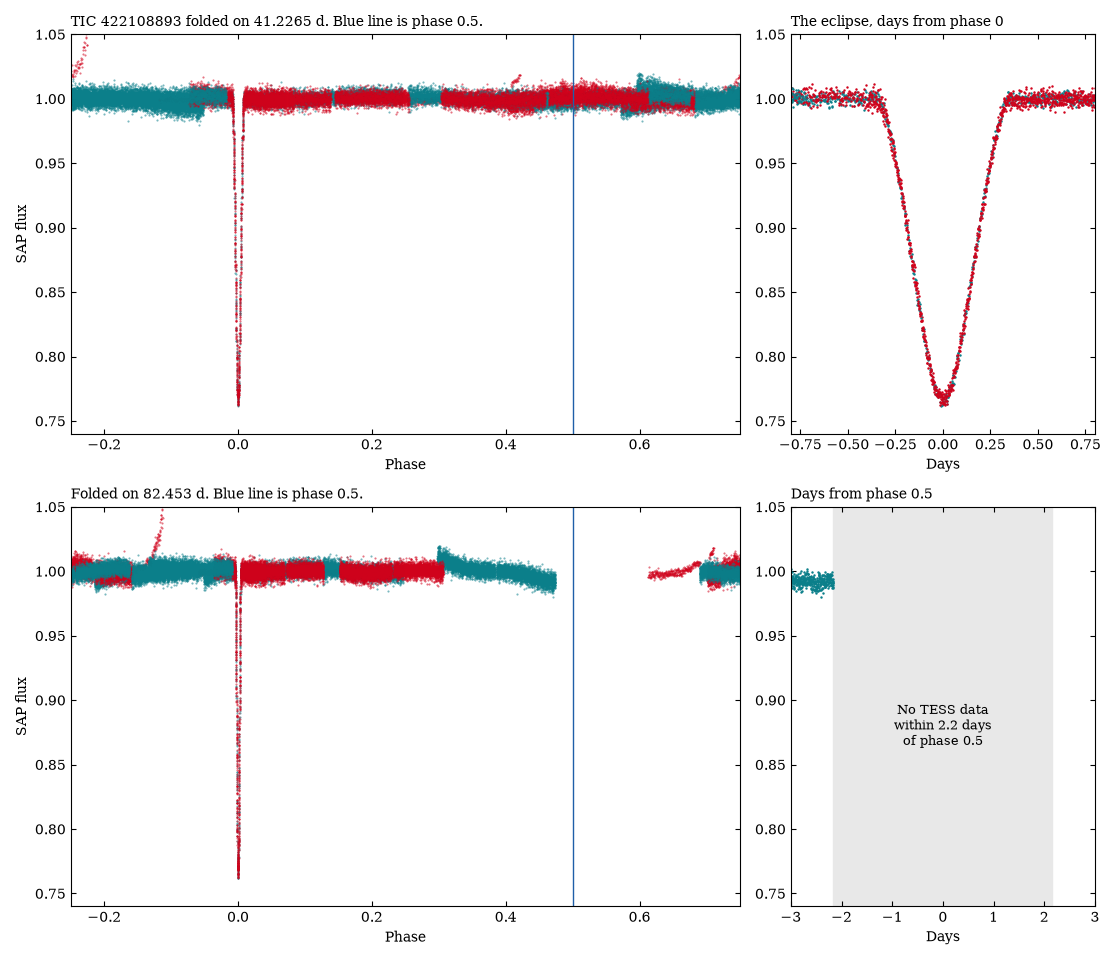
Min = BTJD 1771.08453 + 41.22652 E, or every other one, P = 82.45303 d
Each eclipse falls to about 0.76 of the light in the 200-second sectors, about 23 percent or 0.29 mag. Each lasts about 0.65 day from first to last contact, and about 14 hours below 98 percent. The gaps between them are 26, 14, and 4 times 41.2265 days, and that clock fits all four to within a minute. A period of 82.453 days fits them too, keeping only every other one. TESS has no data within 2.2 days of the halfway point on the 82.453-day clock, so it cannot choose between the two.
Every shorter period is ruled out by the TESS coverage. The scan first returned 20.61 days. That period would have put eclipses at BTJD 3399.53, 3564.44, and 3605.66, and TESS saw full light at all three. No secondary eclipse deeper than about 0.15 percent is seen.
The dip is on this star. In TESScut difference images, the light that goes missing in eclipse is centered 0.9 arcsec from the target in sector 56 and 6.9 arcsec from it in sector 84. That is a simple centroid, not a full pixel model. The TIC contamination ratio is 0.527. The brightest neighbor in the pixel is TIC 422108875, G = 13.77, 14 arcsec away. It has about a sixth of the target light, so even a total eclipse of that star could not take 23 percent from the blend. No catalogued variable lies within 44 arcsec.
The TESS catalog gives V = 11.93 (from UCAC4) and a TESS magnitude of 11.62. Gaia DR3 gives G = 11.83, BP − RP = 0.45, parallax 0.864 ± 0.015 mas, and RUWE 0.98. That parallax is about 1.16 kiloparsecs. Gaia lists 9121 K, and the TESS catalog lists 8280 K and 2.44 solar radii. The star is 1.574° from V345 Lac, in the 1.50–1.60° ring. It passed the cut for that ring search, but that search did not flag it. The 18 November 2026 scan did. That scan used the new 12-harmonic period search: the multiharmonic chi-squared periodogram approach of Rutkowski and Poleski (2026), with 12 Fourier terms fitted at each trial period. They also introduced the fast Toeplitz-solver technique that accelerates it. The scan computed the same periodogram with the separate nifty-ls code (Garrison et al. 2024), which matched their Toeplitz-LS results in a 17 November 2026 test, with a box least-squares (BLS) search as the cross-check. The 12-harmonic search returned 20.61 days and BLS returned 27.49 days. The eclipse timing above rules out both and leaves 41.2265 or 82.453 days. It is a new candidate. It has not been checked from the ground and is not filed with VSX.
The light curves
Finder chart
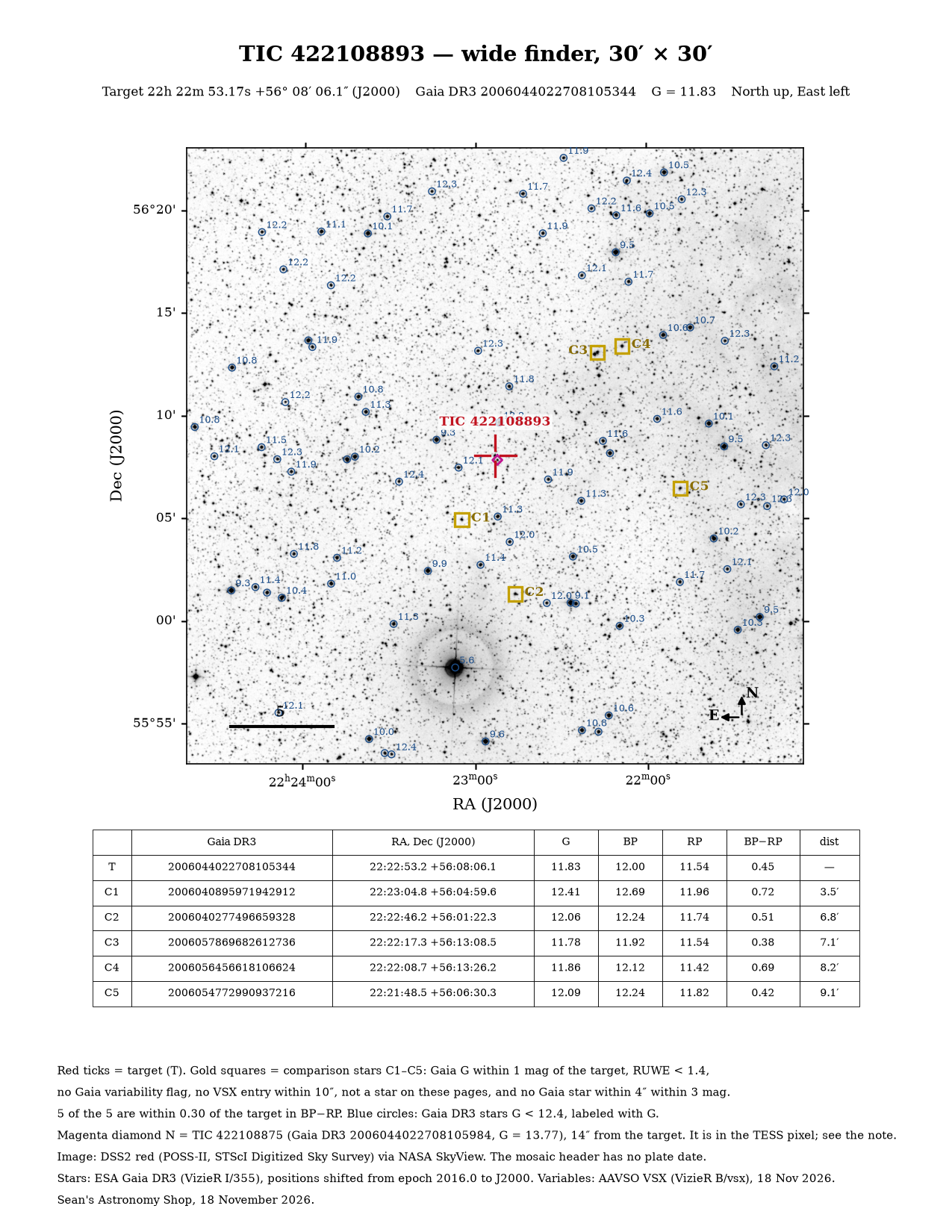
Real sky images (DSS2 red) with Gaia DR3 stars overlaid. North is up, east is left, J2000. Red tick marks point at the target (Gaia DR3 2006044022708105344, G = 11.83). Gold squares C1 to C5 are comparison stars of similar brightness. Tap an image for the full-size printable chart.
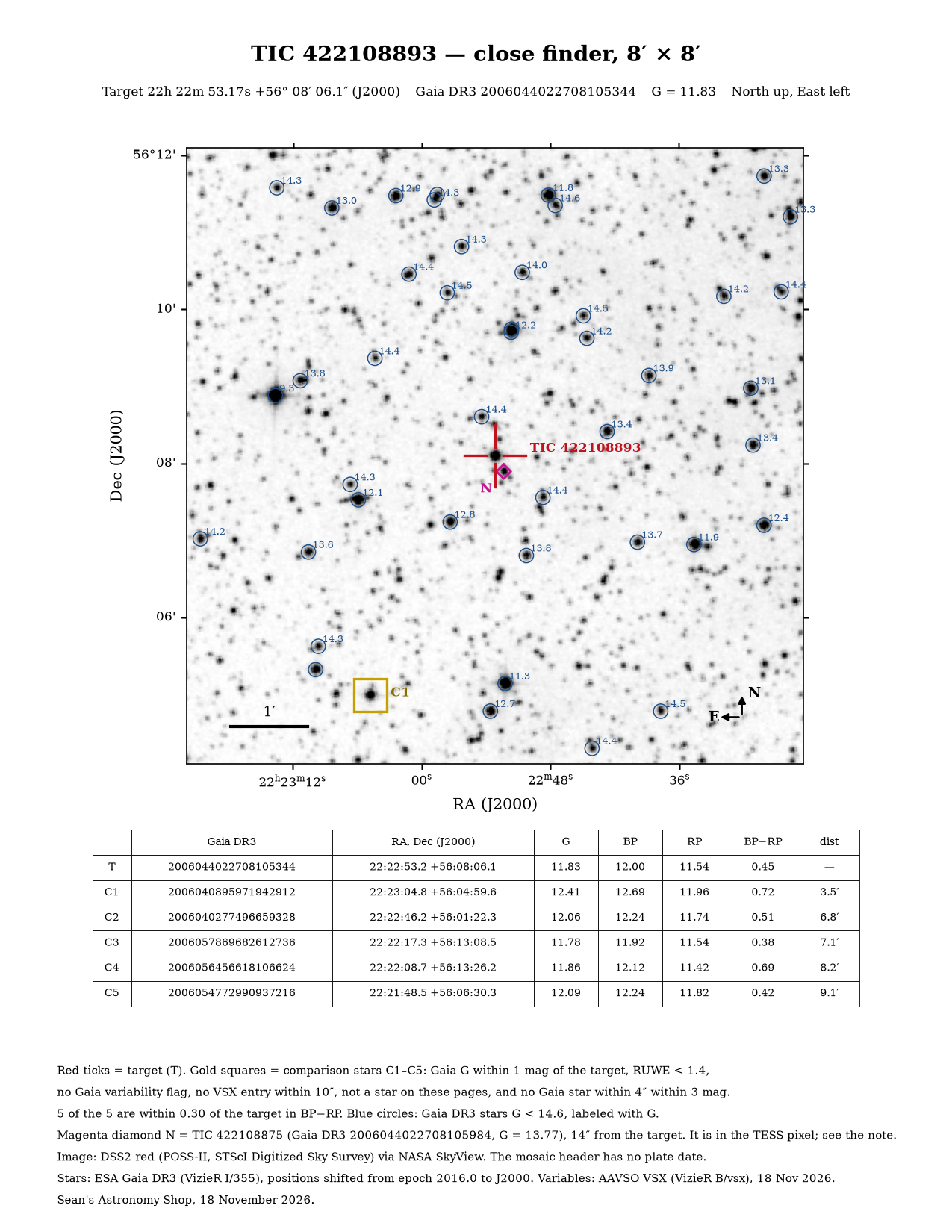
| Gaia DR3 | RA, Dec (J2000) | G | BP | RP | From target | |
|---|---|---|---|---|---|---|
| C1 | 2006040895971942912 | 22:23:04.8 +56:04:59.6 | 12.41 | 12.69 | 11.96 | 3.5′ |
| C2 | 2006040277496659328 | 22:22:46.2 +56:01:22.3 | 12.06 | 12.24 | 11.74 | 6.8′ |
| C3 | 2006057869682612736 | 22:22:17.3 +56:13:08.5 | 11.78 | 11.92 | 11.54 | 7.1′ |
| C4 | 2006056456618106624 | 22:22:08.7 +56:13:26.2 | 11.86 | 12.12 | 11.42 | 8.2′ |
| C5 | 2006054772990937216 | 22:21:48.5 +56:06:30.3 | 12.09 | 12.24 | 11.82 | 9.1′ |
Comparison stars are within 1 mag of the target in Gaia G, have RUWE below 1.4, no Gaia variability flag, no close companion, no VSX entry within 10 arcsec, and are not stars on these pages. Images: DSS2 red (POSS-II, STScI Digitized Sky Survey). Stars: ESA Gaia DR3. The magenta diamond marked N is TIC 422108875 (Gaia DR3 2006044022708105984, G = 13.77), 14 arcsec from the target at position angle 209°. It is inside the TESS pixel, but it has only about a sixth of the target light, so it cannot make a 23 percent dip. Keep it out of the aperture anyway.
VSX
Not filed. New candidate, period unsettled, from the 18 Nov 2026 scan. No catalogued variable within 44 arcsec. The nearest, 45 arcsec away, is a G = 19.5 eclipsing binary with a 0.33-day period.
Next two eclipses
- Eclipse 1The test. An eclipse here only if the period is 41.2265 days. Full light here means 82.453 days. 23 Nov 2026, 20:27 UTC · 23 Nov, 12:27 PST Pacific · 23 Nov, 21:27 CET central EuropeWatch from 23 Nov 2026, 16:27 to 24 Nov 2026, 00:27 UTC, 4 hours before to 4 hours after the predicted time · 23 Nov, 08:27 to 23 Nov, 16:27 PST Pacific
- Eclipse 2Eclipse on either period. This time is on both the 41.2265-day and the 82.453-day clock. 4 Jan 2027, 01:56 UTC · 3 Jan, 17:56 PST Pacific · 4 Jan, 02:56 CET central EuropeWatch from 3 Jan 2027, 21:56 to 4 Jan 2027, 05:56 UTC, 4 hours before to 4 hours after the predicted time · 3 Jan, 13:56 to 3 Jan, 21:56 PST Pacific
Help with a measurement
The useful night is the test time halfway between eclipses on the 82.453-day clock. An eclipse then means the period is 41.2265 days. Full light then means 82.453 days. Cover four hours before and four hours after each predicted eclipse time. The eclipse lasts about 15 hours, so that eight-hour run sits inside it, and an eclipse shows as faded light against the comparison stars for the whole run. Keep TIC 422108875, 14 arcsec away, in its own aperture. Pick a date if you can try.
The note
Research note (PDF): A 41.23- or 82.45-day eclipsing-binary candidate: TIC 422108893
These pages use the public TESS Quick-Look Pipeline and catalog positions. A prediction is not a confirmation. If you observe, write down which star was in the aperture.