
TIC 428180639
Gaia DR3 2007554713011699072
- Position
- 22h 24m 56.42s, +56° 24′ 18.5″
- V magnitude
- 12.43
- Where
- 116 arcmin north-northeast of V345 Lac, in the 1.80–2.00° ring
- Signal
- Shallow candidate, 0.04 mag, 4.59 days. About 0.038 mag, a rounded dip. No secondary is adopted. Not a planet: the star is an A star, and 3.4 percent is a stellar companion.
What TESS shows
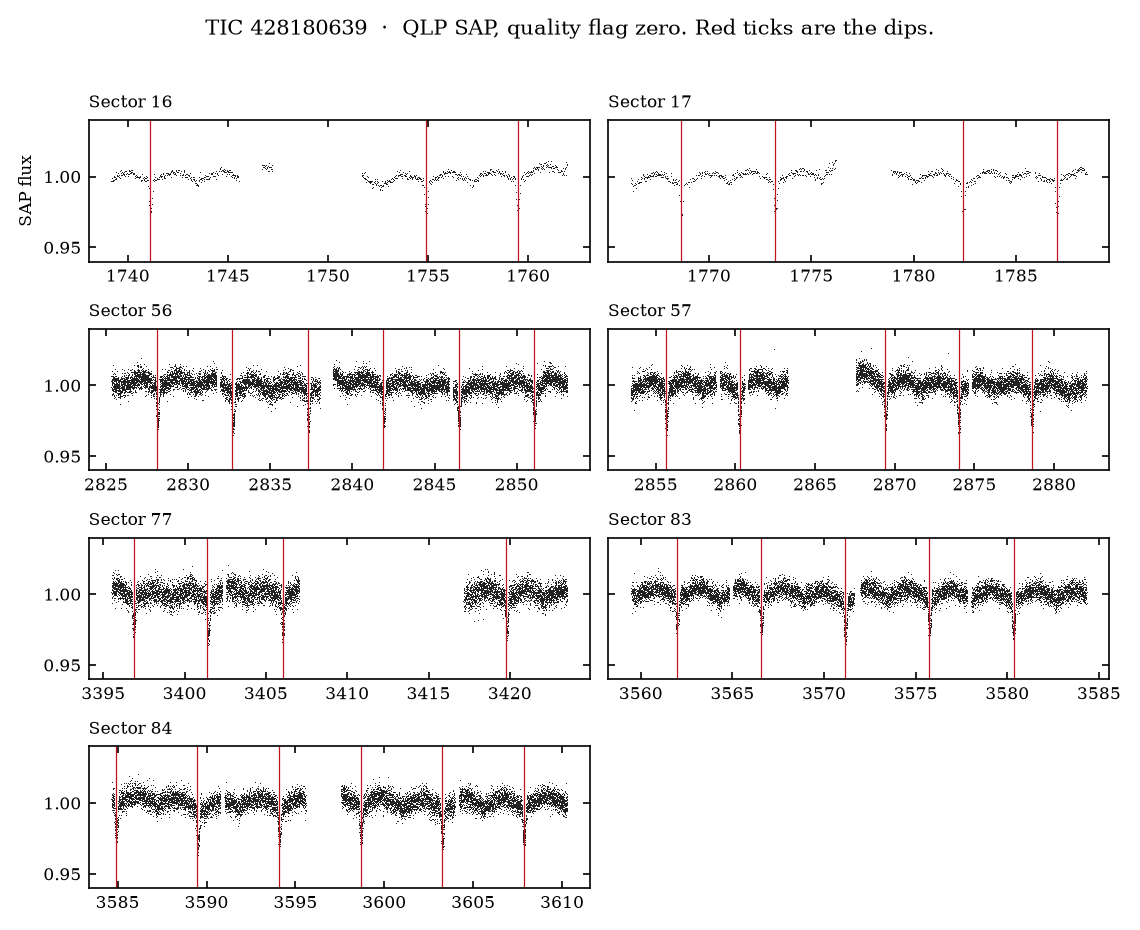
Thirty-three dips in the same seven sectors give
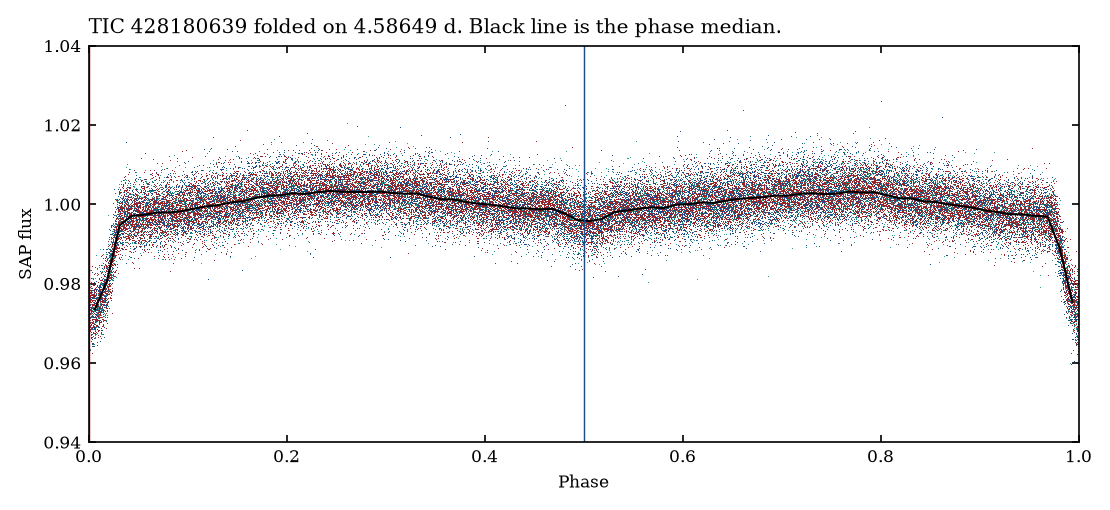
Min = BTJD 1741.13688 + 4.58649 E
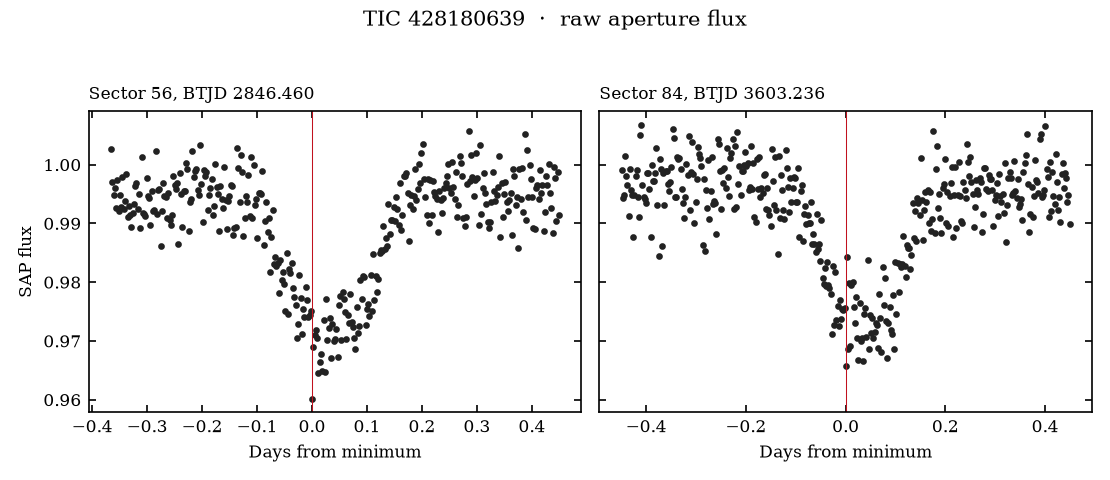
The dip is 0.038 mag, 3.4 percent of the light. It is rounded, with no flat floor. The times scatter by 30 minutes rms. The largest residual is 62 minutes. The phase fold at phase 0.5 is down by about 0.4 percent, and that notch is not adopted as a second minimum. A sine outside the dip has an amplitude of 0.09 percent, so this is not a spot wave of the same size.
The TESS catalog lists 9664 K and 5.2 solar radii, and leaves surface gravity blank. Gaia gives a parallax of 0.386 ± 0.012 mas and no radius of its own. A 3.4 percent eclipse of a star that large is a companion about one solar radius across. A Jupiter in front of an A star removes well under one percent. The dip is kept as a candidate on this star. It is not called a planet. The centroid moves by 0.006 pixel. A G = 16.5 star 11 arcsec away has only about 2 percent of the light, a little less than the dip. The note is not a VSX submission.
The light curves
Finder chart
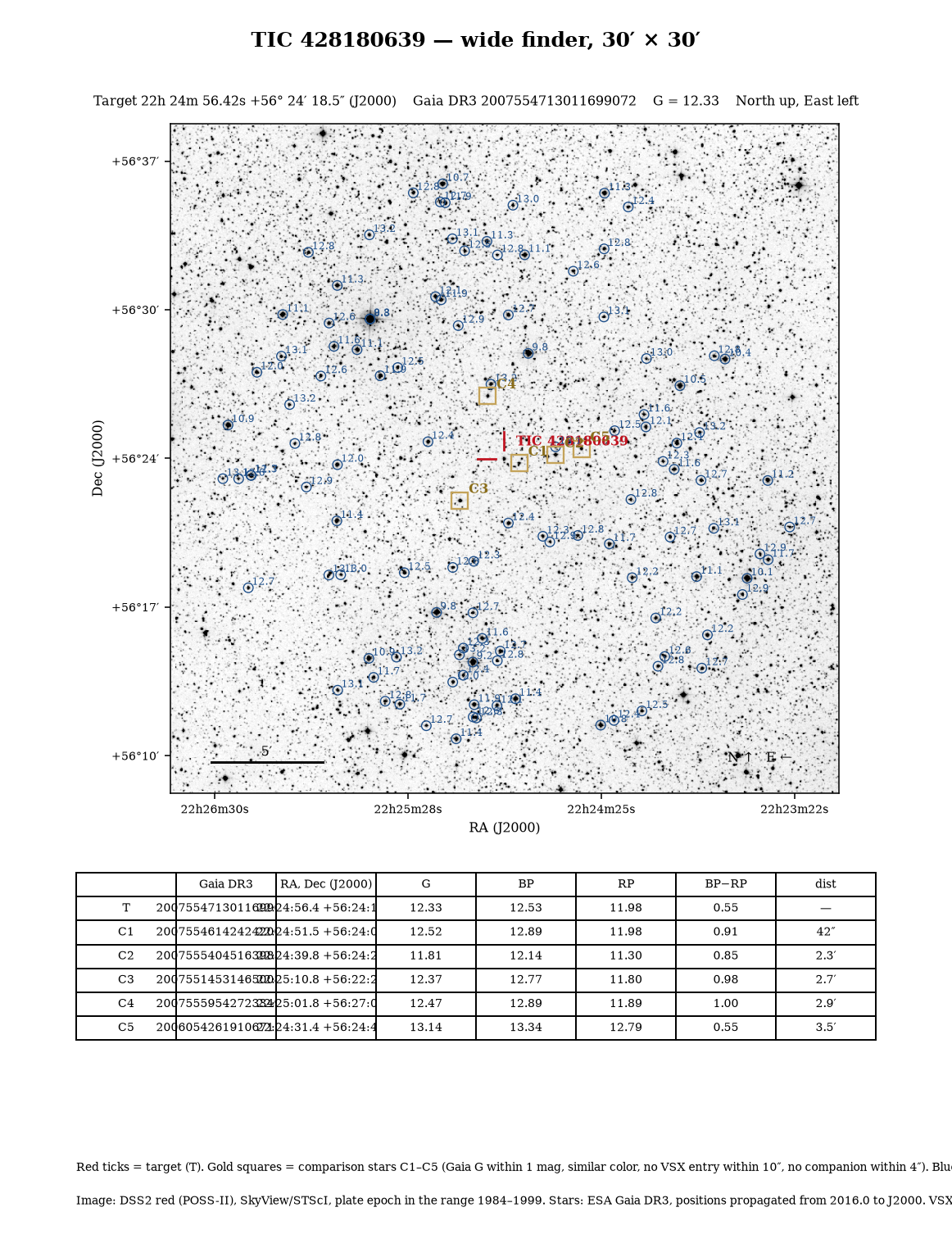
Real sky images (DSS2 red) with Gaia DR3 stars overlaid. North is up, east is left, J2000. Red tick marks point at the target (Gaia DR3 2007554713011699072, G = 12.33). Gold squares C1 to C5 are comparison stars of similar brightness. Tap an image for the full-size printable chart.
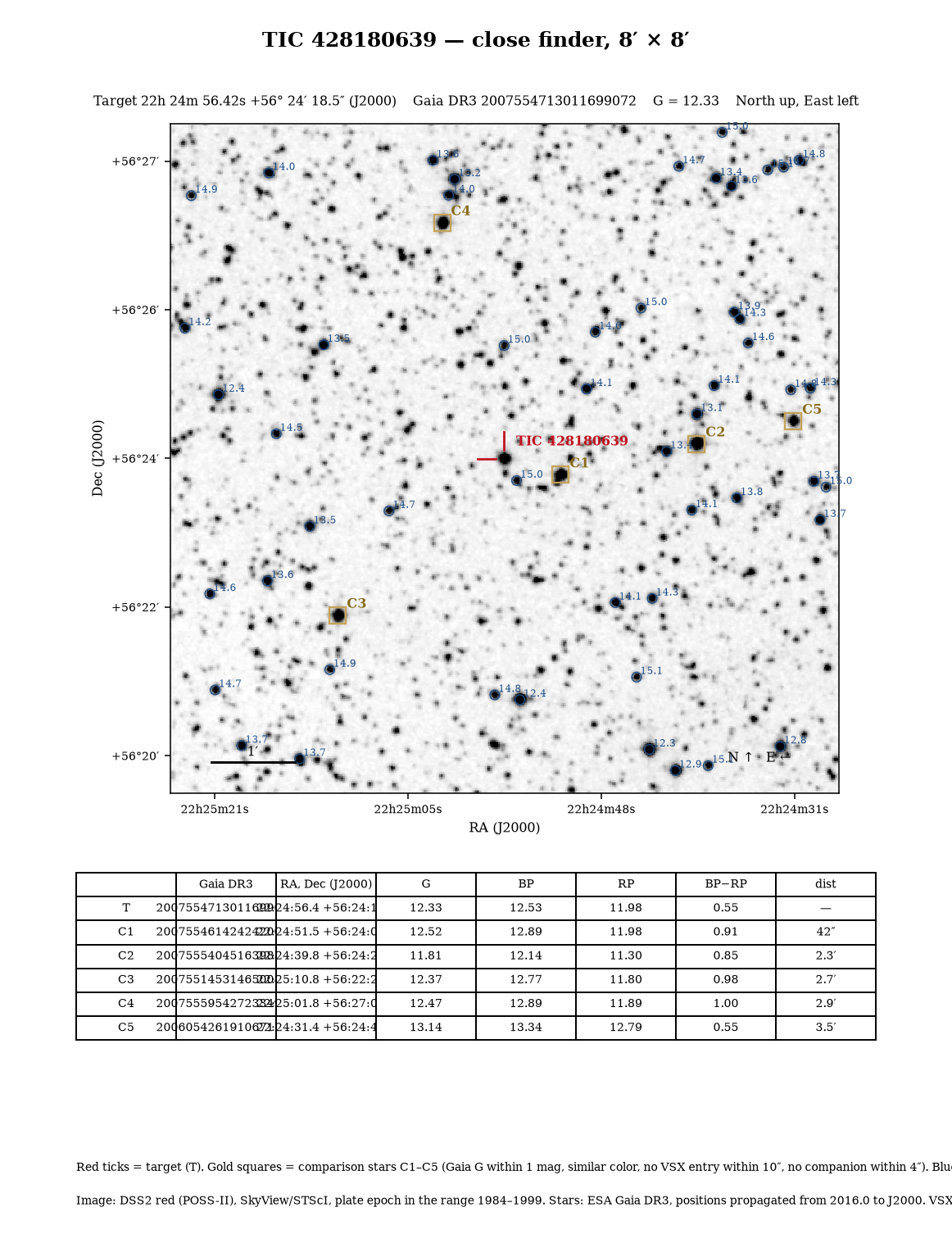
| Gaia DR3 | RA, Dec (J2000) | G | BP | RP | From target | |
|---|---|---|---|---|---|---|
| C1 | 2007554614242420096 | 22:24:51.5 +56:24:07.0 | 12.52 | 12.89 | 11.98 | 42″ |
| C2 | 2007555404516398592 | 22:24:39.8 +56:24:29.2 | 11.81 | 12.14 | 11.30 | 2.3′ |
| C3 | 2007551453146500864 | 22:25:10.8 +56:22:26.2 | 12.37 | 12.77 | 11.80 | 2.7′ |
| C4 | 2007555954272334976 | 22:25:01.8 +56:27:07.9 | 12.47 | 12.89 | 11.89 | 2.9′ |
| C5 | 2006054261910671104 | 22:24:31.4 +56:24:45.4 | 13.14 | 13.34 | 12.79 | 3.5′ |
Comparison stars are within about 1 mag of the target in Gaia G, have similar color, no close companion, and no VSX entry within 10 arcsec. Images: DSS2 red (POSS-II, STScI Digitized Sky Survey). Stars: ESA Gaia DR3.
VSX
Not filed. Candidate from the 1.80–2.00° ring, 5 Nov 2026. The dip repeats. It is not adopted as a planet. The nearest VSX star is 76 arcsec away and is not this clock.
Next two eclipses
- Eclipse 124 Nov 2026, 16:39 UTC · 24 Nov, 08:39 PST Pacific · 24 Nov, 17:39 CET central Europe
- Eclipse 229 Nov 2026, 06:44 UTC · 28 Nov, 22:44 PST Pacific · 29 Nov, 07:44 CET central Europe
The dip is 0.04 mag and rounded. The middle can be off by about an hour. Start about two hours before the predicted time and keep going two hours after. A visual glance will not show it. This is a candidate, and it is not a planet. The largest residual is 62 minutes.
Help with a measurement
This one is a shallow candidate, not a planet. A camera can time a 0.04 mag dip if the G = 16.5 star 11 arcsec away stays out of the aperture. The middle can be off by about an hour. Pick a date if you can try.
The note
A 4.586-day shallow dip, not adopted as a planet: TIC 428180639 (PDF)
These pages use the public TESS Quick-Look Pipeline and catalog positions. A prediction is not a confirmation. If you observe, write down which star was in the aperture.