
TIC 431033666
Gaia DR3 2004767798943260288, 6 arcsec from BD+53 2845
- Position
- 22h 19m 04.51s, +53° 48′ 36.7″
- V magnitude
- 11.10
- Where
- 52 arcmin south of V345 Lac
- Signal
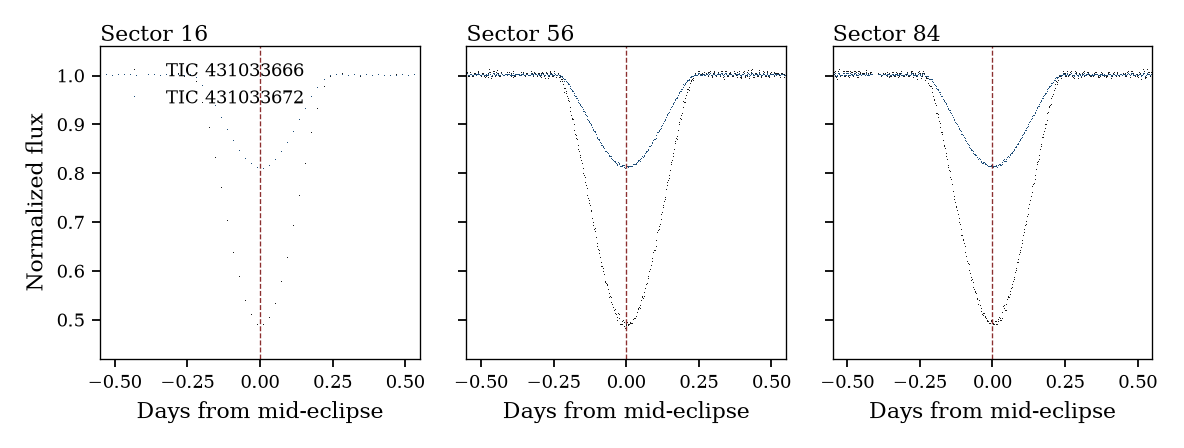
- EA, flat-bottomed primary, 68 days. The blended TESS light falls to about half. The bright B8 neighbor, TIC 431033672, falls about 19 percent at the same times. TESS does not say which star is eclipsed.
What TESS shows
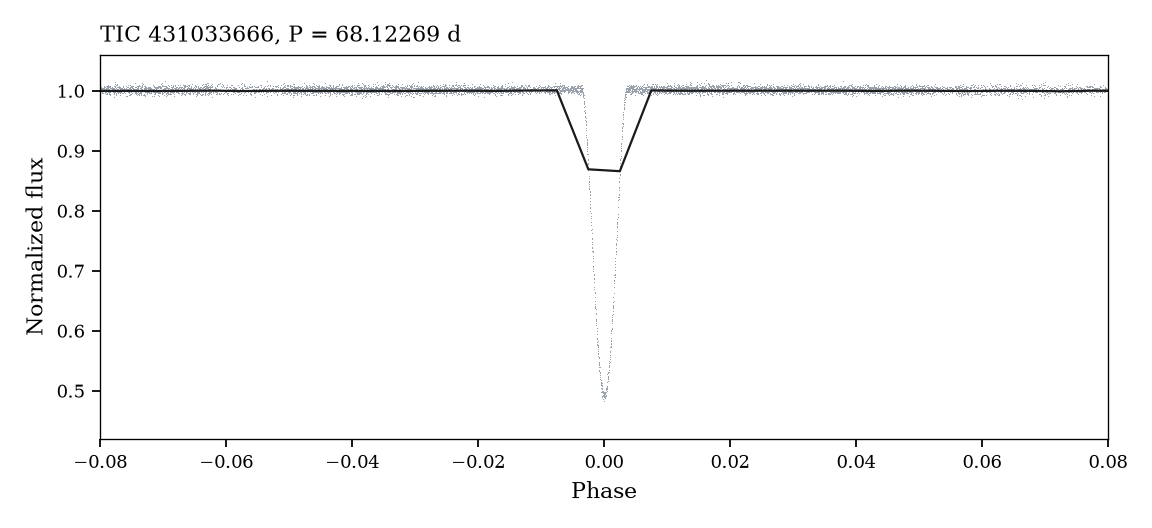
Three flat-bottomed eclipses, in sectors 16, 56, and 84, fit
T0 = 1752.337 BTJD, P = 68.12269 d
The middle is the center of the run where the flux stays below 60 percent of normal. Measuring that center at 55, 60, or 80 percent moves the clock by about 10 minutes, so the prediction is good to about 20 minutes. The blended light stays 2 percent below normal for about 10.4 hours, and below 60 percent for about 3.8 hours. Half-period and one-third-period aliases do not eclipse. A shallow dip in sector 57 is not on this period.
The star is 6 arcseconds from BD+53 2845 (TIC 431033672, V = 9.84, spectral type B8, Gaia DR3 2004767798946201600). That brighter star’s extraction drops about 19 percent at the same three times, and the centroid does not move. A total eclipse of the fainter star, with the B8 star still in the aperture, fits the depth. TESS does not assign the eclipse. No other survey has a light curve that lands on these eclipses. The note has not been sent to VSX, and no new observations are in it.
On 27 October 2026 the fade starts near 06:46 UTC, the deep part runs about 10:04 to 13:53 UTC, and the middle is 11:58 UTC. That start is still up from the western United States. The flat bottom is low in California and on the horizon in West Texas, in morning twilight. Recovery is after the star has set there. A measurement needs separate apertures on the two stars, a third comparison star, and a scale near one arcsecond per pixel.
The light curves
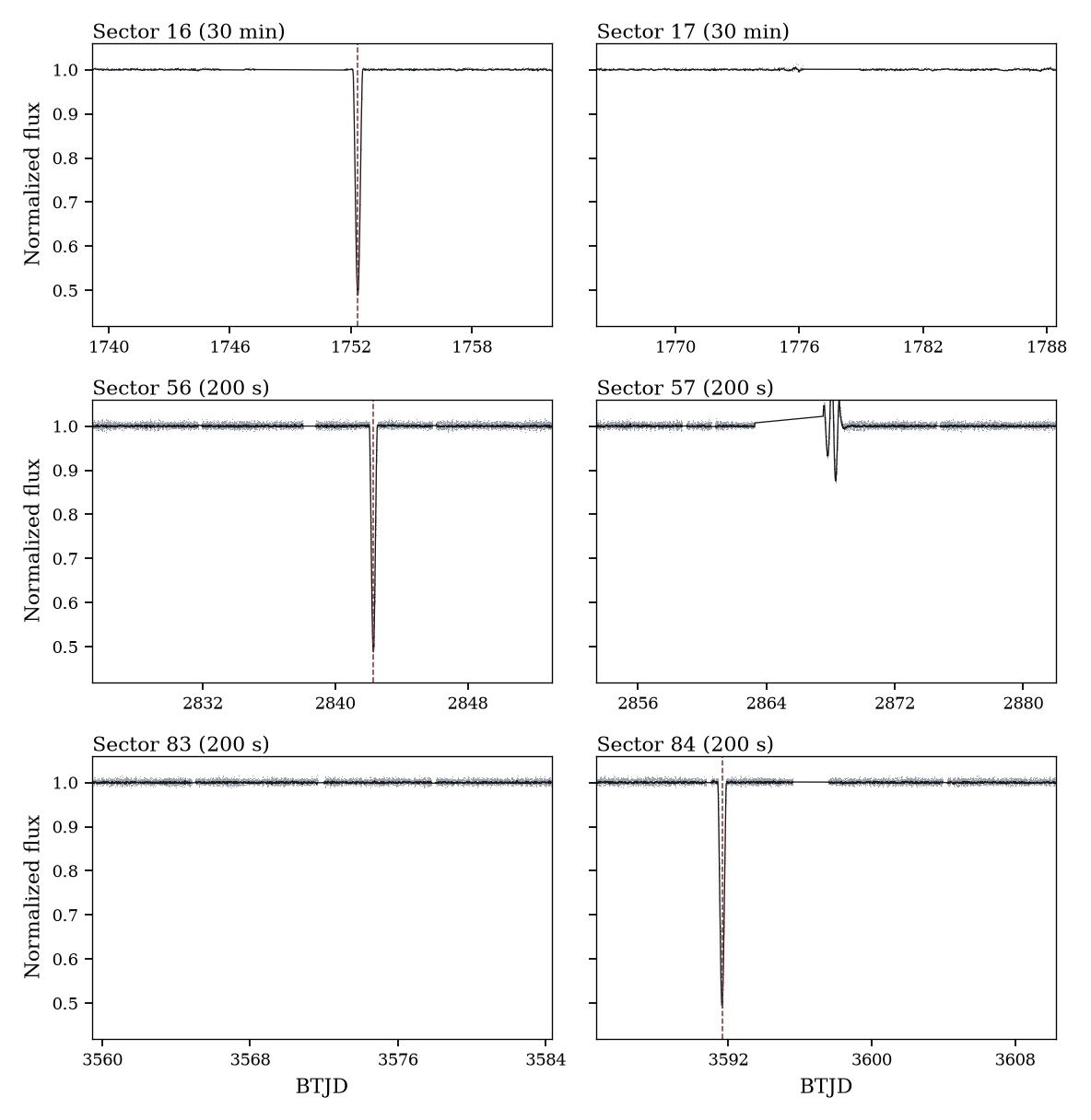
VSX
The research note is ready. It has not been sent to VSX. A new account can have only one new star in review, and TIC 330739083 is that star.
Next two eclipses
- Eclipse 127 Oct 2026, 11:58 UTC · 27 Oct, 04:58 PDT Pacific · 27 Oct, 12:58 CET central Europe
- Eclipse 23 Jan 2027, 14:55 UTC · 3 Jan, 06:55 PST Pacific · 3 Jan, 15:55 CET central Europe
For each of those middles, the light is about 2 percent down from 5.2 hours before until 5.2 hours after, and below 60 percent of the blended light from 1.9 hours before until 1.9 hours after. The 27 October window in the paragraph above is that shape. The January eclipse has the same shape on the UTC clock.
Help with a measurement
The useful measurement is resolved photometry of the 6-arcsecond pair, so we learn which star fades. If that is you, pick a date below.
The note
A 68-day eclipse in the TESS aperture of TIC 431033666 (PDF)
These pages use the public TESS Quick-Look Pipeline and catalog positions. A prediction is not a confirmation. If you observe, write down which star was in the aperture.