
TIC 467546768
TYC 3983-01343-1 · Gaia DR3 2001557293708235264
- Position
- 22h 29m 29.46s, +53° 13′ 30.3″
- V magnitude
- 12.27
- Where
- 128 arcmin southeast of V345 Lac, in the 2.10–2.20° ring
- Signal
- EA, 0.05 mag, 5.20 days. Primary 0.052 mag. Secondary 0.042 mag, 2.615 days later. A G = 13.45 star 13 arcsec away is inside the pixel.
What TESS shows
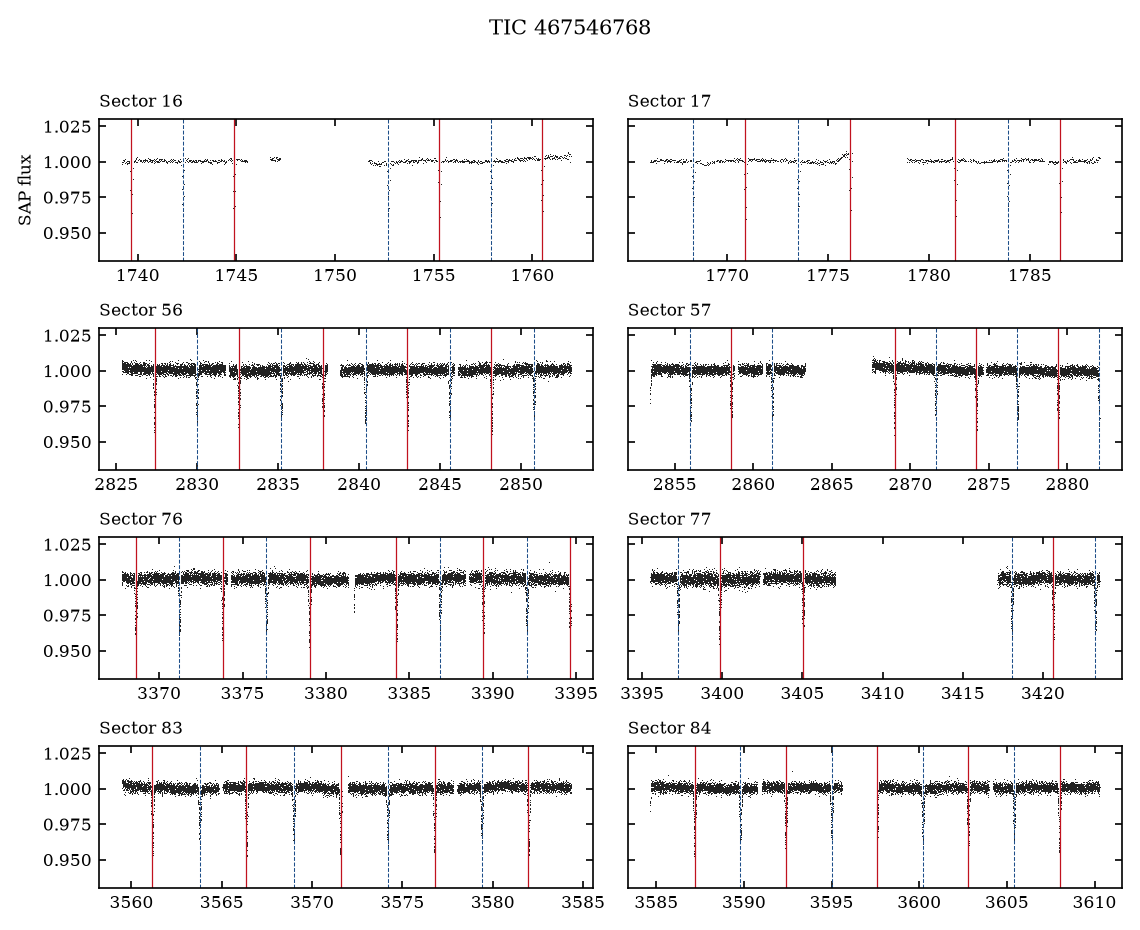
Thirty-six primary minima in sectors 16, 17, 56, 57, 76, 77, 83, and 84 give
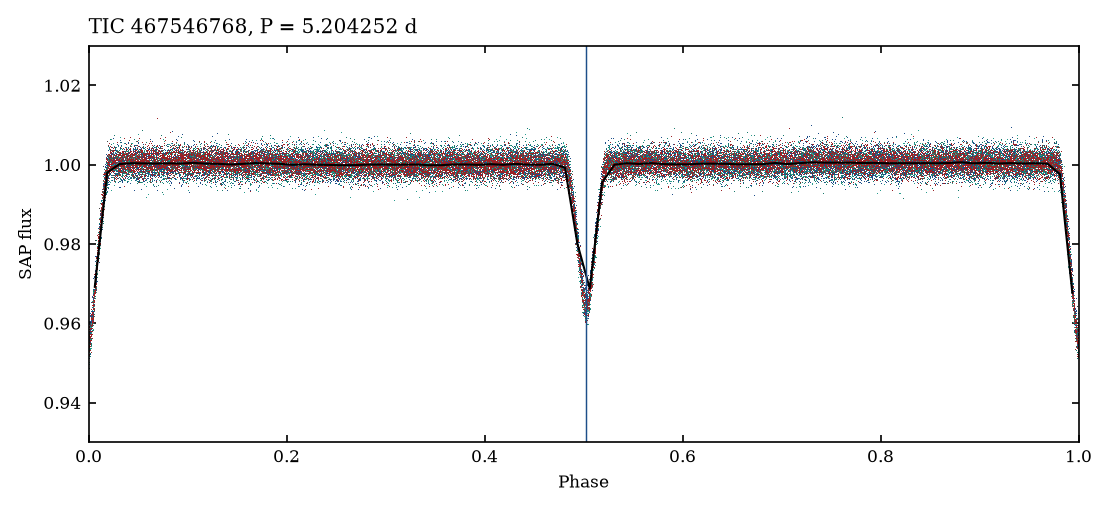
Min I = BTJD 1739.67380 + 5.204252 E
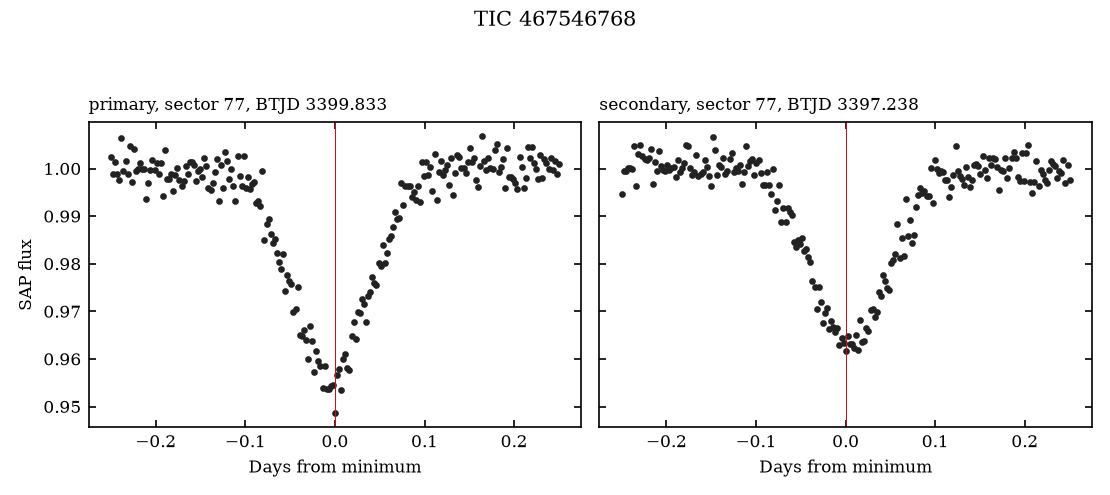
The deep minimum is 0.052 mag, 4.7 percent of the aperture light. In sector 77 it stays below 98 percent of normal light for 2.6 hours, and below half that depth for 2.0 hours. A shallower minimum, 0.042 mag, falls at phase 0.502, which is 2.615 days later. The times scatter by 7.9 minutes rms. The largest residual is 16 minutes. The two depths keep the same offset from 2019 through 2024. A phase shift of 0.0025 is not used to call the orbit eccentric.
A first fit at 2.602 days put every minimum at phase 0. The minima alternate in depth, so the period above is twice that spacing. Gaia DR3 2001557293708234752, G = 13.45, lies 13 arcsec away, inside one TESS pixel, and has about one sixth of the combined light. A partial eclipse of that neighbor could still match a 4.7 percent dip. The centroid moves by 0.019 pixel, which does not decide. The QLP aperture is centered on the target. A ground aperture that keeps the G = 13.45 star out is the measurement that assigns the eclipse.
Gaia gives G = 11.63, BP − RP = 1.36, parallax 0.673 ± 0.013 mas, and RUWE 0.87, about 1480 parsecs. The absolute G magnitude, with no dust correction, is about 0.8. The TESS catalog lists 4947 K and 10.71 solar radii, and leaves surface gravity blank, so that radius is the catalog value. A 4.7 percent eclipse of a star that large is a companion about 2.3 solar radii across. A Jupiter-sized body removes about 0.01 percent of the light. The nearest VSX star is ZTF J222923.36+531215.0, a BY variable with a 2.185-day period, 93 arcsec away. The note is not a VSX submission.
The light curves
Finder chart
Real sky images (DSS2 red) with Gaia DR3 stars overlaid. North is up, east is left, J2000. Red tick marks point at the target (Gaia DR3 2001557293708235264, G = 11.63). Gold squares C1 to C5 are comparison stars of similar brightness. Tap an image for the full-size printable chart.
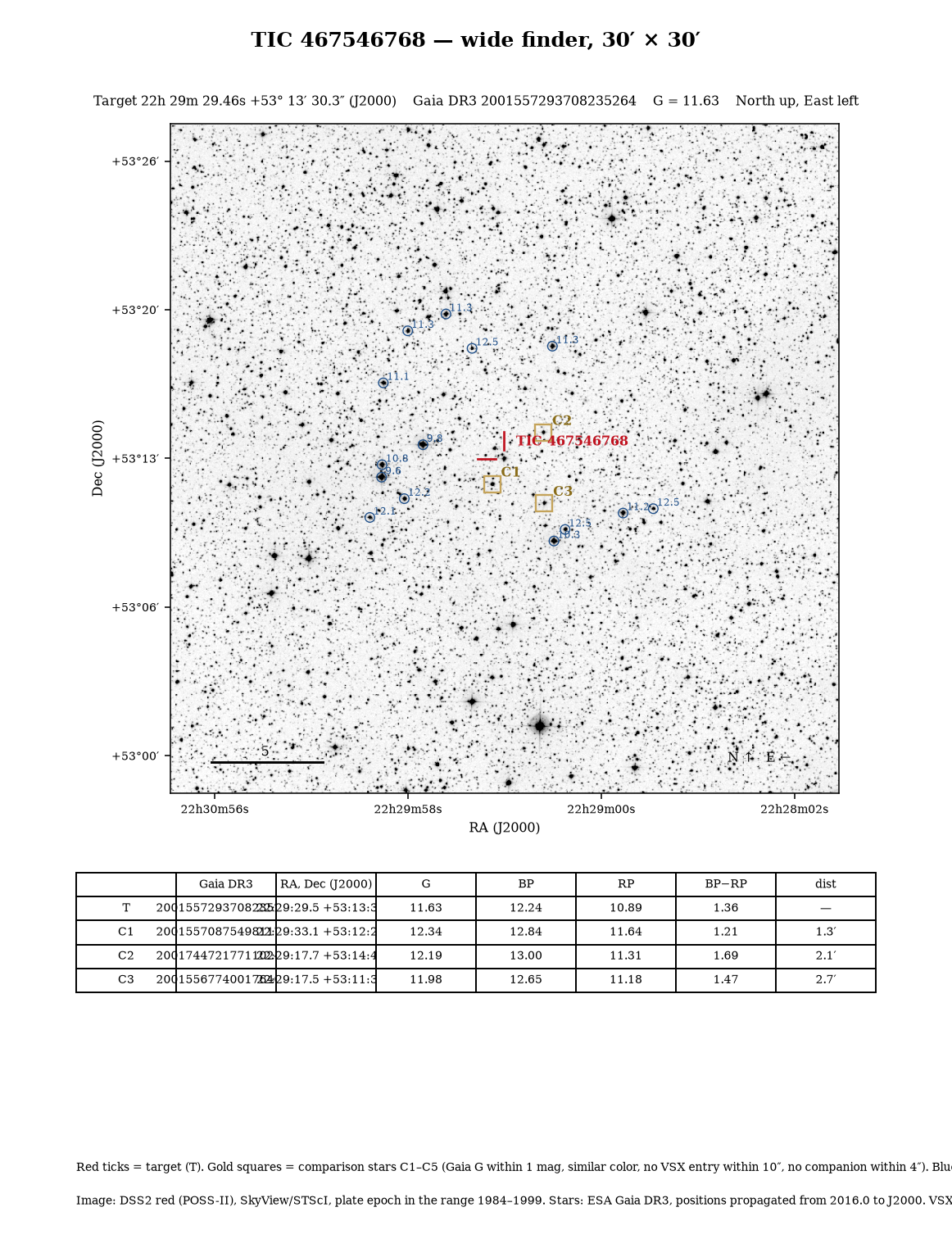
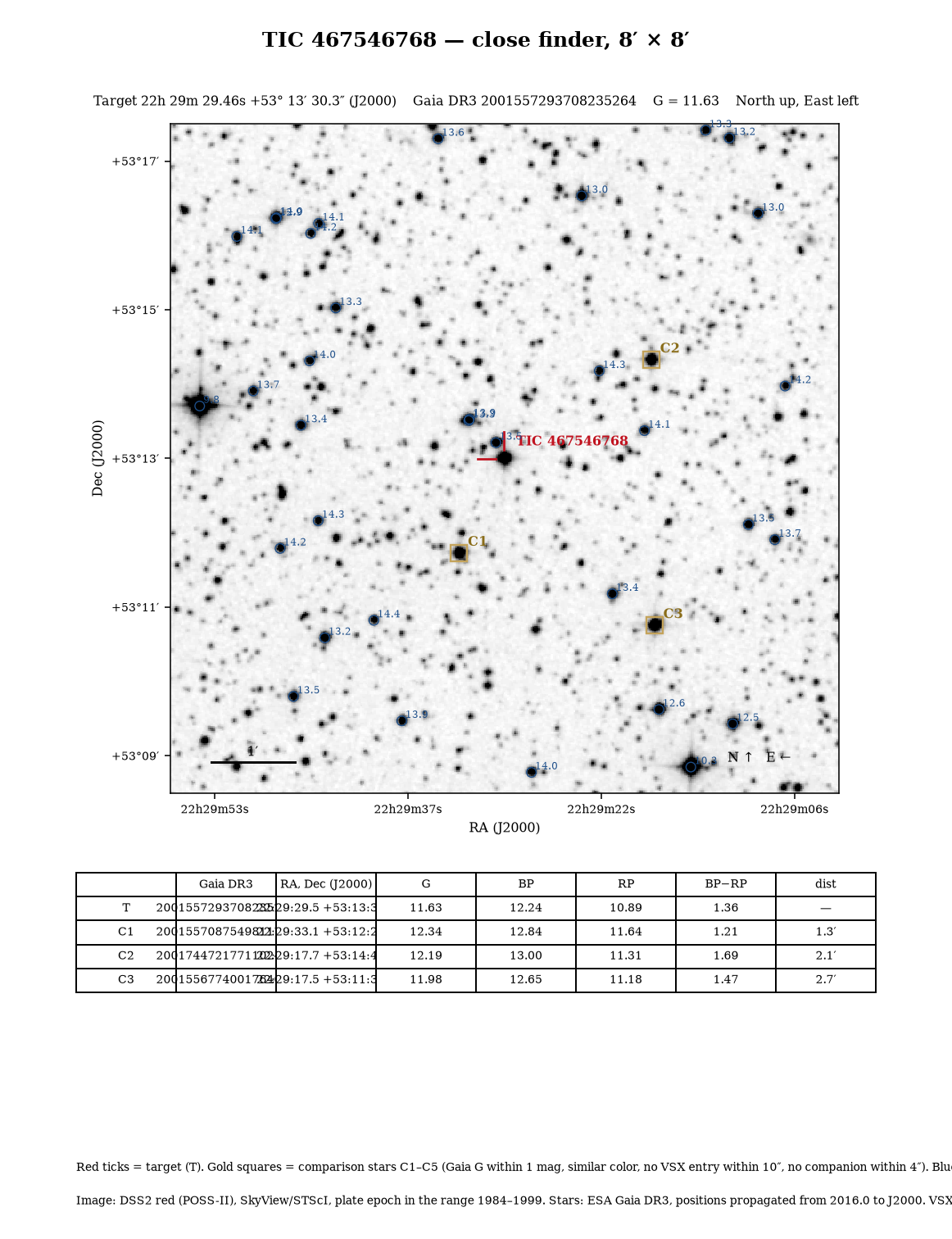
| Gaia DR3 | RA, Dec (J2000) | G | BP | RP | From target | |
|---|---|---|---|---|---|---|
| C1 | 2001557087549811712 | 22:29:33.1 +53:12:22.5 | 12.34 | 12.84 | 11.64 | 1.3′ |
| C2 | 2001744721771102464 | 22:29:17.7 +53:14:41.1 | 12.19 | 13.00 | 11.31 | 2.1′ |
| C3 | 2001556774001764096 | 22:29:17.5 +53:11:30.6 | 11.98 | 12.65 | 11.18 | 2.7′ |
Comparison stars are within about 1 mag of the target in Gaia G, have similar color, no close companion, and no VSX entry within 10 arcsec. Images: DSS2 red (POSS-II, STScI Digitized Sky Survey). Stars: ESA Gaia DR3.
VSX
Not filed. New addition from the 2.10–2.20° ring, 10 Nov 2026. The nearest VSX star is 93 arcsec away and is not this clock. A G = 13.45 star 13 arcsec away could still match a partial eclipse.
Next two eclipses
- Eclipse 1Primary minimum, the deep one. 23 Nov 2026, 07:38 UTC · 22 Nov, 23:38 PST Pacific · 23 Nov, 08:38 CET central Europe
- Eclipse 2Secondary minimum, the shallower one. 25 Nov 2026, 22:24 UTC · 25 Nov, 14:24 PST Pacific · 25 Nov, 23:24 CET central Europe
The deep minimum is 0.05 mag and lasts about 2.6 hours below 98 percent. The shallower one, 0.04 mag, follows 2.62 days later. Keep the G = 13.45 star 13 arcsec away out of the aperture. The centroid does not say which star fades. The largest residual is 16 minutes. They have not been checked from the ground.
Help with a measurement
The useful measurement is an aperture on this star with the G = 13.45 star 13 arcsec away kept out. The deep minimum is 0.05 mag and the shallower one follows 2.62 days later. Pick a date if you can try.
The note
A 5.204-day eclipsing binary in the 2.20° ring: TIC 467546768 (PDF)
These pages use the public TESS Quick-Look Pipeline and catalog positions. A prediction is not a confirmation. If you observe, write down which star was in the aperture.