
TIC 470019013
TYC 3969-00494-1 · Gaia DR3 2005522201357433472
- Position
- 22h 04m 22.22s, +53° 59′ 59.7″
- V magnitude
- 10.72
- Where
- 131 arcmin west-southwest of V345 Lac, in the 2.10–2.20° ring
- Signal
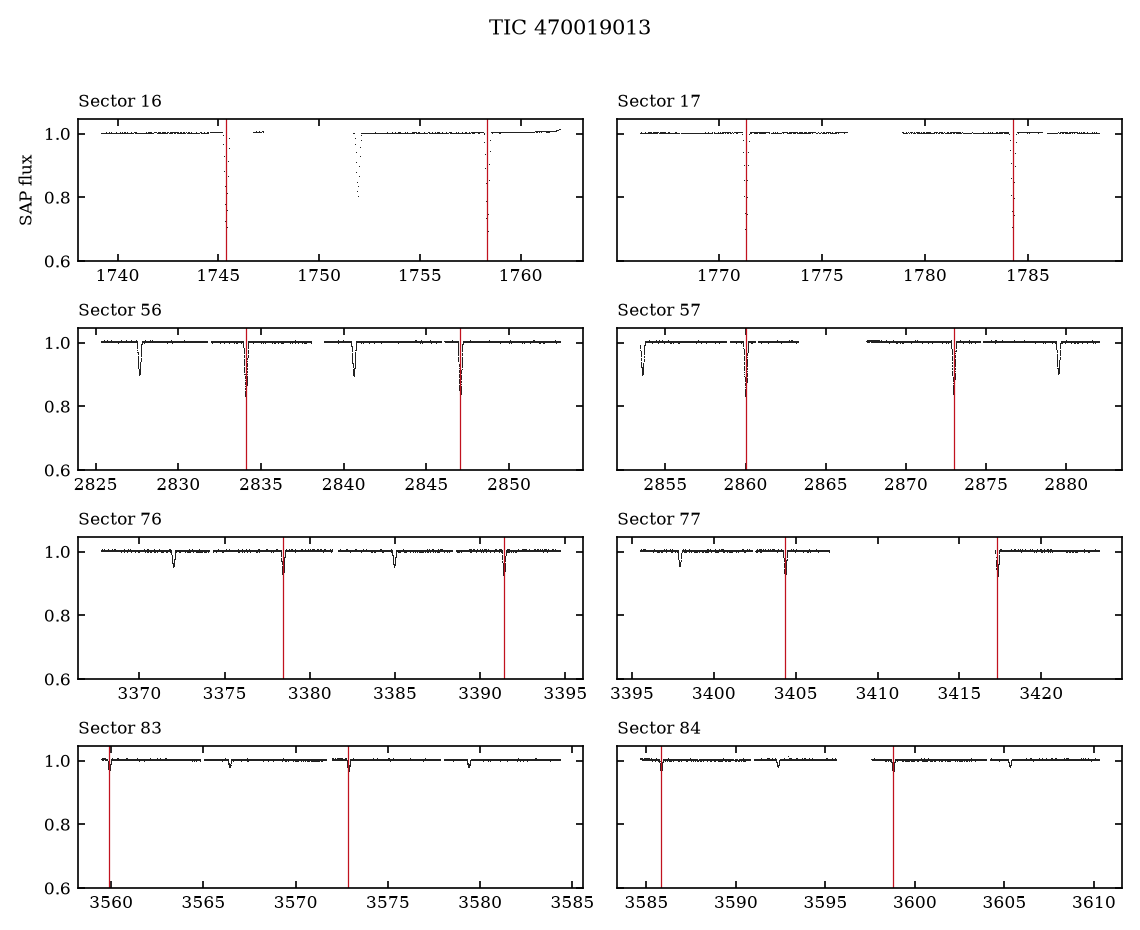
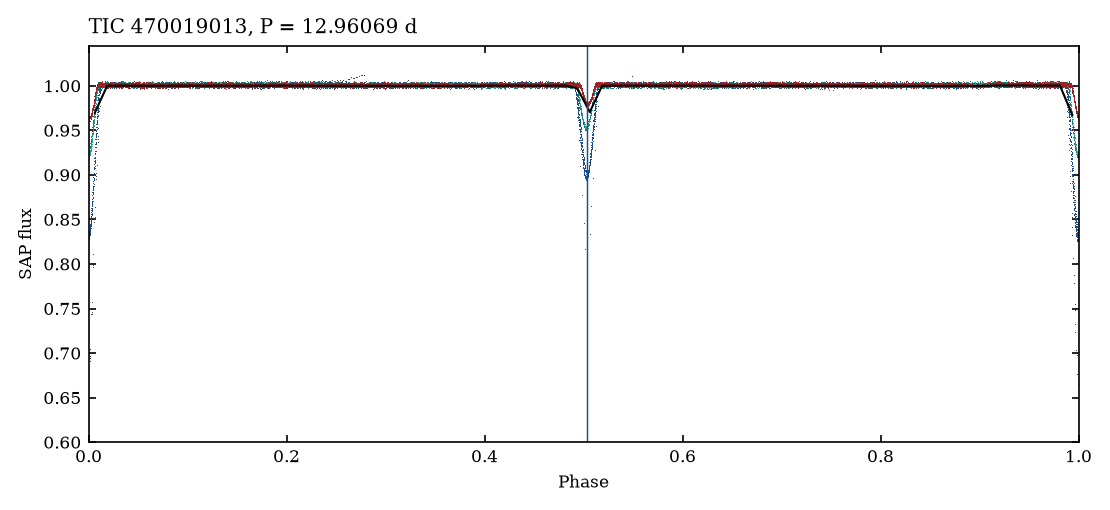
- EA, depth changing, 12.96 days. The depth changes from 0.44 mag in 2019 to 0.044 mag in 2024. The secondary follows 6.52 days later.
What TESS shows
Sixteen primary minima in sectors 16, 17, 56, 57, 76, 77, 83, and 84 give
Min I = BTJD 1745.38795 + 12.960690 E
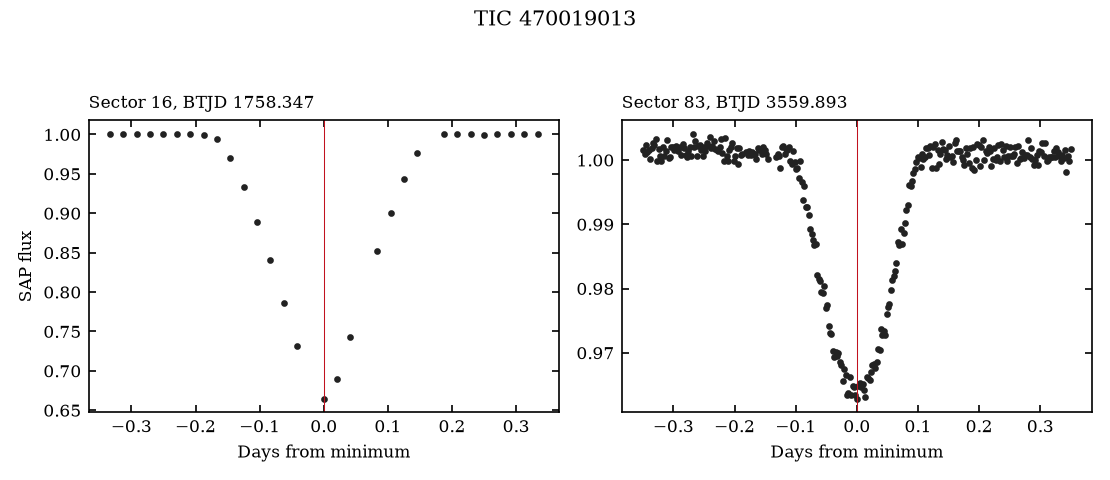
The times scatter by 13 minutes rms. The largest residual is 32 minutes, on cycle 126 in sector 76. Twelve secondaries sit at phase 0.503, which is 6.522 days later. Three other predicted secondaries fall in gaps in sectors 17, 57, and 77 and were not timed. In sector 56, when the floor is 0.825 of the sector median, the light stays under 98 percent for 6.3 hours and under half that depth for 4.1 hours. The centroid shifts by 0.014 pixel, and by 0.046 pixel in sector 16.
The depth changes with sector. The primary is 0.666 of the sector median in sector 16 and 0.960 in sectors 83 and 84. In magnitudes that is 0.44 mag in 2019 and 0.044 mag in 2024. The secondary fades the same way, from 0.802 in sector 16 to 0.977 in sectors 83 and 84. Sector 56 and sector 83 are the same camera and the same CCD, and the floor still goes from 0.825 to 0.963. Sector 57 and sector 84 are the same camera and CCD, and the floor goes from 0.83 to 0.96. Those four sectors are all QLP v01. A ground night should not expect the 2019 depth.
The nearest Gaia star is G = 15.80 at 4.6 arcsec, about 5.2 mag fainter, under one percent of the light. It cannot supply either depth. Gaia gives G = 10.62, BP − RP = 0.55, parallax 1.685 ± 0.022 mas, and RUWE 1.39, about 590 parsecs. On the catalog radius of 2.81 solar radii, the shallow 2024 minimum is a companion about 0.6 solar radii across, and the 2019 minimum is larger. A Jupiter-sized body removes about a tenth of a percent. The contamination ratio is 0.090. That ratio is a catalog blend, and it is not turned into an intrinsic depth. The nearest VSX star is ZTF J220428.80+540114.8, an EW with a 0.284-day period, 95 arcsec away. The note is not a VSX submission.
The light curves
Finder chart
Real sky images (DSS2 red) with Gaia DR3 stars overlaid. North is up, east is left, J2000. Red tick marks point at the target (Gaia DR3 2005522201357433472, G = 10.62). Gold squares C1 to C5 are comparison stars of similar brightness. Tap an image for the full-size printable chart.
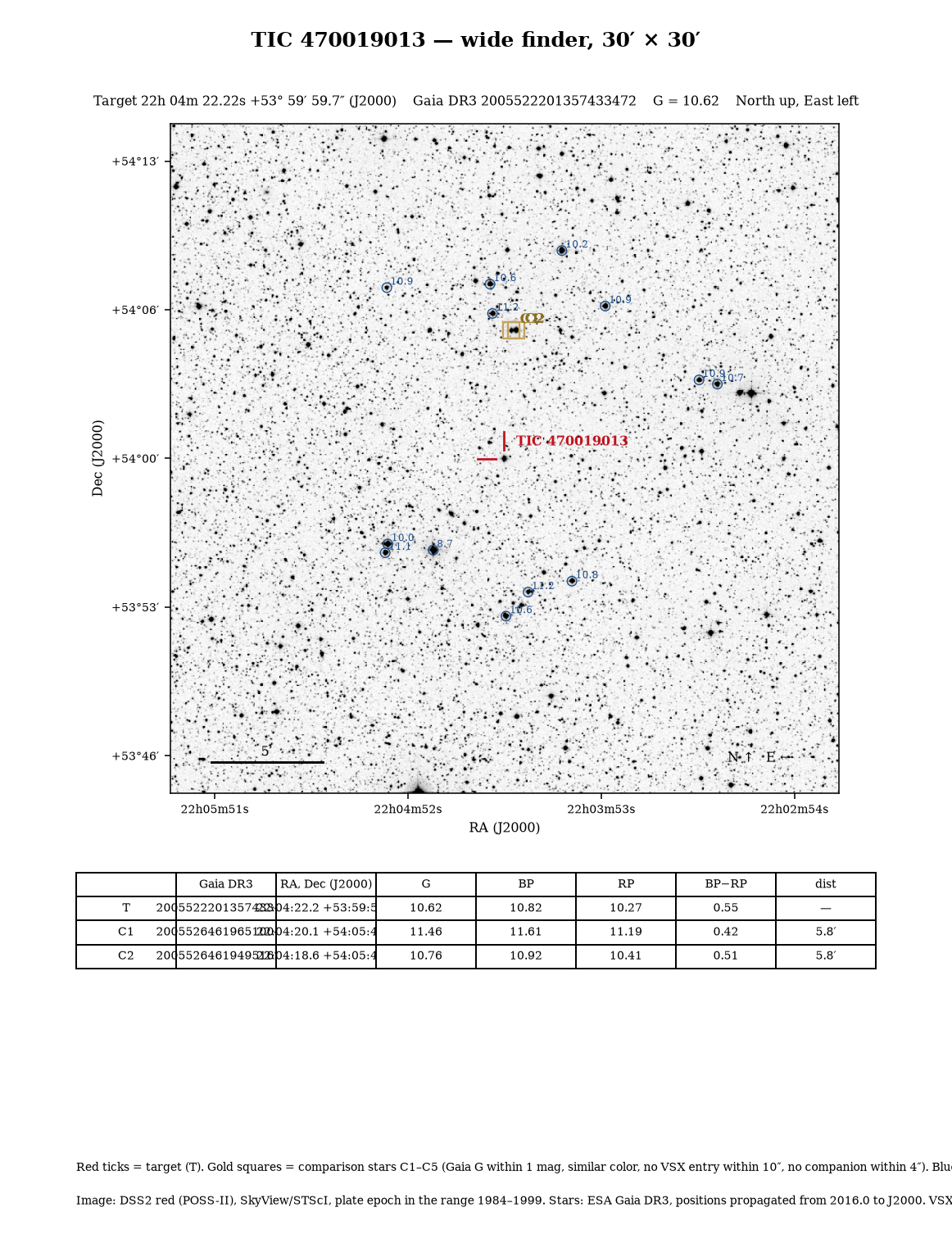
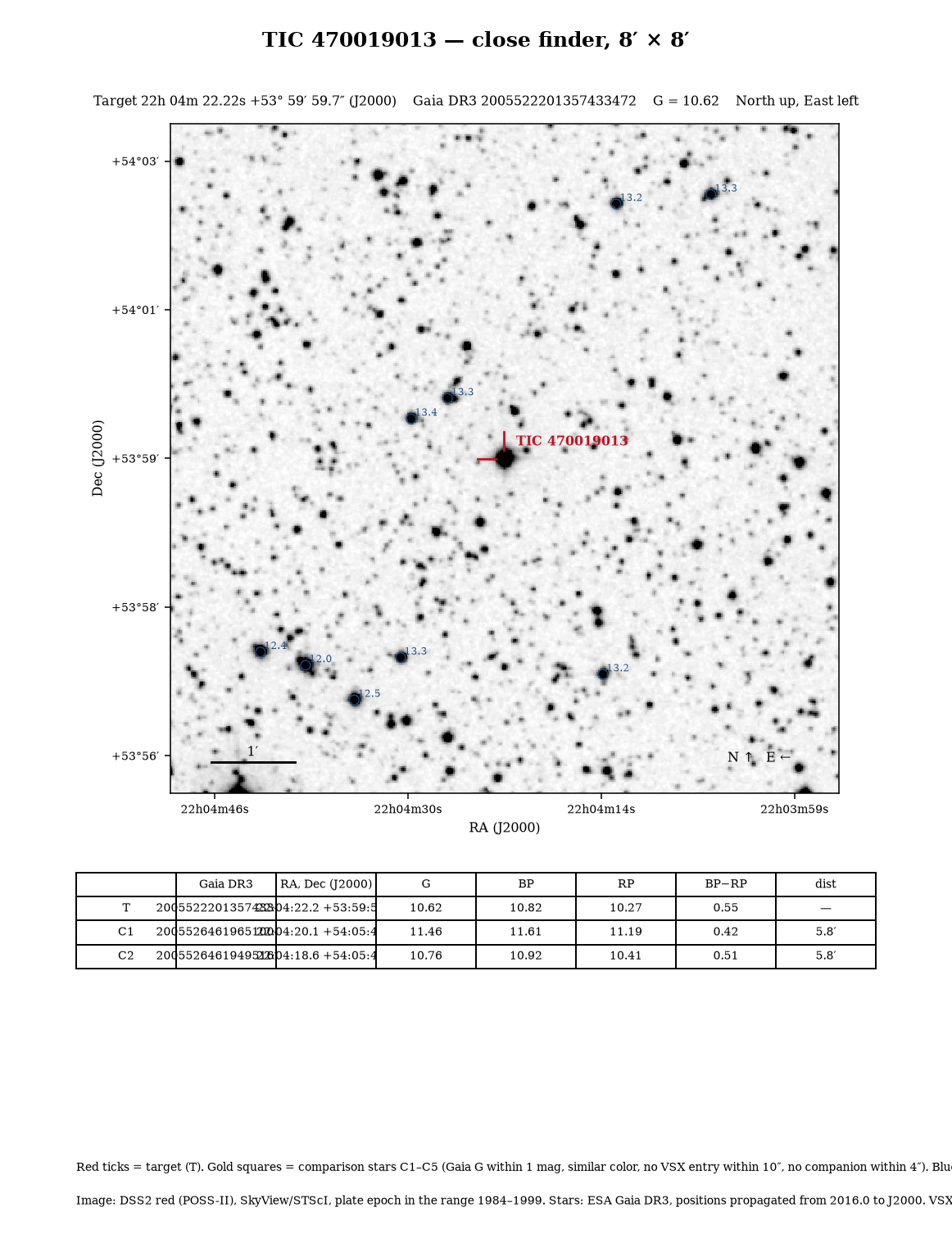
| Gaia DR3 | RA, Dec (J2000) | G | BP | RP | From target | |
|---|---|---|---|---|---|---|
| C1 | 2005526461965100416 | 22:04:20.1 +54:05:44.7 | 11.46 | 11.61 | 11.19 | 5.8′ |
| C2 | 2005526461949516288 | 22:04:18.6 +54:05:45.5 | 10.76 | 10.92 | 10.41 | 5.8′ |
Comparison stars are within about 1 mag of the target in Gaia G, have similar color, no close companion, and no VSX entry within 10 arcsec. Images: DSS2 red (POSS-II, STScI Digitized Sky Survey). Stars: ESA Gaia DR3.
VSX
Not filed. New addition from the 2.10–2.20° ring, 10 Nov 2026. The nearest VSX star is 95 arcsec away and is not this clock. The depth changes from sector to sector. A ground night should not expect the 2019 depth.
Next two eclipses
- Eclipse 1Secondary minimum, the shallower one. 25 Nov 2026, 11:12 UTC · 25 Nov, 03:12 PST Pacific · 25 Nov, 12:12 CET central Europe
- Eclipse 2Primary minimum, the deep one. 1 Dec 2026, 21:44 UTC · 1 Dec, 13:44 PST Pacific · 1 Dec, 22:44 CET central Europe
The deep minimum in 2019 is 0.44 mag. The same clock in 2024 is 0.04 mag. A ground night should not expect the 2019 depth. The shallower minimum follows 6.52 days later. The largest residual is 32 minutes. The nearest neighbor, 4.6 arcsec away, is five magnitudes fainter. They have not been checked from the ground.
Help with a measurement
A ground eclipse checks the clock. The depth changed from 0.44 mag in 2019 to 0.04 mag in 2024, so the night may be shallow. The second minimum follows 6.52 days later. Pick a date if you can try.
The note
A 12.961-day eclipsing binary whose depth changes: TIC 470019013 (PDF)
These pages use the public TESS Quick-Look Pipeline and catalog positions. A prediction is not a confirmation. If you observe, write down which star was in the aperture.