
TIC 63972502
TESS eclipses near V345 Lac · Star spots / rotational variables
TIC 63972502 · Possible rotational (star-spot) variable
- Position
- 22h 30m 17.21s, +54° 35′ 45.8″ (J2000). RA 337.57169°, Dec +54.59606°
- TESS magnitude
- 9.935
- Temperature
- 6,708 K, radius 1.58 solar radii (TIC v8.2)
- Where
- 1.675° from V345 Lac, to the east, in the 1.60–1.70° ring
- TESS sectors
- 16, 17, 56, 57, 83, 84
- Status
- Variable star candidate, not an eclipsing binary. Found 18 Nov 2026 scan. Not filed with VSX. Not checked from the ground.
Best guess
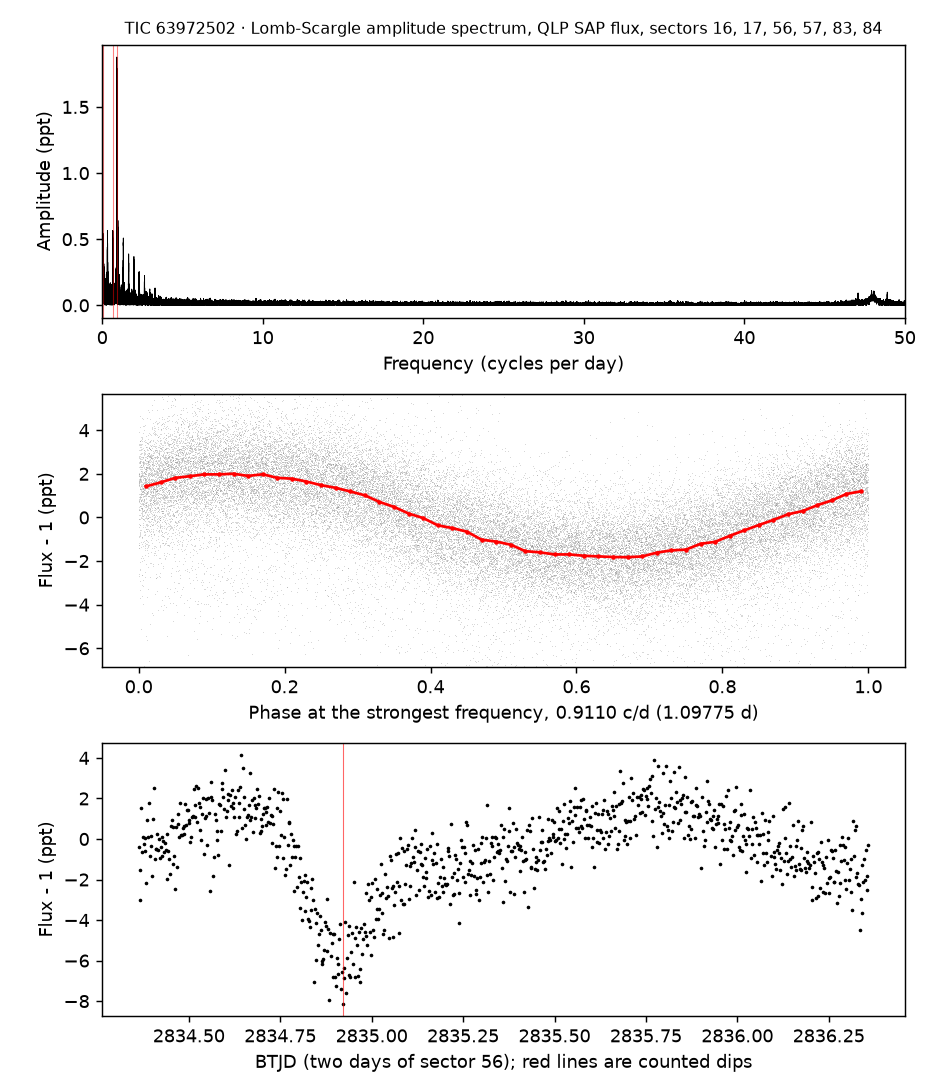
Possible rotational (star-spot) variable. The strongest frequency is 0.911 c/d, a period of 1.098 days (1.9 ppt), with a second, independent one at 0.658 c/d. Fitted separately in sectors 16–17, 56–57 and 83–84, the 0.911 c/d signal has amplitudes of 2.0, 1.7 and 2.2 ppt and its phase moves by about 60 degrees between those years. A changing amplitude and phase, with a second nearby period, fit spots on a star rotating in about 1.1 days, with a little differential rotation. γ Doradus pulsation is not excluded at a TIC temperature of 6708 K. The fold is a smooth wave with no flat stretch.
Listed on Star spots / rotational variables. This is a best guess from TESS data alone. It has not been checked with a spectrum or from the ground.
The light curve
Frequencies
| Frequency | Period | Amplitude | Signal to noise |
|---|---|---|---|
| 0.911 c/d | 1.098 d | 1.89 ppt | 32.0 |
| 0.658 c/d | 1.519 d | 0.61 ppt | 9.7 |
| 0.053 c/d | 18.793 d | 0.57 ppt | 7.7 |
| 0.329 c/d | 3.037 d | 0.54 ppt | 8.4 |
| 0.928 c/d | 1.077 d | 0.51 ppt | 9.3 |
| 1.317 c/d | 18.23 h | 0.50 ppt | 10.7 |
The six strongest peaks, found one at a time with the previous ones removed. Signal to noise is the peak amplitude divided by the mean amplitude within 1 cycle per day after removal. A peak below about 0.1 c/d is usually instrumental.
What the scan measured
- 18 clean dips of at least 0.5 percent, median depth 0.66 percent, range 0.53 to 1.01 percent.
- Median spacing between dips 3.1 days.
- Best scan period 1.09770 days. Folded on it, the box depth is 0.137 percent, much less than the dips themselves.
- No VSX entry within 10 arcsec and no Gaia DR3 eclipsing binary within 5 arcsec.
Follow-up
Photometry over several nights would show whether the period and amplitude drift as spots would. A spectrum would give the rotation speed. If you observe it, write down which star was in the aperture. TESS pixels are 21 arcseconds wide.
The note
Research note (PDF): TIC 63972502: possible rotational (star-spot) variable
These pages use the public TESS Quick-Look Pipeline and catalog positions. Variable star candidate, not an eclipsing binary. Found 18 Nov 2026 scan. Not filed with VSX. Not checked from the ground.