
TIC 64275032
TESS eclipses near V345 Lac · Planet-sized dips
TIC 64275032 · Unconfirmed clustered fades, possible blend. Period not established. Low confidence.
- Position
- 22h 31m 56.81s, +54° 52′ 32.1″ (J2000). RA 337.98673°, Dec +54.87559°
- TESS magnitude
- 10.772
- Temperature
- 5,833 K, radius 1.13 solar radii (TIC v8.2). Spectral type is not given in the TIC fields used here.
- Where
- 1.917° from V345 Lac, to the east, in the 1.90–2.00° ring
- TESS sectors
- 16, 17, 56, 57, 83, 84
- Median dip
- 1.02% deep, 3.4 h, 8 counted dips
- Status
- Unconfirmed dips. Not a planet claim. Found 18 Nov 2026. Not filed with VSX. Not checked from the ground.
Next listed dip
23 Nov 2026, 11:32 UTC 23 Nov, 03:32 PST
± 4.6 days Low confidence
BTJD 4367.984, on the 17.8451-day period used by the Planet-sized dips page. The live page recomputes this time when it loads. The research note lists the times as of 18 November 2026, 12:00 UTC.
No single period from the gaps fits all 8 dips. This uses the longest gap between consecutive dips, 17.8451 days, as the period, counted from the dip at BTJD 2851.150.
The uncertainty window is wider than ±10 hours, too wide to plan an observation around.
Best guess
Unconfirmed clustered fades, possible blend. Period not established. Low confidence. No single period from the gaps fits all eight dips. The pages use the longest gap, 17.8451 days, as a fallback. The timing window on the next predicted time is ±4.6 days, too wide to plan an observation. Some of the dips appear at the same times in TIC 64274875 (2.7 arcmin away, 3 shared dips) and TIC 64274968 (1.1 arcmin away, 2 shared dips), so light from one source is spilling into more than one aperture. A VSX entry, Gaia DR3 2006382393098306304 (DSCT!GDOR!SXPHE), lies 16 arcsec away and shares TESS pixels with this star. The fades may belong to a neighbor. This is not a planet claim.
Dip shape
Eight dips of about 1 percent were counted, all in sector 56, in two tight groups a few days apart and then a 17.8-day gap. The events are shallow and sit in noisy photometry. No dip shows a clear flat bottom. Most look like brief V- or U-shaped fades; a smooth or sinusoidal shape is not ruled out, and some of the shorter events are barely distinct from the scatter. A fold on the 17.845-day longest-gap fallback does not line the groups up as a single eclipse, and no period fits all eight dips.
The light curve
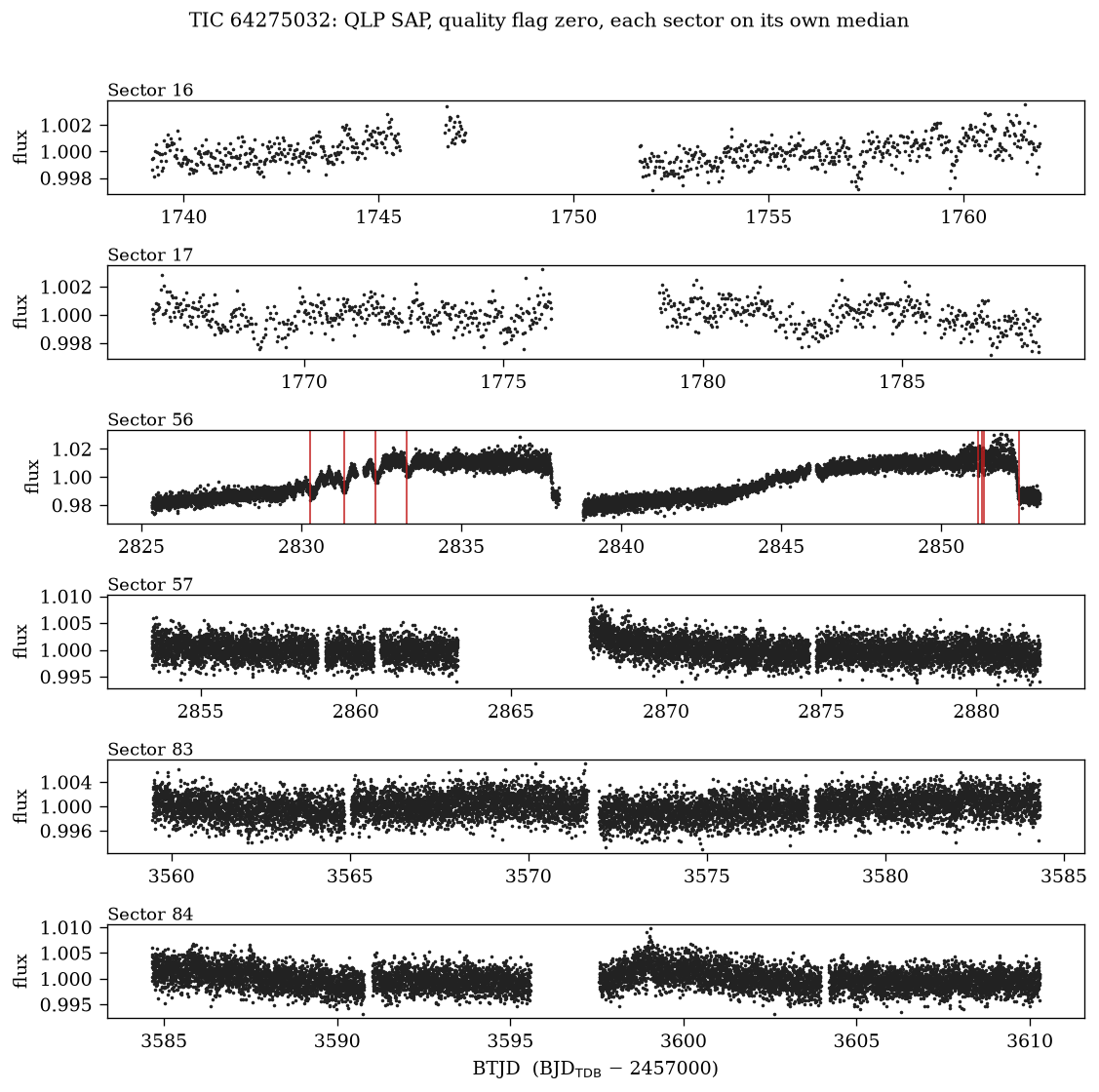
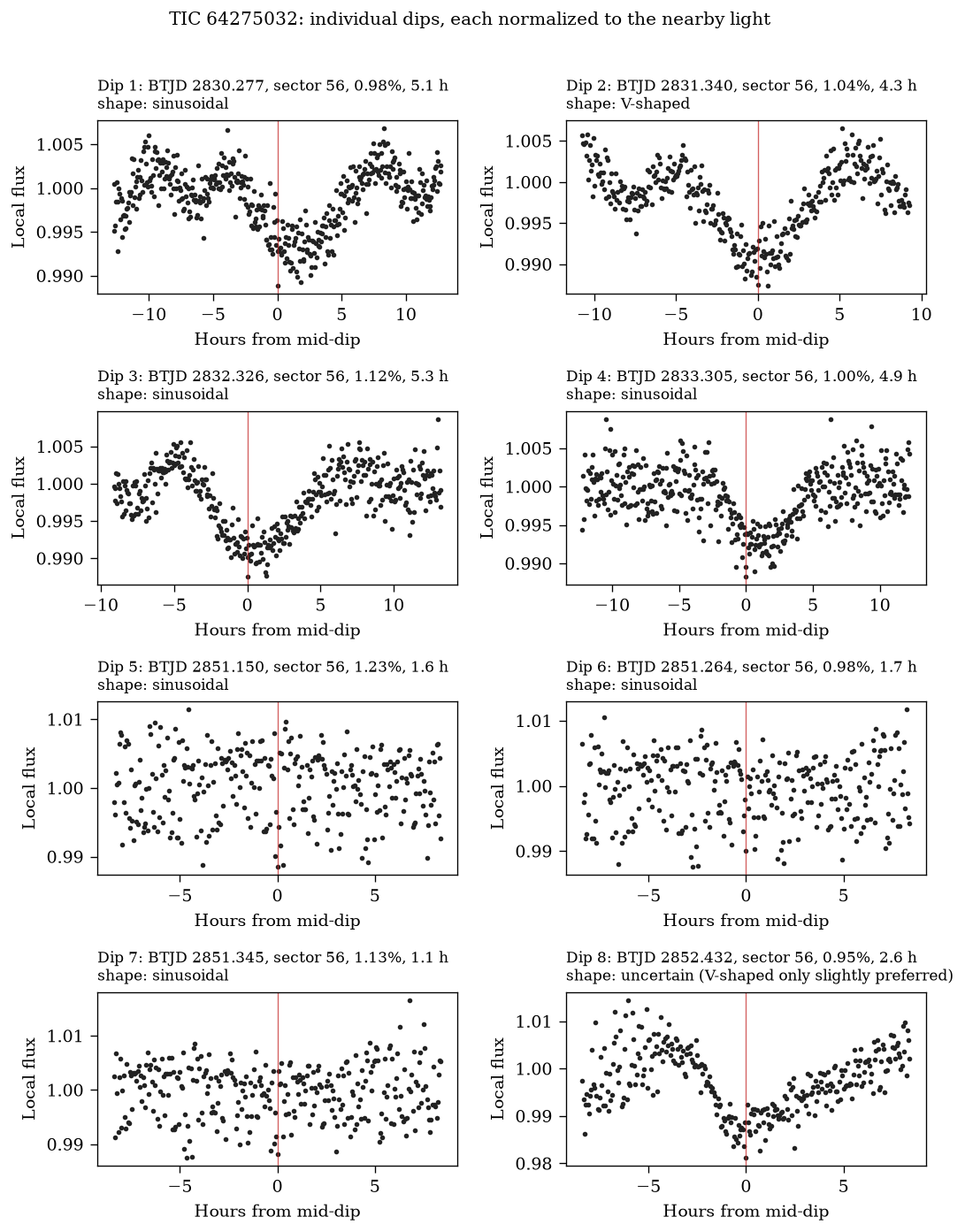
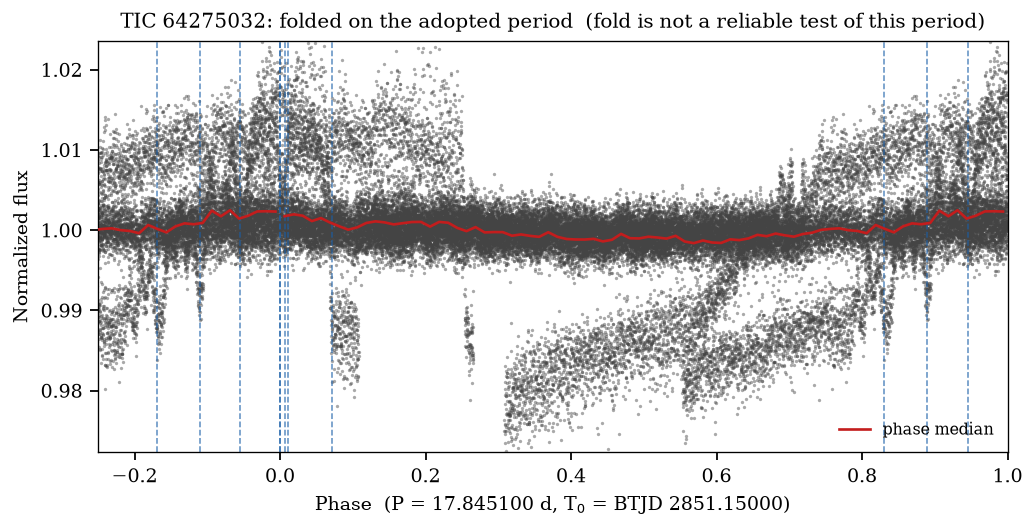
Finder chart
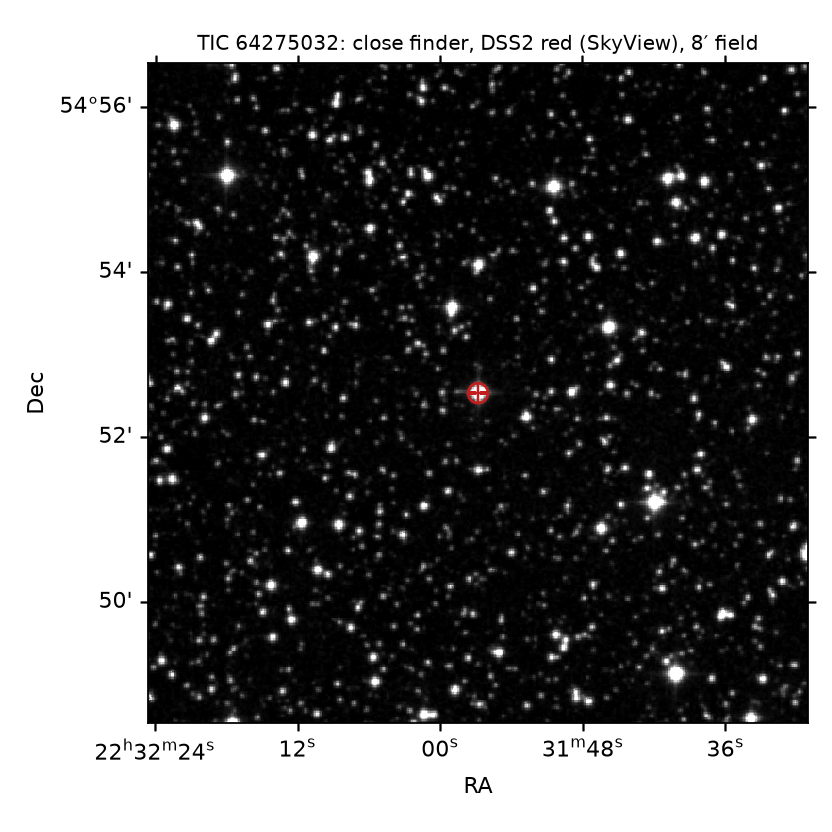
What the scan measured
- 8 clean dips of at least 0.5 percent, median depth 1.02 percent, median duration 3.4 hours.
- TIC radius 1.13 solar radii; a depth conversion (not a planet measurement) gives about 1.14 Jupiter radii. Contamination ratio 0.123.
- Dips at the same times in TIC 64274875, 2.7 arcmin away (3 dips).
- Dips at the same times in TIC 64274968, 1.1 arcmin away (2 dips).
- A VSX entry lies 10 to 30 arcsec away: Gaia DR3 2006382393098306304 (DSCT!GDOR!SXPHE), 16" away.
The note
Research note (PDF): TIC 64275032
These pages use the public TESS Quick-Look Pipeline and catalog positions. Unconfirmed dips. Not a planet claim. Not filed with VSX. Not checked from the ground.