
TIC 64564609
TESS eclipses near V345 Lac · Pulsating variables
TIC 64564609 · Likely δ Scuti star, possibly a δ Scuti–γ Doradus hybrid
- Position
- 22h 33m 28.24s, +54° 56′ 07.1″ (J2000). RA 338.36769°, Dec +54.93530°
- TESS magnitude
- 10.052
- Temperature
- 8,086 K, radius 2.16 solar radii (TIC v8.2)
- Where
- 2.141° from V345 Lac, to the east, in the 2.10–2.20° ring
- TESS sectors
- 16, 17, 57, 83, 84
- Status
- Variable star candidate, not an eclipsing binary. Found 18 Nov 2026 scan. Not filed with VSX. Not checked from the ground.
Best guess
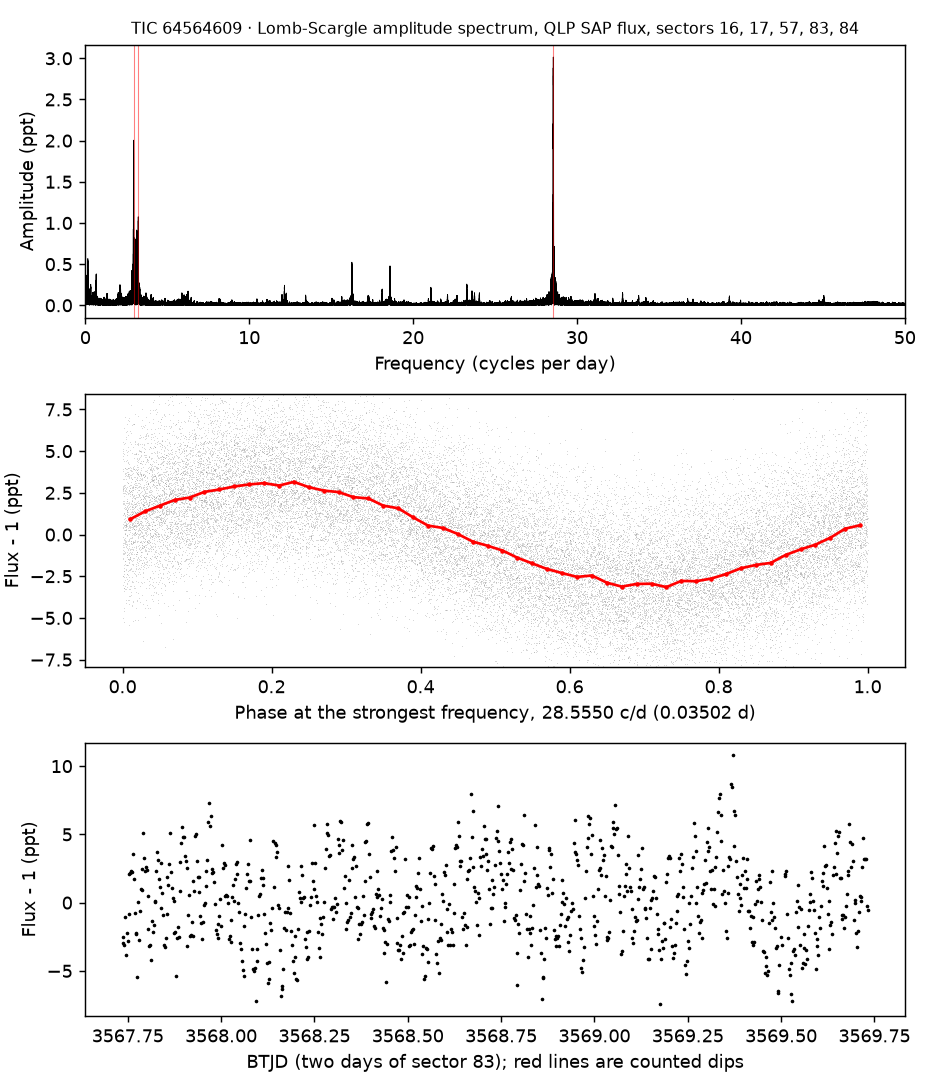
Likely δ Scuti star, possibly a δ Scuti–γ Doradus hybrid. The strongest frequency is 28.555 c/d (3.0 ppt), far above any eclipse or rotation timescale, with further power at 2.946, 3.233 and 3.135 c/d (0.9 to 2.0 ppt). High-frequency p-mode power plus low-frequency g-mode power in a star with a TIC temperature of 8086 K is the pattern of a δ Scuti star with γ Doradus modes. The fold on the scan period of 0.67878 days is a smooth wave. A VSX eclipsing binary 25 arcsec away shares TESS pixels with this star, but an eclipsing binary cannot make a 28.6 c/d signal.
Listed on Pulsating variables. This is a best guess from TESS data alone. It has not been checked with a spectrum or from the ground.
The light curve
Frequencies
| Frequency | Period | Amplitude | Signal to noise |
|---|---|---|---|
| 28.555 c/d | 0.84 h | 3.02 ppt | 189.9 |
| 2.946 c/d | 8.15 h | 2.01 ppt | 44.0 |
| 3.233 c/d | 7.42 h | 1.08 ppt | 29.1 |
| 3.135 c/d | 7.66 h | 0.85 ppt | 25.0 |
| 3.036 c/d | 7.90 h | 0.75 ppt | 23.4 |
| 0.152 c/d | 6.577 d | 0.57 ppt | 10.7 |
The six strongest peaks, found one at a time with the previous ones removed. Signal to noise is the peak amplitude divided by the mean amplitude within 1 cycle per day after removal. A peak below about 0.1 c/d is usually instrumental.
What the scan measured
- 63 clean dips of at least 0.5 percent, median depth 0.76 percent, range 0.69 to 0.98 percent.
- Median spacing between dips 9.3 hours.
- Best scan period 0.67878 days. Folded on it, the box depth is 0.150 percent, much less than the dips themselves.
- No VSX entry within 10 arcsec and no Gaia DR3 eclipsing binary within 5 arcsec. A VSX entry lies 10 to 30 arcsec away: Gaia DR3 2006392499172436992 (E), 25" away.
Follow-up
A few hours of time-series photometry would show the pulsation directly, and a spectrum would give the temperature and luminosity class. If you observe it, write down which star was in the aperture. TESS pixels are 21 arcseconds wide.
The note
Research note (PDF): TIC 64564609: likely δ Scuti star, possibly a δ Scuti–γ Doradus hybrid
These pages use the public TESS Quick-Look Pipeline and catalog positions. Variable star candidate, not an eclipsing binary. Found 18 Nov 2026 scan. Not filed with VSX. Not checked from the ground.