
V345 Lac
TIC 421726141 · TYC 3986-02900-1 · Gaia DR3 2005071229786849664
- Position
- 22h 18m 43.3s, +54° 40′ 33.5″
- V magnitude
- 11.25
- Where
- Center of the search. Already a known eclipsing binary
- Signal
- Eccentric EA, known since before this search. Primary about 36 percent. Secondary about 38 percent, and deeper.
What TESS shows
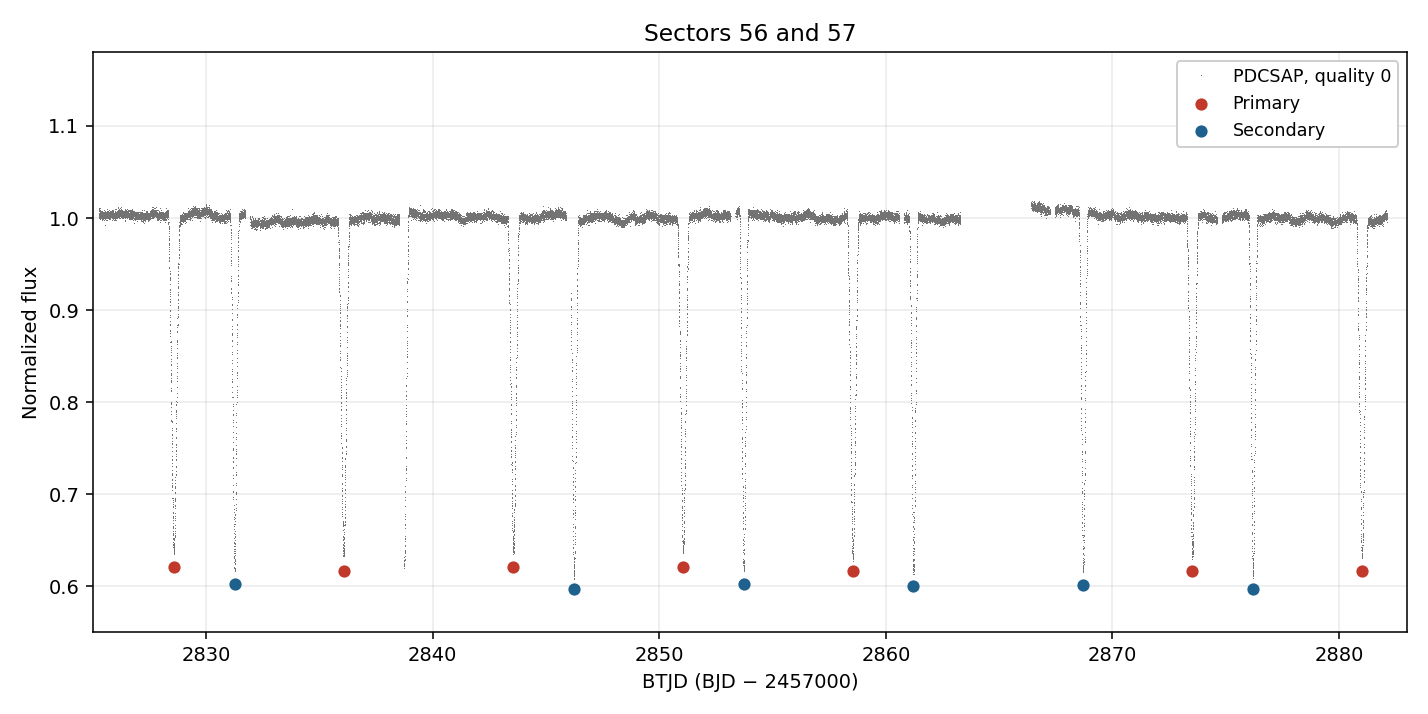
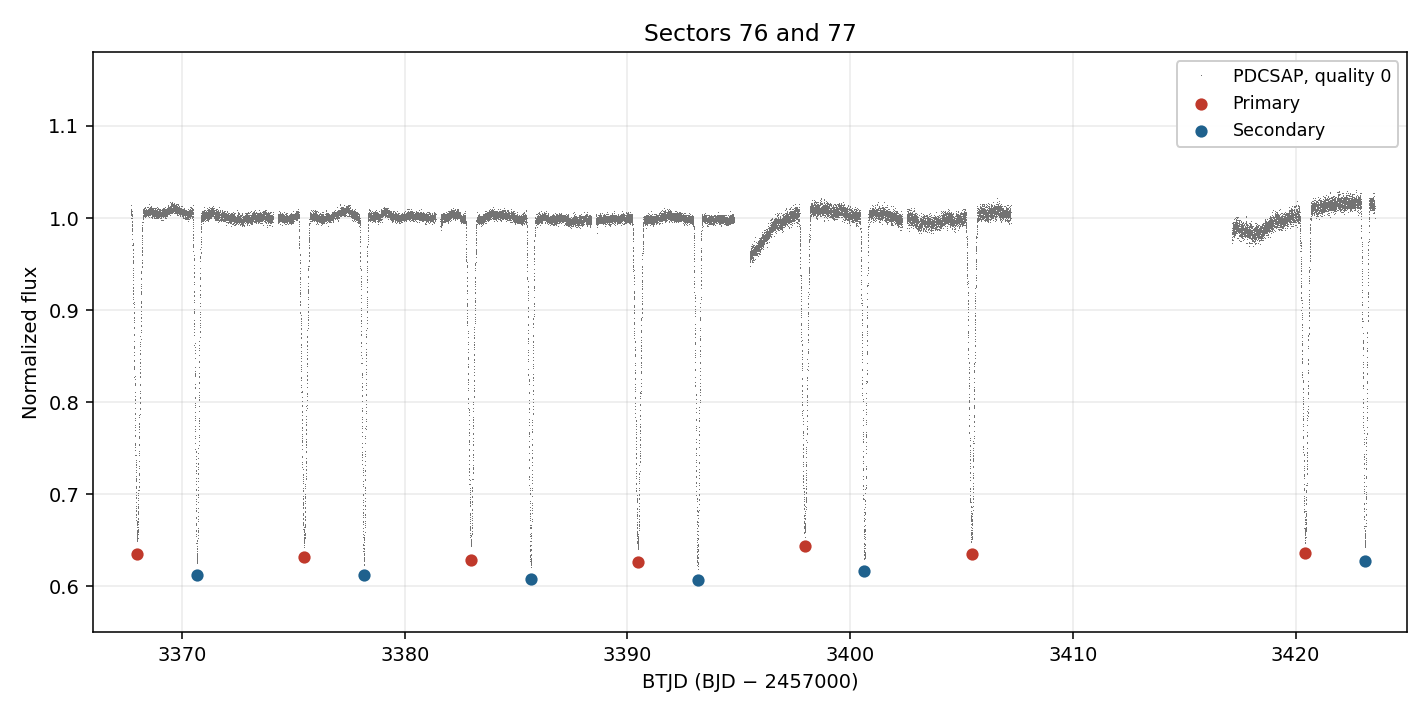
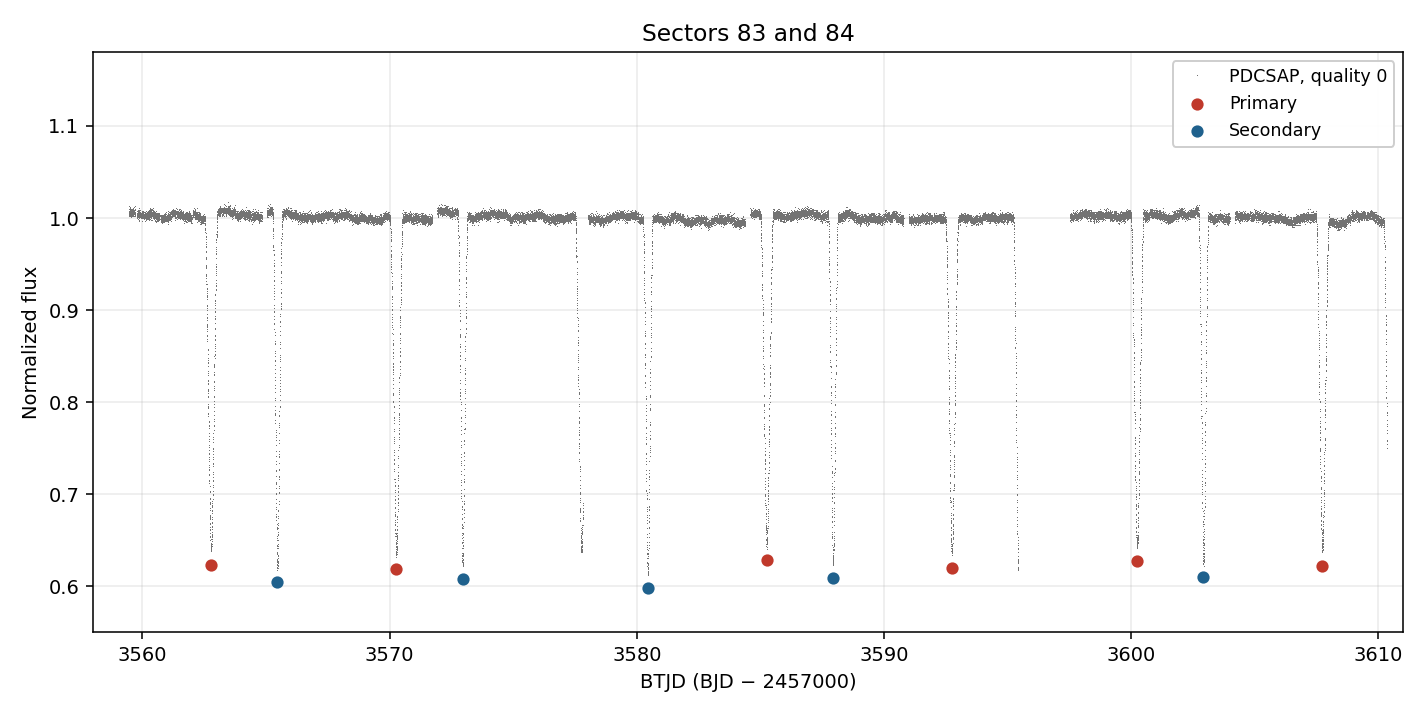
V345 Lacertae is the known eccentric eclipsing binary this search is centered on. The page is a timing check of that published star. TESS 120-second PDCSAP flux with quality flag exactly zero, in sectors 56, 57, 76, 77, 83, and 84, times 20 primary minima and 17 secondary minima. The linear ephemeris is
Min I = BTJD 2828.5708 + 7.4919092 E
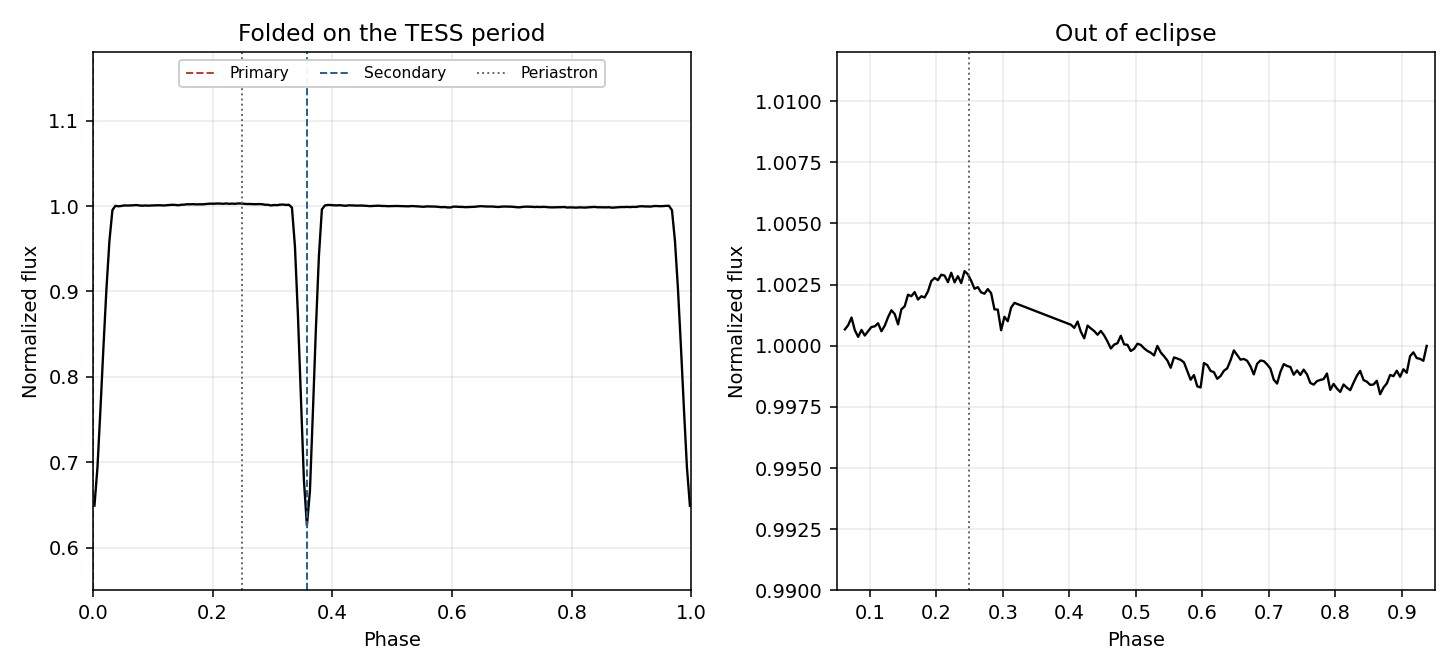
The period is 7.4919092 ± 0.0000043 days. It agrees with the Wolf et al. (2019) sidereal period, 7.49190587 days, to about 0.3 seconds. The primary fades by about 36 percent. The secondary fades by about 38 percent, so the secondary is the deeper minimum. It falls at phase 0.358. At the middle of the TESS series the primary-to-secondary gap is 2.6815 days. Periastron is near phase 0.25. Those timings match e = 0.260 and ω = 208.3°, with e cos ω = −0.223.
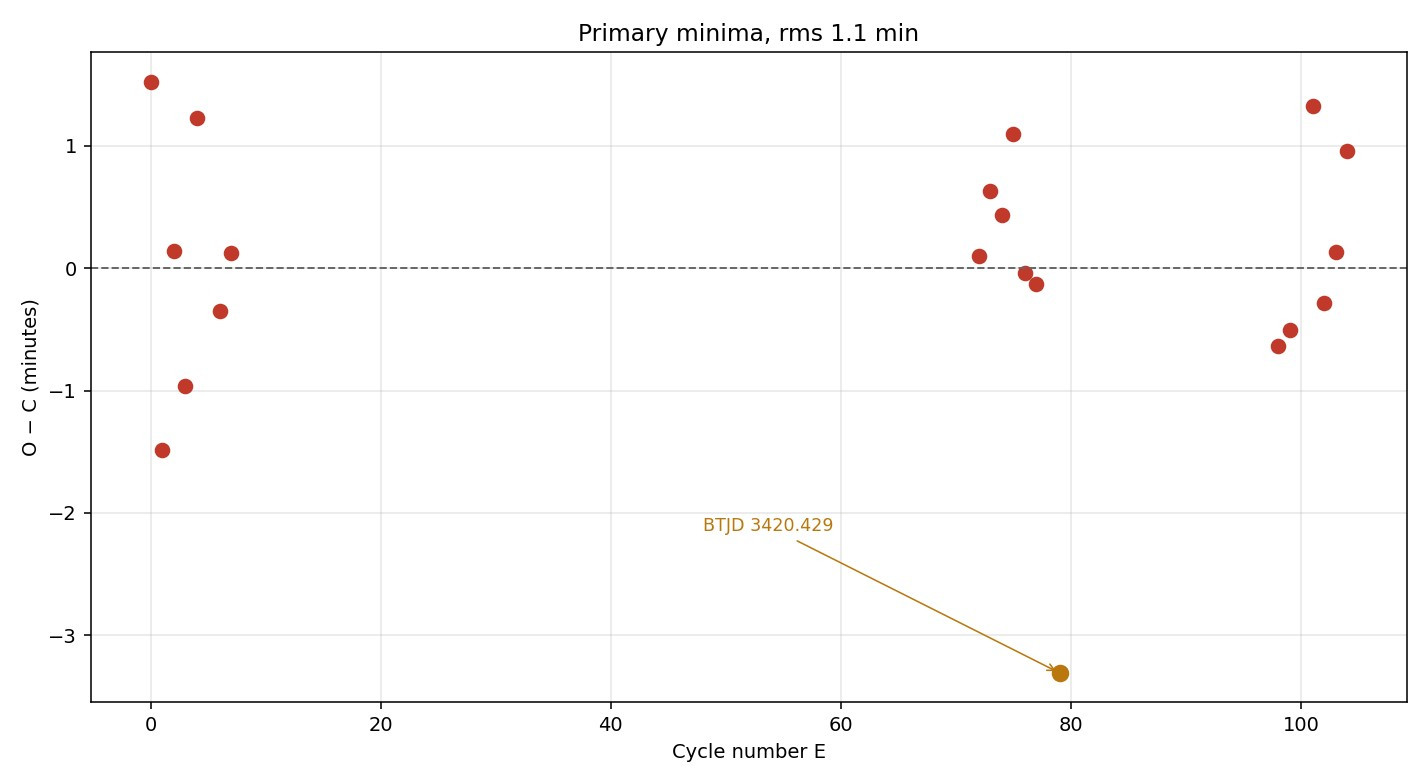
From sectors 56 and 57 to sectors 83 and 84 the gap grew from 2.6785 days to 2.6835 days, which is 7.2 minutes, or 3.6 ± 0.4 minutes per year. Wolf et al. predicted 3.4 minutes per year. Primary times scatter by 1.1 minutes rms. The minimum at BTJD 3420.429, just after the Sector 77 gap, is 3.3 minutes early.
Two years of TESS times are too short to measure the apsidal period, U = 1580 ± 610 years, or the 23.9-year light-time orbit. The note does not file a new star.
The diagrams
VSX
Already in the catalogs as an eclipsing binary. This note does not file a new star. It checks the Wolf et al. (2019) orbit with TESS times from 2022 to 2024.
Next two eclipses
- Eclipse 1Primary minimum. 13 Oct 2026, 10:51 UTC · 13 Oct, 03:51 PDT Pacific · 13 Oct, 12:51 CEST central Europe
- Eclipse 2Secondary minimum, the deeper one. 16 Oct 2026, 03:24 UTC · 15 Oct, 20:24 PDT Pacific · 16 Oct, 05:24 CEST central Europe
The secondary follows the primary by about 2.68 days, and that gap grows by about 3.6 minutes per year. These clocks are good to a few minutes. The secondary is the deeper minimum.
Help with a measurement
A timed minimum from the ground extends the long O−C record. That is how the slow drift of the secondary gets checked. Pick a minimum if you can try.
The note
V345 Lacertae: TESS Eclipse Timings and the Apsidal Drift of the Secondary Minimum (PDF)
These pages use the public TESS Quick-Look Pipeline and catalog positions. A prediction is not a confirmation. If you observe, write down which star was in the aperture.