Ships
- USS Saufley (DD-465) Captain, 29 August 1942 – 6 December 1943
The Navy's own books support the name, the navy, the Academy class, and the commissioning of Saufley under Bert F. Brown. They do not, by themselves, print the December day he left her. What follows is the life the registers, the Navy Directory, the Academy yearbook, the ship's history, and the award citations will support. Where they stop, or where they disagree, the blank stays in the sentence.
Origins
The Register of Commissioned and Warrant Officers of 1 July 1945 puts a birth date on his own line, not in a ditto: 3 August 1903. The same line gives his date of entry into the naval service as 15 June 1922. The register does not print a town beside the day. Salt Lake City is the home the Lucky Bag of 1926 prints under his name. It is the place a midshipman claimed, not a proved birthplace.
A decorations compilation, the Hall of Valor, gives the same day, 3 August 1903, and adds a town the register does not: Nephi, Utah, with Salt Lake City as home. It also gives a death, 20 January 1982. Another compilation, uboat.net, agrees on both days and disagrees on the town. It says Delphi, Utah. No Delphi turned up as his place in a register, a directory, or a yearbook. Delphi is not used here. Nephi is what one compilation says. It is not a line in the Navy Register, and no birth record was opened to test it.
Nothing read here names a father, a mother, a brother, or a sister. Nothing names a wife or a child. The Lucky Bag says he was in love, and puts a sentence in his mouth about loving one girl rather than more than one. The girl is not named. The sketch does not say he married her. No later directory, register, citation, or author note prints a next of kin. That is a blank, not a conclusion that he died without a family. No obituary was found. The death day is what two compilations repeat. The place, the cause, and who survived him were not found.
Formation
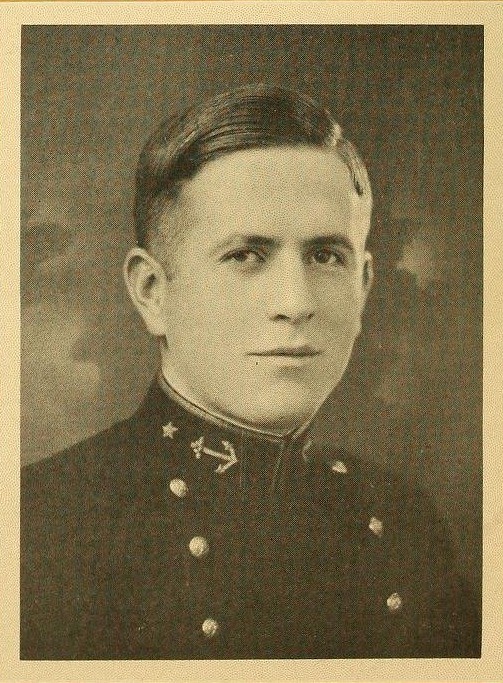
He entered on 15 June 1922 and he is in the Lucky Bag of the class of 1926. The page is headed Bert Franklin Brown, Salt Lake City, Utah, with the nicknames "B. F.," "Brownie," and "Biff." The Navy Directory of 1 October 1926 already lists him as an ensign. The exact day he was commissioned is not printed on the register lines that were read. He was an ensign by the first of October in the year his class finished.
The yearbook is classmate prose, written to be clever, and the optical text of that page is tangled with the men beside him. The index in the same book gives Brown, B. F., a boxing credit. The activity lines sitting against the sketch in the body give track, the Lucky Bag staff, and four years of stars. Those two lists do not agree, and the columns are scrambled enough that neither is used here as a record of what he did. The sketch that names Salt Lake, and that calls him Brownie, is his. The sketch that calls a man a California child is the next man's.
What his classmates wanted kept is a portrait of appetite and quickness. They quoted Mark Twain, that hunger is the handmaid of genius, and said Brownie's appetite and his genius rose and fell against each other, "a state of equilibrium" by which he got past every obstacle, "including one famous lonely tree in Ordnance." After a hard plebe year he "cast off the title, 'Mr. Green,' assumed the name of Brown, asserted himself as a true son of Utah," and set about telling two California roommates why Salt Lake City was the center of scenic America. They called him versatile, and then they joked: he could drop any of nineteen bad habits without discomfort, make a liberty in Paris and come out ahead, hold more in his head than a navigation instructor could put on a crib, run two miles, and he was "strong for the Navy." "On top of all this he's in love." The line they gave him is, "Really, I can't see much to this idea of loving more than one girl." The nineteen habits and the Paris liberty are the yearbook's comedy. The thing that can be checked is thinner. He was a Salt Lake midshipman in the class of 1926. He had been through ordnance and survived it, in their telling. He wanted them to know he belonged to Utah, and that he had chosen one girl. They did not give her name.
The sea duty that can be dated comes from the Navy Directory, which is a snapshot of orders, not a cruise.
On 1 October 1926 the Directory lists Ensign Bert F. Brown in a ship the optical text renders as "u s s Hamapo." There is no such ship. In the same volume USS Ramapo is spelled correctly, under her commanding officer. One letter, H for R, is an ordinary misreading. The first ship is probably the oiler Ramapo. It is not clean enough to narrate as a cruise, and it is not narrated as one.
On 1 April 1928 he is still an ensign, in USS Farquhar. On 1 July 1930 he is a lieutenant (junior grade) in USS Badger. On 1 April 1931 he is a lieutenant (junior grade) in USS Maryland. Those are the destroyers and the battleship the directories actually name. Farquhar and Badger were destroyers then in commission. Maryland was the battleship. The directories do not say what billet he held in any of them. They do not say he commanded them. He was a junior officer on the books.
On 1 January 1933 the Directory, in the alphabetical place where Bert F. Brown stands in the other volumes, reads "Brown, Bert P," lieutenant (junior grade), "instrn, naval academy, Annapolis." The initial is one letter off. The station is under instruction, the Directory's usual mark for a student, not for an instructor. On 1 October 1934 and again on 1 January 1935 he is Bert F. Brown, lieutenant (junior grade), under instruction at the naval gun factory, Washington Navy Yard. That is the ordnance pipeline: the Academy, then the gun factory. The Register of 1 July 1945 prints course numbers on his own line, 26, 31, and 32. In the key of the 1 July 1944 register, which the 1945 key follows in the same order, 26 is a completed postgraduate course in ordnance engineering, general; 31 is a completed course in torpedo instruction; 32 is a completed course in chemical warfare. The Naval Institute's later note on him says he completed the postgraduate course in ordnance. The registers say which course. They do not say whether he asked for it.
The Directory of 1 January 1936 and the Directory of 1 April 1937 were read through for his name. He is not in them in any spelling that could be found. The next clean appearance is 1 January 1938: the optical text again prints "Bert P," now a lieutenant, in USS Quincy. On 1 January 1939 the same ship has him as Bert F. Brown, lieutenant. Quincy was the heavy cruiser. He was a lieutenant aboard her, not, on these lines, her captain. On 1 November 1940 and still on 1 April 1941 he is a lieutenant commander at the Naval Proving Ground, Dahlgren, Virginia.
The Institute's author note, current when he was publishing in 1951 and 1953, compresses this into one sentence: a battleship, a cruiser, and destroyers, and three years at the Naval Proving Ground before the war. The directories show the destroyers first, then the battleship, then school, then the cruiser, then Dahlgren. The "three years" are not bracketed by a pair of orders. He was in Quincy on 1 January 1939 and at Dahlgren on 1 November 1940, and he was still at Dahlgren on 1 April 1941. He put Saufley in commission on 29 August 1942. The proving-ground time sits in that gap. How many months of it were the three years he, or the Institute, later counted, the books that were opened do not say.
He had become a lieutenant commander by the November 1940 directory. The day of that promotion is a ditto in the 1945 register, running back through other men's lines, and it is not used. What is used is the rank the Directory prints on a dated page.
The mind the Navy had trained was an ordnance mind: guns, torpedoes, the proof of weapons at Dahlgren. The war did not give him a bureau desk first. It gave him a new destroyer.
War years
Saufley was laid down on 27 January 1942 at the Federal Shipbuilding and Dry Dock Company, Kearny, New Jersey, launched on 19 July 1942, and sponsored by Mrs. Helen O'R. Scruggs. The Dictionary of American Naval Fighting Ships says she was commissioned on 29 August 1942, Lieutenant Commander Bert F. Brown in command. The online transcription of that history prints the year as "19-12." The keel date, the launch date, and every other record of the ship make the year 1942. Brown is the only commanding officer DANFS names.
DANFS then sends her through shakedown off northern New England, several coastal escort runs, and a departure from Norfolk on 9 September, with arrival at Nouméa on 2 December and the Guadalcanal campaign three days later. A secondary chronology puts the Norfolk departure on 9 November and a Panama transit on 13 November, after shakedown in Maine, Newfoundland, and Virginia. Eleven days from commissioning to a South Pacific sailing, with a New England shakedown already behind her, is a hard reading of the September date. The November date is not in DANFS. Neither sailing is narrated here as a settled cruise. What DANFS does establish, with Brown the man it has just named in command, is the work that follows in the Solomons through the autumn of 1943.
She escorted reinforcements from Espiritu Santo to Lunga Point. She made antishipping sweeps north and west of Guadalcanal and bombarded Japanese positions on the island. During the Japanese evacuation of Guadalcanal in late January and early February 1943 she operated with Task Force 11. On 19 February she sailed for Lunga Roads for Operation Cleanslate, the occupation of the Russells. She carried troops, towed landing craft, and fired in support of the landings on Pavuvu and Banika on 21 February. The point of those islands, in the ship's history, was the airfield ground from which later moves could be covered.
In March she was back on escort and antisubmarine duty in the southern Solomons, New Caledonia, and the New Hebrides. She had a short availability at Sydney and returned to Nouméa. On 30 June, as the Allies moved on Rendova, she bombarded the shore installations there. July and August were assault operations against New Georgia and escorts to the New Hebrides and to Vella Lavella.
The Silver Star citation, Commander South Pacific serial 002124 of 12 October 1943, is the Navy's account of four of those days. It calls him Commander Bert Franklin Brown, commanding officer of Saufley, in the initial occupation and the reinforcement of Vella Lavella from 15 to 18 August 1943. The ships he was covering carried troops, supplies, and equipment. Japanese dive bombers and torpedo planes attacked repeatedly. The citation says he kept protection over the convoy, finished each trip, and brought the escorted ships through without damage. The words "brilliant tactics" and "forceful and inspiring leadership" are the citation's. They are not a deck-log reconstruction of how he maneuvered. DANFS, for its part, does not isolate those four days. It puts Saufley on New Georgia and on the Vella Lavella escorts across July and August. On 31 August, still in that season, she took minor damage and no casualties from near misses by shore batteries in the Slot.
Two weeks later the submarine hunt began. DANFS times it at 1011 on 15 September 1943. Saufley was on the way to Espiritu Santo with Montgomery and two merchantmen. A torpedo wake was sighted. Montgomery's sound gear was out, so Saufley searched down the track. Over the next three and a half hours she made five depth-charge attacks. At 1443 a Japanese submarine surfaced. DANFS names her RO-101. Saufley's five-inch guns and machine guns fired on the conning tower. A Catalina came in and dropped two depth charges. The transcription says "crapped"; the sense of the sentence is dropped. The first charge missed by about forty feet. The second hit. When the splash went, the submarine was gone. An underwater explosion followed. By 1735 diesel oil covered about a square mile. DANFS calls that the grave of RO-101.
The Legion of Merit citation for the same day, as printed by the Hall of Valor from a Commander Destroyers Pacific serial 04113 of 18 November 1945, tells it more simply and more entirely as his. It calls him Captain Bert Franklin Brown, commanding officer of Saufley, and says that by his skill he conned the ship in successful attack runs "resulting in sinking an enemy submarine." It does not name RO-101. It does not mention Montgomery, the merchantmen, or the Catalina. Depth charges and gunfire are the weapons it names. The two accounts can be held together without forcing them. The ship history gives the clock, the other ships, the aircraft, and a name. The citation gives the Navy's judgment that the commanding officer's conning produced a sinking. It does not give him the Catalina's bomb, and DANFS does not take the bomb away from the aircraft.
The rank in the two citations is not the same word. In October 1943, a month after Vella Lavella, South Pacific called him commander. In November 1945, writing up the September attack, Destroyers Pacific called him captain. He was a lieutenant commander at commissioning in August 1942 and a commander by the Silver Star of October 1943. He was still carried in the commanders' section of the register of 1 July 1944. He was in the captains' section on 1 July 1945. The November 1945 citation uses the later rank. It is not evidence that he was a captain on 15 September 1943.
Through the rest of September and into October, DANFS has Saufley on night anti-barge patrols between Kolombangara and Choiseul. She sank four barges. On the night of 1 October 1943 Japanese aerial bombs damaged her. Two of her crew were killed. Eleven were wounded. DANFS does not print their names. It does not say where Brown was standing, or what he did in the minutes after the bombs. They died in the ship he commanded.
The command lists, including this project's stub, end him on 6 December 1943, when a secondary chronology says Saufley arrived at Tulagi and Lieutenant Commander Dale Cochran relieved him in a routine change of command. DANFS never says he left. It folds November and December 1943, and January 1944, into one sentence about escorts for the reinforcement of Bougainville, and then it takes the ship on without him: the Green Islands, Emirau, a contact later identified as I-2, the Marianas, Leyte, Lingayen, and the rest of a long war. Sixteen battle stars belong to the ship. They do not belong, on this evidence, to one captain. Nothing after 6 December 1943 is told here as his cruise. If the relief date is wrong, the error is that his Solomons time has been cut short, not that another man's later battles have been given to him. The date is widely repeated. It was not found in a deck log.
What he did in the months after he left her is thin. The Institute's note says that in June 1944 he went to sea again in destroyers, and that he ended the war as a squadron commander at Okinawa. It does not name the squadron or the flagship. The citations do some of that work, and only some.
On 15 and 16 February 1945, the Bronze Star citation says, he was a task unit commander with Commander Task Group 78.3 at the landings at Mariveles, Bataan, and Corregidor. For two days before the landing he supported part of the minesweeping. During the landing on Corregidor, under fire from shore batteries, he directed his destroyers in close to the beach and put fire on the guns so the troops could land. The Hall of Valor header dates this award to 15 and 16 January 1945. The citation text says February. February is what is used. The header is an index, not the citation. The citation does not name his ship. It does not say he was already commander of Destroyer Squadron 49. A squadron history on the open web makes Picking the flagship of that squadron and does not put his name on her. Picking is not claimed here as his.
The Legion of Merit with a gold star, in lieu of a second award, calls him commander of Destroyer Squadron 49 in the Okinawa operation from 1 April to 23 June 1945. The conditions are "difficult and arduous." He directed the ships against suicide planes and in close gunfire support under shore batteries. The citation says the squadron destroyed shore installations, surface craft, aircraft, and personnel. A separate Bronze Star, a gold star in lieu of a second award, narrows one piece of that same season. For eight days between 7 June and 23 June 1945 he was officer in tactical command of a radar-picket station unit near Okinawa. The ships fought off suicide attacks. The citation says nearly all of the attacking planes were destroyed by the ships' guns or by the combat air patrol, and that his conduct held the damage and the casualties down. The Hall of Valor header spreads this second Bronze Star across 1 April to 23 June, which is the Legion's window, not the eight days in the text. The text is followed.
He was a captain in both of those 1945 citations, and the register of 1 July 1945 lists him among the captains. The temporary-rank column on his line is a "do," a ditto, running back to a date printed on another officer's line. That ditto is not his promotion day. The Silver Star still called him commander in October 1943, and the register of 1 July 1944 still had him a commander. The captaincy falls between those two registers. The day was not recovered.
Cost
The cost that can be named is small, and it is not small to the men who paid it.
On 31 August 1943 his ship was shaken by near misses from shore batteries and nobody was hurt. On the night of 1 October two men were killed and eleven wounded by bombs, on barge patrol, and their names are not in the history that records the numbers. Between those dates he had four days off Vella Lavella in which the citation says the ships he escorted were not hit, and one afternoon off San Cristobal in which a submarine was destroyed under a shared attack he conned. The Navy gave him a Silver Star for the four days and, later, a Legion of Merit for the afternoon. It did not give the dead a sentence of their own.
At Okinawa the citations speak of casualties reduced to a minimum, and of planes shot down, and of troops put ashore at Corregidor under his destroyers' fire. They do not name a man he lost. A compiled history of Destroyer Squadron 49 records that Luce was sunk on 4 May 1945 with 126 of her people, and that William D. Porter was lost on 10 June 1945 with no one killed, and it places both ships in that squadron. Luce's own history in DANFS tells the sinking off Kerama Retto on 4 May, two suicide planes, 126 of 312, and does not name the squadron or Brown. Those deaths are not written into his life here. If he was the squadron commander the Legion says he was, from 1 April through 23 June, they happened in the weeks of his title. The citation he received for those weeks does not mention them. That silence is part of the record. It is not proof that the losses were someone else's.
What the war asked of him, on the evidence, was not one gesture. It was repetition. Escorts, bombardments, a long sound search, night barge patrols, then a second sea tour that ended on a picket station where the aircraft came in suicide. The ordnance officer's war was other people's steel, aimed by him, and sometimes coming back.
Nothing in the citations or the ship's history says he was wounded. Nothing says Saufley was hit so badly under him that she left the line for good. She was damaged on 1 October and she stayed in the war. He left her in December, if the command lists are right, alive, and a commander, with a Silver Star already signed and two men of his crew already dead.
After
The Institute's note is the only continuous account of the years after Okinawa, and it was written while he was still on duty. He had commissioned and commanded Saufley. He had seen a year's duty in the Solomons in 1943. In June 1944 he had gone back to destroyers and ended the war as a squadron commander at Okinawa. After the war he was head of the Guided Missile Branch of the Bureau of Ordnance. He served on the staff of Commander Service Force, Pacific. When the note was printed he was in Op-51, Guided Missiles, and he was still a captain.
The note sits on two articles he signed in the Naval Institute Proceedings: "Work or Worry in the Atomic Age," November 1951, and "Research and the Naval Officer," January 1953. The pages themselves sit behind a gate and were not read. The titles are his. They are the only sentences of his, outside the yearbook joke and the citations written for him, that this search can point to. A man who had proved guns at Dahlgren, and who had then stood on a destroyer bridge while other guns fired at him, spent the next decade on missiles and on the question of what research does to command. That is as far as the unread articles can be pushed. His arguments are not invented here.
The Hall of Valor says he retired a rear admiral. uboat.net dates that retirement 1 March 1955 and styles him rear admiral on the retired list. No retired-list register was opened that contains the day. He was still a captain, on active duty in the guided-missile office, when the Institute described him in 1951 and 1953. The retirement falls after that. The star, if he received it on retirement, was not found on a Navy Register page.
The same two compilations date his death 20 January 1982. He would have been seventy-eight, counting from the register's 3 August 1903. No obituary, no cemetery record, and no survivors' names were found. The girl in the Lucky Bag, if she was still in his life, is not in the file. What he left a family cannot be said, because the family was not found. What he left the Navy is plainer, and it is still only a list: a destroyer commissioned and fought through the Solomons for a year, a submarine attack the Navy credited as a sinking, a squadron at Okinawa, and then the missile office. The ship outlived him by a career he did not command. Saufley went on, under other captains, into the Philippines and the last summer of the war, and long after that into experimental work. That later life is hers. It is not his.